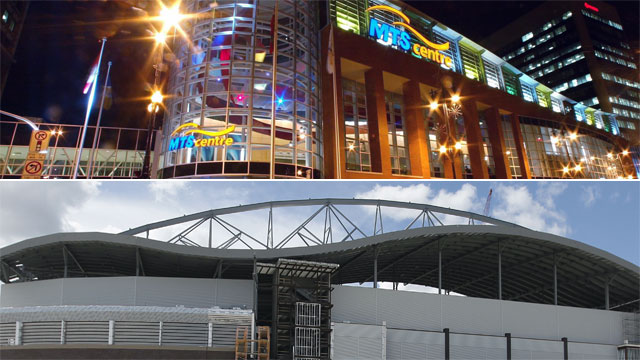

History will be made this week in Winnipeg, which will experience a couple sports in a uniquely different way, although there is a connection between the two.
On Wednesday night, the Winnipeg Blue Bombers of the Canadian Football League will christen their new stadium, Investors Group Field, and play host to the defending Grey Cup champion Toronto Argonauts in a pre-season game.
Three nights later, at the MTS Centre, the Ultimate Fighting Championship will present its product for the first time in the city.
Canadian football and mixed martial arts are uniquely different in terms of the rules, but there is a common thread, at least when you’re talking Canadian content.
In the CFL, there is a built-in equation that requires half of the 42-player roster to be comprised of Canadian players, seven of whom must be starters. That, however, does not apply to pre-season games when the import-non-import ratio rules are not in play because teams are allowed to expand their rosters to get a full gauge of the talent, regardless of their nationality. But when the regular season starts, the rules are enforced rigidly.
Wherever the UFC stages one of its shows worldwide, it tries to inject a profile of combatants with the same nationality in which the event takes place. Last Saturday in Brazil, the UFC card had a healthy supply of Brazilians on the card because the sport is huge there. The emotional attachment of the fans toward their countrymen battling in the cage became evident every time one of the Brazilians dominated the fight.
UFC 161 will feature several Canadians on the card, including some who are fighting on the main card. Ryan Jimmo of New Brunswick faces Croatian Igor Pokrajac in a light-heavyweight bout that is the third-last on the card.
Coincidentally, Jimmo’s first pro bout was against a CFL player, Adam Braidwood, who was employed at the time by the Edmonton Eskimos. Braidwood won the bout, but his life and career spiraled out of control after that.
The Jimmo/Pokrajac match will be preceded by the UFC’s first-ever women’s fight in Canada, featuring Alexis Davis of Port Colbourne, Ont., against Britain’s Rosi Sexton in a bantamweight bout.
When the UFC decided this year to incorporate women into its roster this year and took a shot introducing it with Strikeforce bantamweight champion Ronda Rousey headlining a card in February, it broke new ground. It has also paved the future for more women fighters at the grassroots level thinking that they can dream of becoming professional MMA fighters, possibly in the UFC.
It will only happen because the UFC decided it needed to expand its roster by adding women, and so far it has worked out well.
Saturday’s card has already sold out, and even though there have been changes to the fight lineup, it was constructed with the mindset that it had to include a large supply of Canadians.
Mind you, in comparison to the Brazilian countrymen fighting on last Saturday’s card, the total of Canadians fighting on this Saturday’s card is minute.
Canada is probably a couple decades away from filling a UFC card with at least one Canadian in every fight. And that’s speculating well into the future of the UFC and whether it’s around or one or more new promotions are created.
With the announcement last week that the Canadian House of Commons passed a bill to that removes the Criminal Code prohibition on professional MMA in Canada. The section of the Criminal Code of Canada pertaining to prize fighting had not been updated since 1934. Saturday’s UFC card will become the fifth Canadian city where the company has featured a card.
So far there have been 12 overall, including three in Toronto, which became a significant stop once the Ontario provincial government finally legislated prize fighting for a combat sport other than boxing.
MMA is sanctioned provincially in B.C., Manitoba, Nova Scotia, Ontario and Quebec and municipally within Alberta, New Brunswick and the Northwest Territories. The UFC stated in a media release last week it wants to have the sport sanctioned and regulated in all 10 provinces and three territories.
That may be optimistic, but at least the opportunity is now there because of the key federal bill that passed. An increasing number of training centres in Canada have created full MMA programs because of the increasing popularity of the sport. This is where the sport will be grown and eventually lead to emerging Canadian talent.
You can say that people who come to fights don’t particularly care about the nationality of the combatants, but it is part of marketing the show.
The same can be said about the CFL. Fans watch the sport because they want to see the best players on the field, but the league has marketed itself in recent years to underline the Canadian theme. Some of the biggest stars of the game are Canadian.
When a good play is made, it is irrelevant whether the player is Canadian, American or whatever part of the world he was born and raised. The players don’t where flags on their backs, but fans that follow the sport know the nationalities.
There is usually a soft spot for the Canadians, who seem to truly embrace the CFL because they grew up playing the game in Canada. Those who make it accomplish a dream.
The same can be said of the Canadian fighters on Saturday’s UFC card. It is a triumph for those who have made it to the UFC, which is the biggest MMA promotion in the world, and it means even more having the opportunity to do in their native country.
This is what’s known as Canadian content.