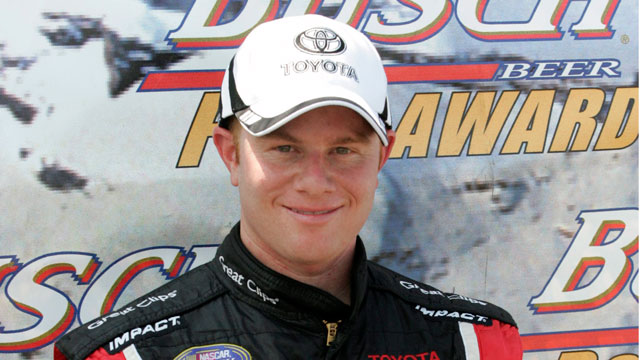

I shocked myself the other night.
Word had just come down on Twitter and from friends on Facebook that four-time USAC champion, and NASCAR journeyman driver Jason Leffler had been seriously hurt in a sprint car race in Bridgeport, N.J.
Somebody had posted a photo of Jason’s badly smashed sprint car, and even though you can never really tell from a photograph how severe the wreck is, this one did not look that bad.
Then a short time later, the flash was official. Leffler, who had to be cut out of the car and airlifted to a local hospital, didn’t make it.
Jason was only 37 years old.
I’m not sure if it’s the 45-plus years I have been wrapped up in this sport — first as a fan, then as a broadcaster — but initially I wasn’t outwardly upset at the news I was working with, as I prepped wrappers and reports for our Raceline Radio Network affiliates, including of course, Sportsnet 590 THE FAN.
I have dealt with the nasty side of this sport, and fatal injuries before. Too many times.
Greg Moore’s loss still makes me tear up to this day.
But I was not feeling sad at all at first as I gathered facts on Leffler’s tragic accident at Bridgeport. It happened during a qualifying heat, where something appeared to break in the front end of the car. It dug in and veered hard into the wall. The car then flipped wildly and came to rest badly mangled.
Well, those who know sprint car racing know these cars — that barely weigh 1,000 pounds and are propelled by alcohol-fired small and big block V8 motors sometimes producing as much as 900 horse power — are capable of speeds in the 140 M.P.H. range on small clay bull-ring tracks. That’s darn fast and when they flip, they bounce almost like a ball, far and high.
The big aluminum wing on the top helps keep the car on the ground at speed and also helps absorb the impact of the flip, helping deflect the deceleration away from the driver who sits directly under it in the roll cage behind the engine. Again, the photo of the Leffler’s wreck didn’t seem to show any kind of incursion into the cockpit area.
One unofficial comment had Leffler suffering cardiac arrest. A day or so later, the coroner declared Jason had been killed by blunt force trauma to the head and neck.
My point here? I was gathering all these facts like any news story, forgetting we just had a young man killed by racing automobiles. The sadness didn’t hit me until I was in conversation with THE FAN’s Jeff Sammut on air.
After doing Raceline for 21 years, had I become cold to the fact that athletes in this sport can and have been killed when something goes wrong? I don’t think so, and I’m relieved to be able to say every tragedy on the track hits us hard. Leffler’s just took a little longer to move the emotional meter.
Perhaps one reason for the lack of initial emotion is that we deal with death on the race track so infrequently. So when we lose somebody, we go numb for the want of a better description.
It’s rooted in the same argument I use when some knee-jerk reporters and announcers proclaim their belief the sport is too dangerous, some actually calling for a ban on the pursuit. Hard to fathom for some when we talk about a fatal crash, but the fact is, auto racing boasts an outstanding safety record.
You only hear about the fatalities, or the bad injuries. You don’t hear about the thousand of laps that are turned on any given racing weekend where nothing happens. Thousand of races where there are NO serious crashes and when there are wrecks, over 99 per cent of the time, the driver will emerge from the vehicle without so much as a scratch.
In a sport that is so inherently dangerous by its very nature, serious injury and certainly fatal injuries are extremely rare and highly infrequent. You have a better chance of being hurt driving to the store to buy ice cream in your passenger car than a driver does on the race track.
The sport of auto racing has made tremendous strides in the last decade to make it safer. Sometimes the death of a star has to wake us up to continue the neverending effort to protect drivers and fans when working with fast-moving conveyances in enclosed areas.
The loss of Dale Earnhardt comes to mind.
There are plenty of rough and dangerous games out there, where people can get hurt or killed, but the only way to make our sport 100 per cent safe is to shut off the cars and keep them off the track. While that is unlikely to happen any time soon, we can never forget human beings, fathers, mothers, uncles, brothers and friends are driving these things for our entertainment.
God Speed Jason Leffler.
Say hi to Dale and Greg for me!