
At a time that the Toronto Blue Jays have health concerns, a sputtering offence and a disappointing starting rotation, it’s easy to overlook the offensive struggles of their bench players. Yet with the possible exception of Rajai Davis, their reserves have contributed little on offence.
As a group, Davis, Mark DeRosa, Emilio Bonifacio, Henry Blanco and Munenori Kawasaki have combined for a .209/.264/.323 batting line with two home runs in 246 plate appearances.
In other words, they’re hitting like Jeff Mathis. The former Blue Jays catcher has a career batting line of .198/.256/.314, ranking among the least productive non-pitchers in recent history.
Not a good sign for the 10-18 Blue Jays, and 246 plate appearances is enough to matter. That total amounts to nearly half of the plate appearances that a starter gets in the course of an entire season.
Manager John Gibbons has made an effort to maximize the platoon advantage for his bench players, with right-handed hitters facing left-handed pitching often. Davis faces left-handers in 37% of his plate appearances and DeRosa faces lefties 44% of the time. Meanwhile, the left-handed hitting Kawasaki has faced right-handers 77% of the time.
Blanco has had just 16 plate appearances in the last month — hardly enough to get into a rhythm at the plate. But with just two singles and a walk to his credit against five strikeouts he hasn’t produced much.
However, Blanco gets credit for catching R.A. Dickey and his career batting statistics suggest he’ll produce a bit more as the season progresses. The Blue Jays aren’t asking Blanco to hit like Johnny Bench — or even like John Buck. They brought him in to catch the knuckler.
Even so, don’t forget about Josh Thole, a left-handed hitting catcher who is hitting .379/.438/.569 at Triple-A Buffalo. The 26-year-old struggled at the plate in 2012, but hits right-handed pitching, has a career on-base percentage of .331 in four MLB seasons and, like Blanco, has experience catching Dickey.
At some point, general manager Alex Anthopoulos may consider calling Thole up. As a left-handed bat he’d complement the skills of the right-handed hitting Arencibia and provide Gibbons with an option against tough right-handers.
The struggles of the bench extend to the middle infield, where shortstop Munenori Kawasaki has slowed down considerably after winning over much of the Blue Jays’ fan base early on. Should Anthopoulos consider alternatives, he’ll have limited options. Upgrading over Kawasaki at this stage in the season won’t be easy.
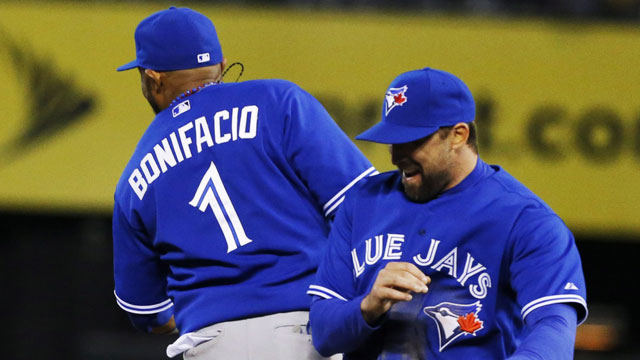
In theory, Bonifacio should provide the Blue Jays with speed and versatility. However, he has struggled to reach base, which limits his ability to use his legs.
Bonifacio has not attempted a stolen base in his first month in Toronto after stealing 70 total bases from 2011-12. Furthermore, his struggles on defence at second base could limit his playing time.
DeRosa has just a .160 batting average on balls he puts in play, which means he owns the worst average on balls in play — .160 — on the team that ranks last in MLB in BABIP. Expect some improvement from DeRosa, especially if Gibbons continues to limit his exposure to right-handed pitching.
Davis has been the team’s most productive bench player, with a .279/.313/.410 batting line and six stolen bases in seven attempts. That production lines up reasonably closely with Davis’ career numbers, an indication that this level of play is sustainable.
Like many aspects of the 2013 Blue Jays, the bench will improve as the season progresses. The hitters will creep toward their career norms as the team’s MLB-worst batting average on balls in play rises. While they may not rival the St. Louis Cardinals or Washington Nationals when it comes to depth up and down the roster, there’s reason to expect improvement from the Blue Jays.
After one month, however, the bench has hit poorly. If you’re looking for reasons why the team has struggled to this point in the season, look beyond the injuries and the starting rotation. The bench has been part of the problem, too.