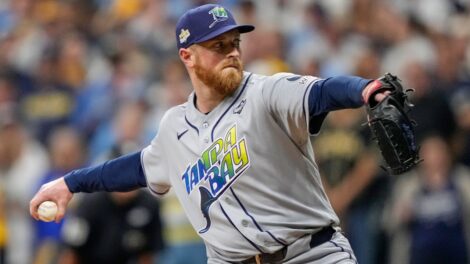
KANSAS CITY — So, how do you want to look at this? The Toronto Blue Jays, who were shutout in Game 1 of the ALCS and are beginning their second playoff series in 22 years with a deficit, are starting David Price in Game 2, a man who is legitimately one of the finest pitchers in baseball today and will finish either first or second in American League Cy Young voting this season. Well, that sounds good.
But David Price has not resembled David Price lately, especially in his three most recent outings. The first was a five-inning, five-run game back on September 26 against his old team, the Tampa Bay Rays, who always seem to play him tough; the second was a start in Game 2 of the ALDS, when Price battled dodgy command and gave up five runs over seven to add to his already unimpressive postseason numbers; and the third was a three-inning, 50-pitch relief appearance five days ago, when Price got hit hard and allowed three more runs to that same Rangers lineup that seemed to have him figured out. Well, that sounds bad.
This is why it’s difficult to put a finger on how Blue Jays fans should feel about Price heading into his start Saturday afternoon. It’s a little unclear which version of the five-time all-star is going to show up.
It is David Price, after all, so the good money is on him being dominant. But ever since he was given an 11-day break to end the regular season and then used in relief for the first time in five years during the ALDS, his routine and work schedule have been out of whack, which has occasionally had a negative effect on the creatures of habit that are starting pitchers.
For his part, Price doesn’t feel like it’s much of an issue, not that he ever does about anything. He threw a good amount of pitches in his bullpen session Thursday afternoon, and says he’ll take the mound on Saturday looking to do the same things he always does.
“The dimensions that I’m throwing are still 60 feet, 6 inches. That stuff doesn’t change,” Price said. “At this point in the season you know where home plate is. You have a good feel for what you’re trying to do out there.”
Knowledge of where home plate is would certainly be a good thing to bring into his start. A second good thing would be formulating a plan with catcher Russell Martin to effectively attack a Kansas City Royals team that makes a ton of contact and is difficult to contain on the base paths.
Price faced the Royals in back-to-back starts earlier this season when he was pitching for the Detroit Tigers. The first one went very, very well as Price spun a complete game gem, allowing just one run on five hits. But the Royals stung him in his next start, rapping 12 hits off Price while scoring five runs. What was consistent across both of those games was that Price hardly struck out any batters, earning just four K’s between them.
“They do a great job of putting the ball in play,” Price said. “They do a really good job of putting themselves in scoring position and allowing them to kind of push runs across home plate with outs. That’s something you definitely want to stay away from. Just get that leadoff guy out. If you can do that you can kind of manage that running game a little bit better and just take it pitch by pitch.”
Price is right (sorry). The Royals have speed for days and were second in the American League with 104 steals this season, converting on 75 percent of their stolen base attempts. They were especially aggressive when it comes to stealing third, a base they took 27 times in 29 attempts, which led the AL.
“They have a lot of team speed,” Price said. “They can cause a lot of trouble for pitchers whenever they have runners on.”
The Royals are also aggressive when running the bases on balls in play, advancing more than one base on a single or more than two bases on a double 44 percent of the time, the second highest rate in the AL. And they turn that aggressiveness into runs. Kansas City baserunners scored from second base 70 percent of the time on a single, and scored from first nearly half the time on a double.
They’re also good at cashing in on their opportunities, as 32 percent of their base runners this season came around to score—the second best rate in the AL. (The best rate? That belongs to the Blue Jays, of course, who cashed 35 percent of their base runners)
Containing the Royals speed will be big for all Blue Jays pitchers, but perhaps Price can help set an example for a team that has invested a lot of time in improving it’s base running defence.
During spring training back in February and March, John Gibbons and his coaching staff made controlling the running game a priority, working individually with all of their pitchers on techniques for keeping runners from swiping bags. Some added a slide step. Others shortened their leg lift. They all concentrated on varying the amount of time they hold the ball before delivering between pitches, in order to make them less predictable to base stealers.
“Teams ran wild on us last year. A big part of that was our pitchers were slow to the plate,” Gibbons said. “So, that was a focus this spring. That was a conscious effort and it’s paid off. “
But none of them have been better than Price. He says he began really focusing on shutting down the running game years ago when he was working with Joe Maddon in Tampa Bay. He had suffered through a pair of especially poor years controlling runners, allowing 13 steals in 20 attempts in 2010 and 20 in 25 attempts in 2011, and wanted to do something about it.
He cut those numbers in half the next two seasons, as base stealers were successful on just 11 of 21 attempts in both 2012 and 2013. His numbers were similar in 2014 before this season when he’s been exceptional at nullifying the running game, going the entire year without allowing a stolen base and watching the only two runners who tried to steal on him get cut down.
“You’ve gotta get rid of it quick. That’s something I’ve focused on,” Price said. “The Royals can produce runs with outs. If that leadoff guy gets on, you can’t allow him to steal second base and get a free 90 feet. Then you have two ground balls to the right side or two relatively deep fly balls and it’s a run.”
Of course, if Price continues to allow hits the way he has in his last few outings, he’ll have his base-running-containment work cut out for him.
Those struggles have led to some concern that Price may be running out of steam as he pitches into the seventh month of his season. Over the last two years he’s thrown 486.2 innings between the regular season and playoffs, and he’ll add to that total Saturday afternoon. His velocity has remained consistent throughout the season, and even spiked up by a mile per hour on most of his pitches this October. But his command and location haven’t been as precise are they normally are.
By his own admission, Price has been letting his fastball bleed out over the plate, which explains why his whiff rate on that pitch has dropped substantially since the summer (from 16.55 percent in August to 7.41 in October) while his line drive rate on four-seamers has spiked from 27 percent in August to 39 percent in September and October. Whether Price can reverse those trends or not will go a long way to deciding how successful he’ll be against the Royals. Not that he’s particularly concerned about it.
“I have one hundred percent confidence in myself. I know my teammates do, as well, and our coaching staff,” Price said. “You’ve got to be able to live in the moment. I want to be able to step up for my teammates and this organization and all our fans in Canada. Good things are coming. I know they are.”