
If the Toronto Blue Jays have innings limits in mind for their best young arms, they aren’t about to announce the specifics publicly.
The cases of Stephen Strasburg and Matt Harvey show that teams stand to lose more than they gain by disclosing those plans in detail. The Blue Jays would only weaken themselves by exchanging the flexibility they currently enjoy for the constant scrutiny the Nationals and Mets experienced.
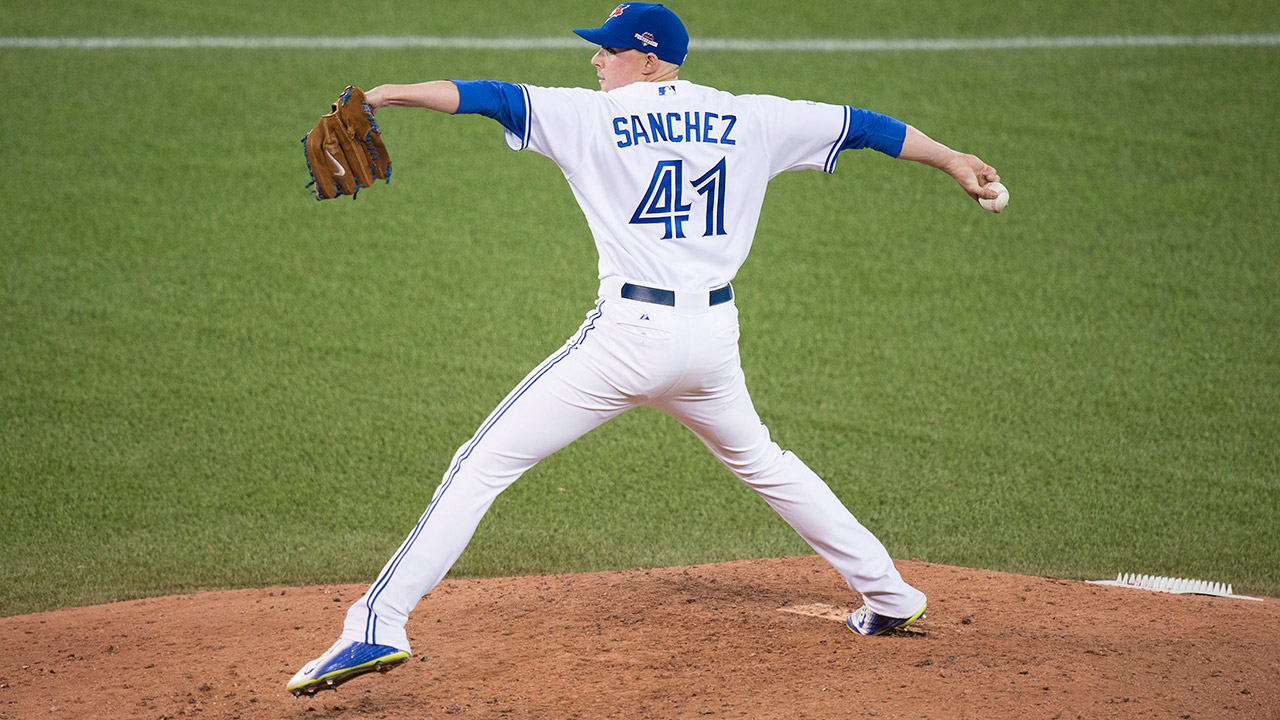
But given the importance of acquiring and developing young pitching, teams have ample reason to monitor workloads carefully, even if the science of keeping pitchers healthy is inexact at best. For the Blue Jays, that means getting the most out of pitchers like Marcus Stroman, Aaron Sanchez and Roberto Osuna without pushing them too far.
Innings are one way to measure the toll on arms. But the goal is to avoid injuries, not avoid innings, so it should be no surprise that Blue Jays president Mark Shapiro points to another variable: fatigue.
“You start with the subjective eye of a major-league pitching coach or manager with years and years of watching players and knowing what fatigue looks like down to the objective information we gather as simple as pitch counts and innings to as complicated to some of the other information we can gather at a performance level,” Shapiro says.
 Download it now: iOS | Android | Windows | Special Offer
Pitchers who keep going while fatigued have a higher risk of injury, so there’s little reason to push players excessively, especially with seven-man bullpens available. Along those lines, MLB executives can gather big picture data related to innings and pitch counts. But while the responsibility of identifying industry-wide trends rests with the front office, the Blue Jays’ coaches and catchers provide the first line on defence when it comes to monitoring pitchers’ workloads.
As the Blue Jays’ starting catcher, Russell Martin often has the best sense of how Toronto’s pitchers are faring on a given day. Asked how he assesses fatigue in big league pitchers, Martin says it can be as simple as looking at a pitcher’s face or as complex as watching his mechanics. For example, a pitcher might generate more force with his legs if his arm is tired.
“It’s sort of like when you’re doing a lot of pushups: first your arms get tired, then your core gets tired, then you’re done,” he says.
A warning sign for Martin: when breaking pitches lose their tightness and move gradually instead of sharply. Fellow Blue Jays catcher Josh Thole adds that location can reveal a lot. If a pitcher can’t bury a breaking ball in the dirt, that’s often a sign of fatigue. The same applies when fastballs start coming in around the belt.
That’s not to say starting pitchers are noticeably fatigued by the end of every start. Sometimes they require fewer pitches than usual. As teams turn to bullpens earlier and earlier, starters aren’t asked to absorb as many innings.
Martin doesn’t consciously try to break down mechanics while he’s catching — he’s got game calling, receiving and throwing to worry about — but he’ll notice if a pitcher comes out of his delivery in a meaningful way.
That’s where the Blue Jays rely on the eye of pitching coach Pete Walker. Walker, who pitched parts of eight seasons at the MLB level, watches carefully from the Blue Jays’ dugout to determine whether Toronto’s pitchers are fading.
“Elevation is number one. Starting to run deep counts number two. Hard contact number three,” Walker says. “Those are the things you gauge in the course of the game. You talk to guys between innings. It’s the pulse of the game. You can kind of tell if a guy’s fatigued by looking at him and also by communicating with him.”
Sanchez set a career-high with 133.1 innings in 2014, Stroman pitched 130.2 innings the same year, while Osuna topped out with 78 innings last year, including the playoffs. The Blue Jays seem prepared to have Stroman throw 200 innings, and if anything Osuna might pitch fewer innings in 2016 now that he’s closing games. That leaves Sanchez, who has bulked out considerably since being handled with extreme caution as a prospect. The Blue Jays have said they expect to transition Sanchez to the bullpen later this year without offering up a target number of innings.
Typically teams have avoided major workload jumps for young arms in recent years.
“There are norms and thresholds that are occurring that happen for a reason,” GM Ross Atkins adds. “You have to be cognizant of them, but you also have to individualize every decision you’re making.”
Not as simple as an innings cap, but maybe expecting simplicity when it comes to young arms wasn’t realistic to begin with.