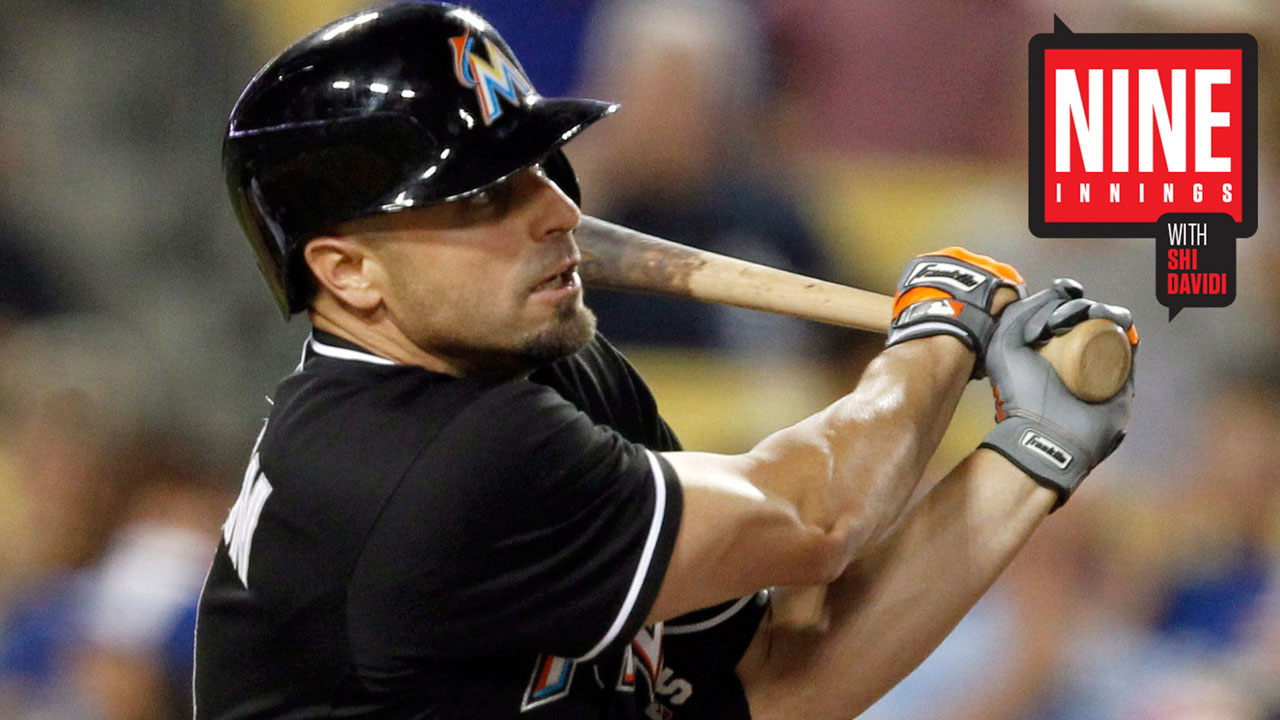

Nine Innings is a series of questions with players & personnel from around Major League Baseball. In this edition, Shi Davidi talks to Washington Nationals outfielder and former Blue Jay Reed Johnson.
Reed Johnson is chilling on a couch in the Washington Nationals clubhouse, in uniform, watching the happenings around him. With his left leg in a walking boot after surgery on his foot in early May, that’s about the extent what the veteran outfielder can do right now as he endures the slow road to recovery.
On April 28 against the Atlanta Braves, he was coming out of the box just as he has thousands of times before in his 1,315 career big-league games – starting with the Toronto Blue Jays in 2003 – when something went wrong.
“I didn’t twist my ankle or anything,” Johnson says. “I just heard a pop through the bottom of my foot and I was having some arch pain. I thought it was just a plantar fasciitis or something, but it was the peroneus longus tendon, which attaches under your foot and runs up the side of your leg. It just ruptured and rolled up into the side of my leg.
“It wasn’t painful, all of a sudden I had some cramping up the side of my leg.”
The pain came after surgery to reattach the tendon, a process that included having stem cells removed from his hip and inserted into his foot to speed the healing. Johnson, a 17th-round pick in 1999, spoke with Nine Innings about the injury, staying fit and motivated at 38, and his five years with the Blue Jays.
1st inning – Where do you draw motivation from to keep playing?
“I’ve always said someone is going to have to rip the uniform off me. Just the competition and the camaraderie of being around these guys, when you do have an injury like I have now where you’re going to miss a few months, it reassures you about the appreciation level that you have when you are able to be out on the field. Obviously you never want to be injured, but it just reminded me that I still want to be part of what’s going on in Major League Baseball, and especially in this clubhouse with the Nationals.”
2nd inning – What are your hopes for this season after the injury?
“When I came over here at the end of spring training, obviously the goal was not just to get to the playoffs, but to win a World Series. Even with the injury keeping me out another three months, it still gives me an opportunity in August/September to be back for that playoff push, and hopefully deep into the playoffs. A lot of the goals I had at the beginning of the season can really still be reached because it’s all about winning a World Series, and if I can help the team out in the last month and a half of the season, and then into the playoffs, that’s what I’m going to do.”
3rd inning – You’ve always played the game hard, running, diving, and that’s surely taken a heavy toll on your body over the years. Physically, how do you cope with that?
“I feel like as the years have gone on, the off-seasons start earlier and earlier. You’d think they start later, you want to take the rest, but I eat well year-round. Usually it was I’d eat well during the off-season and then in season, you’re in and out of different clubhouses, eating dinners late at night, so it’s a little tougher to eat well but I try to force myself now that I’m getting older to eat well year-round. I train year-round, I’m only taking couple of weeks off in the off-season. It’s those types of things I feel that I’ve had to do better than I have in the past because I’m 38 and playing with 20-, 21-year-old kids. If I had kids when I was 16 or 17, they could be my kids. But it’s a compliment too when you come into camp and people don’t have an idea of how old you are. I take pride in keeping myself in shape, but it’s not the old Babe Ruth off-season of hot dogs and beer. I wish it was that easy.”
4th inning – When you broke in with the Blue Jays in 2003, you got off to a great start, and in your 28th game, June 15 against the Chicago Cubs, you hit a home run to start the game and end it in the 10th inning for a 5-4 win. How vivid is that memory for you?
“It’s pretty vivid. Being my rookie year, pretty early in the season, to be able to make an impact on your team early in your career, you kind of earn the respect of the veteran players. That was a special moment for me to have a direct impact on a team win, and everybody in that clubhouse knew how much they hated extra innings and free baseball anyways, so for me to end it, I think everybody was more excited about that.”
5th inning – Many young players need a period of time to transition from the minors to the majors, but you never really seemed to have that. What do you think allowed you to hit the ground running?
“I just told myself when I got called up that I was going to do the same things that brought me success throughout the minor-leagues. I had a pretty good minor-league career over a 3½ year stint and I felt like if I go up there and try to do something different – if I’m hitting with Carlos Delgado and Vernon Wells and all these guys’ hitting groups and I’m trying to do what they do in batting practice and get off my game – that’s going to affect me once the game starts. I felt like I was really disciplined in what my approach was and what I was good at. I tried to be myself, play the game, hit balls the other way, and not get caught up in trying to do things from a power standpoint that I wasn’t capable of doing.”
6th inning – When you think back to your years in Toronto, the Blue Jays had some good teams in the wrong division at the time with the powerhouse Yankees and Red Sox. How do you reflect on those seasons?
“It was definitely tough, but there was always that hope just because we had such a good a team that we’d be able to make a run into the playoffs. The second wild card would have helped, especially for those third and fourth teams in the AL East. You had Boston and New York spending $150 million a year when everyone else was around $50 million. That definitely can make a difference. Then in ’08 I get released and go to Chicago and I realized that’s what it’s all about, playoff baseball, everything hangs on every pitch. It becomes so important not only to your teammates but also to the city and to the people in the stands. Once you get a taste of that – I wish we would have gotten a taste of that early because I think it would have made a difference for the players and the front office at the time. They would have realized how much fun it would be to bring the people back into that stadium. It would have been something special, for sure.”
7th inning – That 2008 spring when the Blue Jays cut you in favour of Shannon Stewart, what was it like emotionally for someone who grew up in the organization and played so hard for the team?
“It was tough at the time. At the beginning of spring training and throughout spring training you’re told different things, and different things actually developed at the end of spring training. At the time, you don’t want to burn any bridges when things like that happen. What they told me when I was there was that it was going to be my job if I was healthy – I was coming off a back surgery and I understood. It went from that to all you’ve got to do is beat out Shannon Stewart, and I felt like I played pretty well. At the end of the day, it was more about the money. I was scheduled to make $3.2 million and if they released me they only had to pay me $550,000 or something like that. That’s the business side. At first you’re upset, and later on in your career you start to understand that it’s really about a business. I always told myself it will never be a business for me, it will always be a game, I love to play the game, but then you see your friends go through situations, and then you go through situations, you realize, OK, it’s a business, you can’t take things personal.”
8th inning – How did you end up with the Cubs?
“The whole thing was only hard for about 20 or 30 minutes. I went home, talked to my agent, it was early Sunday morning, my agent got on the phone and started calling around. We got a hold of Jim Hendry (the Cubs GM at the time), and literally within hours, I was basically scheduled to go to Arizona. I finished spring training with the Cubs and made their big-league team. If I would have been sent home and never played baseball again, there would probably still be some bitterness, but my goals changed from thinking I was going to help the Blue Jays win to now I’ve got to help another team win. It was really one of the best moments of my career, being able to go to a team like Chicago that won 97 games and went to the playoffs. Just to have that experience was a great thing.”
9th inning – How much do you think you have left in you beyond this year – are you basically chasing a World Series ring?
“That’s something I’m looking for, but I feel like I have the mentality that I’m going to never really want to stop playing. Eventually someone is going to tell me that’s enough, but they’re going to have to tell me, that’s how I feel like my career will end. Once you’ve played Major League Baseball, there aren’t a lot of things out there from a competitive standpoint, whether it’s playing golf with your buddies or playing pickup basketball, that will really reach that level of competitiveness, or being able to problem solve when you’re going through your struggles, being able to get yourself out of those struggles. There’s really no better feeling than that, having success in this game. One of the hardest things to do is hit a baseball and when you’re doing it well, everyone else is looking at you like, ‘Dang man, this guy is on fire.’ There’s no better feeling than being able to have that success on a baseball field.”