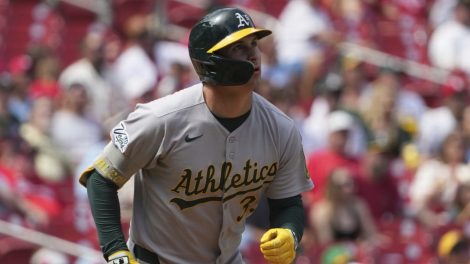
TORONTO – Justin Smoak stopped being so hard on himself. Kevin Pillar developed a more effective plan at the plate. Ryan Goins found ways to slow himself down. Over the past few weeks those small changes have played large for the Toronto Blue Jays, who have undone much of the damage from their dreadful start, in no small part, thanks to the trio’s production amid a potentially debilitating spate of injuries.
“There’s more maturity in their approach,” says hitting coach Brook Jacoby. “Not every pitch thrown up there is ‘mine,’ they’re looking for pitches in areas, looking for off-speed pitches, whatever it may be.
“It’s not chasing hits – it’s chasing good pitches to hit. We talk about that a lot,” Jacoby continues. “The more times you make a move on a ball in the zone you’ve got a better chance of getting the results you’re looking for.”
All three, so far, have been getting the results they’re looking for far more often than they did last year. Pillar is tied for the American League lead in hits with 49. Smoak leads the Blue Jays with eight homers and 25 RBIs. Goins has come up with several pivotal hits.
At minimum, they’ve helped steady the Blue Jays amid the absences of Josh Donaldson, Troy Tulowitzki and Russell Martin, and the extended slumps of others. At best, they’ve made adjustments that will help keep them productive over the long term and really deepen the lineup once the injured stars return.
[snippet id=3319157]
During his personal reflections over the off-season, Smoak came to the conclusion that he needed to learn how to handle his failures in a more productive way. Too often he’d beat himself when things didn’t go right leading to doubt, changes and, if they didn’t deliver results immediately, more doubt.
That had to stop, he decided.
“I feel like I don’t let one at-bat ruin my day now,” says Smoak. “I’ve done it before. It’s a long season, if one at-bat ruins one day, that’s four or five at-bats. Consistent playing time always helps. I definitely feel a lot better with that.”
To this point, Smoak has appeared in each of the Blue Jays’ 39 games so far, starting all but six. He’s been their most frequent No. 5 hitter and of late has been batting cleanup. Contrast that with last August, when he got only 48 plate appearances, and September, when that number slipped to 24 and he struggled badly.
Unsurprisingly, his approach collapsed.
“What I wasn’t able to do last year with not being in there on a consistent basis was to get myself to sit on pitches. When 92 looks like 92 and not like 120, I can go up there and sit on certain pitches in certain situations, guys in scoring position, just have a better game plan,” Smoak says. “More than anything I was scared to get beaten by the heater because I knew, ‘I don’t care if this guy throws 88, it’s going to look 100, so you’ve got to be ready for the heater.’
“Of course they didn’t want to throw the heater but I’m still trying to hit it. I was just rushed, not letting the game come to me but trying to make it happen.”
That’s why Smoak would so regularly take fastball swings over breaking balls in the dirt. He was so sped up physically he couldn’t decipher which was which. His strikeout rate spiked to 32.8 per cent, a number that’s crept back down to 20.3 per cent so far.
For an example of the difference, take his approach last Thursday against the Seattle Mariners and rookie starter Chase De Jong, when he went 3-for-4 with four RBIs.
“In my first at-bat, first and third, two outs, never seen the guy before in my life, but I had a feeling he’d throw me a curveball, so I’m sitting curveball until we got to 3-1. Then I got the heater and I was able to hit it (for a single),” says Smoak. “In my second at-bat I went up there somewhat sitting soft and he walks me to throw heaters up.
“In the bases loaded at-bat, I go up there sitting on a curveball and I got it (for a two-run single). So you can play the game, play the chess match instead of beating yourself up about it.”
Pillar’s reputation as he progressed through the Blue Jays system was as a strong all-around player who could really hit. In 413 minor-league games over five years he did just that, slashing .324/.367/.479. Yet over his first four seasons in the big-leagues, that didn’t really translate in the same way, with a .267/.303/.385 slash line, and he believed he was far better than that.
“I think I got away with a lot of stuff in the minor-leagues,” says Pillar. “Obviously guys’ stuff isn’t as good and more so the defence wasn’t as good. It wasn’t that I was consistently barrelling up balls, but I could find ways to get hits in the minor-leagues so it didn’t really force me to make changes until I got here. The same weak ground balls in the four-hole that were getting through were now routine outs, or the same flares that I would hit to the outfield were becoming outs and I had to learn it wasn’t about putting the ball in play at the big-league level, but about trying to hit the ball hard.”
To that end, Pillar realized he had to refine his approach and in part, that’s resulted in improved discipline, with his walk rate climbing to 7.7 per cent from 4.1 per cent last year and his chase rate down from 37.1 per cent last year to 31.4 per cent.
The difference is in “having a bit more of a definitive plan up there,” he says.
“Obviously there are going to be times when you get fooled – if there’s a good slider and I’m looking for a fastball in a certain location that’s going to happen. But you learn that’s OK to get fooled when it’s plainly obvious that he’s throwing a breaking ball and I’m all in on the heater. And sometimes you just have to let it go, even if it’s a strike,” continues Pillar. “That’s the biggest adjustment for me.
“It wasn’t necessarily chasing pitches outside the zone, it was also about swinging before I necessarily needed to swing, not taking the strikes I wasn’t looking for. Sometimes it’s better to just let it go. With that, if I’m up there looking fastball and he throws me a breaking ball, he’s just given me information. I’ve got an idea of where he needs to start height-wise, location-wise. That’s allowed me to lay off some pitches as well.”
[relatedlinks]
Throughout the off-season, Troy Tulowitzki told Goins the same thing over and over and over: Slow down. What would happen, in the all-star shortstop’s view, is that Goins would speed up all the elements in his swing which would keep him from recognizing and tracking pitches effectively.
Goins didn’t feel that way in the box, but now, “I can see it on video when I felt slow it still wasn’t slow.” To counter that, he worked in the batting cage to get “almost lazy” with his triggers and body movements “and that’s translated into the games.”
“If I can go slow enough and move slow enough,” he adds, “I can see the ball and make good decisions.”
Reflective of those decisions is a chase rate that’s dropped from 31.1 per cent to 23.5 per cent and a line drive rate up to 19.4 per cent from 11.3 per cent. Helping drive that improvement isn’t only the emphasis on slowing down, but also a shift in mentality.
Regular playing time has also helped all the different elements take.
“I can say in the past when I haven’t played every day, there’s been a, ‘I need to have a good at-bat right here, I need to get a hit in this game, maybe I’ll be in the lineup tomorrow,’ kind of feel,” explains Goins. “Now, I took the approach in spring training that was, ‘You know what? I don’t care. I’m going to go up there, swing hard and hopefully hit the ball hard. And whatever happens, happens.’ I think with that, swinging hard and trying to hit a bullet, it allows your body to check off on pitches that aren’t in the zone. If I was, ‘Hey, I need to have a good at-bat, not strikeout, put the ball in play,’ I might be more susceptible to chasing pitches.”
Those kinds of concerns about results over process really became evident for Goins last season during a 9-for-91 stretch April 14-May 25. Early in that slide, he felt as if he was making quality contact that turned into outs, which led him to press for results, which led him to chase, which led to bad at-bats.
This year, he’s trying not to let the hard outs affect him.
“I’ve lined out a lot again, the numbers even say it, the hard contact is there, but if I can keep doing that over time, that’s sustainable. Hitting the ball soft and getting hits isn’t sustainable,” Goins says. “I’ve done it a couple of times where I’ve had a cheap knock or whatever you want to call it, but for the majority of the time, hit the ball hard, and if they catch it, they catch it.
“It does suck, I look up there, I see my numbers and I’m hitting (.217) but in my head I feel like I’m hitting .300, my batted balls in play average is down below league average, which means it should change for me, but you can never say if it will change or not. But you control what you can control and once it leaves your bat you’ve got no control.”