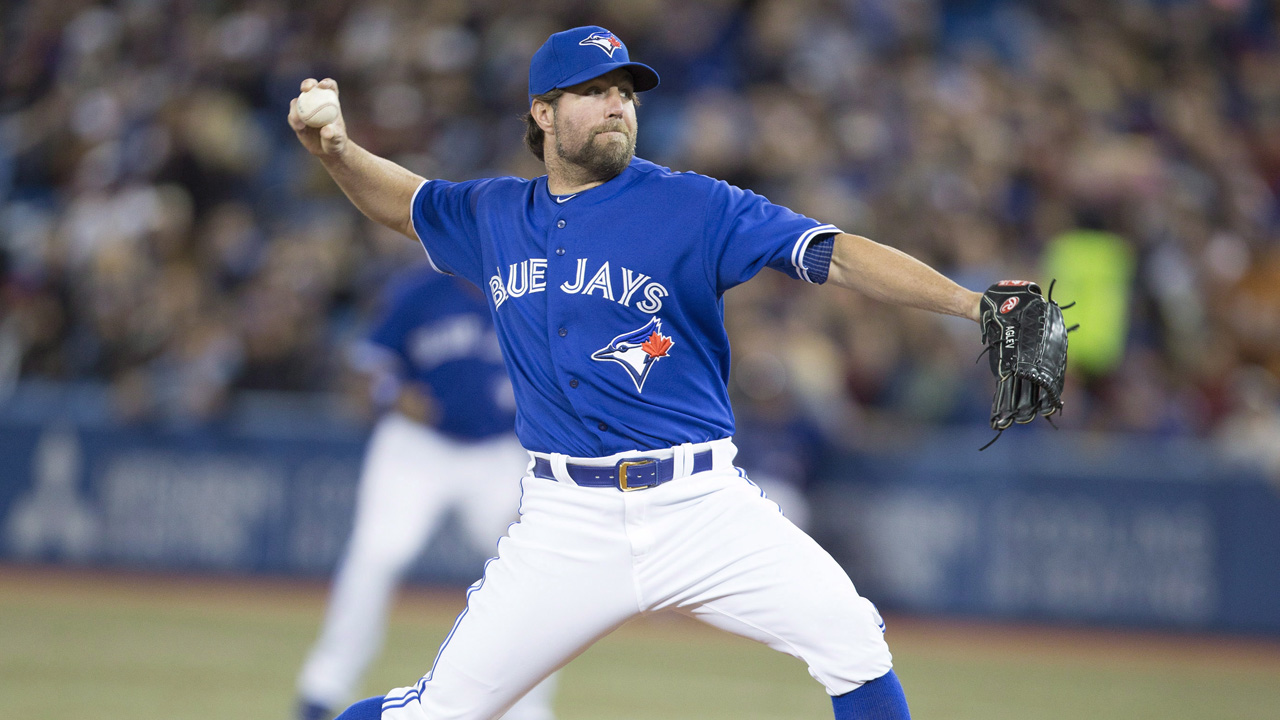

Here’s a scenario for you. Let’s say the Yankees were to surge past the Blue Jays in the AL East (and if Toronto can’t figure out how to win in the Bronx, where they are 11-38 since new Yankee Stadium opened, that’s a very realistic possibility) while the Blue Jays continue to play well enough against the rest of the division to stay in second place and finish the season in a wild card spot. For the sake of the scenario, let’s assume the Blue Jays are aware of this fate long enough in advance to re-shuffle the rotation and line up whichever pitcher they’d like for this one-off, winner-take-all playoff game. Who would you send to the mound?
You’re certainly not going to go with J.A. Happ, whose outings this year have been reminiscent of a hang glider trying to land on a short cliff at the far end of a canyon named Disaster.
Drew Hutchison has ebbed and flowed from great starts to troublesome ones, and with fatigue seeming to diminish his velocity as the season wears on (his fastball has gone from an average of 93.8 mph in April to 92.6 mph in June; his changeup from 87.2 to 85.5) he may be running out of fuel by the end of September. Not an ideal candidate.
Starting 23-year-old rookie Marcus Stroman would be intriguing option, following in the trail blazed by the St. Louis Cardinals who leaned on 22-year-old rookie Michael Wacha in last year’s post-season, and were rewarded with four terrific outings that helped carry them to the World Series. Stroman possesses the most electric stuff on the Blue Jays staff and has allowed three runs or less in each of his first four major league starts.
But that’s your issue right there. Stroman has hardly any experience pitching in regular season games at the MLB level, let alone the postseason. Asking such an unseasoned pitcher to take the mound for an outing as intense and high pressured as a one-game playoff is risky. Plus, Stroman is no Wacha. Let’s put him aside as well.
Now we come to Mark Buehrle. The 35-year-old has out-pitched everyone in the rotation by a mile, and most of baseball at that. His 2.32 ERA is seventh in the majors among qualified pitchers; he’s made 15 starts and allowed more than two earned runs in just three of them; he’s yet to have an outing that didn’t go at least five innings, despite twice walking five. If he continues to produce these results, he would be a no-brainer for the wild card start.
And that’s the thing. Buehrle is a pitcher known for being unfailingly consistent who is having a year that is a tremendous departure from his career norms. He’s averaged an ERA of 3.84 over the last 13 seasons. In seven of those seasons, his ERA fell between 3.58 and 3.89. He’s practically set the generational standard for consistency.
So, considering that Buehrle is vastly over-performing his career norms at an age when pitchers typically begin to decline, along with the fact he’s seen an abnormally low percentage of his fly balls go for home runs this season (his 4.6% HR/FB rate is way down from his career average of 9.7% and even the 2014 MLB average of 10%) and the matter of his 80.7% strand rate which is nearly eight percentage points higher than his career average and seven points higher than the MLB average, it seems the guy could be due for some good old fashioned regression to the mean. That doesn’t mean it will happen, it just means it’s incredibly likely to happen.
If Buehrle had discovered some newfound velocity, or was utilizing a new pitch batters hadn’t seen before, or was altering his approach in any way at all, you could buy that he was a new man. But he’s throwing the same pitches at the same speeds that he always has, if not a tad slower. The only difference in his usage is that he’s been throwing his sinker and curveball more often, while using his fastball and cutter less, but the deviation isn’t dramatic. His strikeout rate is down, while his walk rate is up. None of his success is explainable with anything other than luck.
Sure, you go with Buehrle in a wild card game if he can continue to produce the way he has. But everything in the realm of logic tells us that he won’t. Which brings us to the top of the rotation, the opening day starter, the de facto ace of the pitching staff—R.A. Dickey.
It has been an interesting ride for Dickey in a Blue Jays uniform. His next start will be his 50th for Toronto and likely won’t do much to affect the 4.17 ERA he’s put up in the 49 preceding it. The 39-year-old arrived north of the border on the heels of a Cy Young season, but since then he’s been league average at best.
Home runs have certainly hurt, as Dickey has allowed at least one long ball in each of his last six starts, but so too has his tendency to get hit late in games. Through the first four innings this season, Dickey’s ERA is 2.40 and the opposition is batting just .214 against him. But in the fifth, sixth and seventh innings Dickey’s ERA skyrockets to 7.45 as opponents begin to bat .293. Nearly half his walks this season (17 of 40) come in those fifth through seventh innings, which is remarkable considering that’s a season-long sample of 29 innings while the first four frames are a sample of 60.
Sure, you could pitch Dickey for the first four innings of the game and then try to piggyback your way to the finish line with some combination of relievers or even another starter. But that would contradict an integral law of baseball field management which states that if your pitcher is going strong through four or five innings you stick with him. Taking Dickey out of the game on a low pitch count with little damage done simply isn’t going to happen.
And there you have it. Five choices; five arms; five pitchers who don’t give you an easy decision. So—who would you start?