CLEVELAND — So, what can the Toronto Raptors do differently in Game 2?
Something must change, surely, because if the Raptors play the same way they did in Game 1’s 116-105 loss to the Cleveland Cavaliers, they’ll likely be heading back to Toronto later this week in a two-game hole.
The 11-point score differential (thanks to the Raptors dominating garbage time, 13-4), relatively level shooting percentages, and no turnover discrepancy between the two teams makes things look a lot better than they were. The Cavaliers were never in danger of losing this basketball game, and, as Raptors head coach Dwane Casey put it, at times they looked like they were playing at a different speed.
“They were well rested. They were moving, flying around, almost like they were a half-step quicker than we were all night,” Casey said. “We’ve got to make adjustments as far as how we want to guard the paint and then get out to the three. And then, offensively, get cleaner looks.”
A better start would be a good, um, start. Toronto’s beginning to this game fell somewhere between jittery and downright unprepared, as the team bricked makeable shots, looked rattled and panicked when Cleveland trapped, and made a series of unforced errors, including literally throwing the ball away on their first possession of the game and turning an open look from beyond the arc into a travel, as Patrick Patterson did midway through the quarter.
Meanwhile, LeBron James was setting the stage for a night of prodigious production (he finished with 35 points and 10 rebounds) and borderline disrespectful feats, yelling at Kyrie Irving on a fastbreak to throw the ball to him off the backboard before finishing a move rarely seen outside an all-star game with a deafening dunk.
Later on in the night, James would go on to berate Casey after a foul call, throw an exaggerated no-look alley-oop pass, and even grab a beer from the hand of a sideline server and frown at it after an and-one attempt didn’t go his way. After the game, he said he would have had a sip if it was a glass of red wine.
That’s how bad the start was. And in an ear-splitting Quicken Loans Arena, a bad start can begin to feel like an impossible mountain to climb pretty quick.
“They were the quicker team tonight. We’ve got to match that to start the game,” Casey said. “We’ve got to come out with that sense of urgency in the first quarter. I thought we got into it during the second quarter. But not quick enough for this team.”
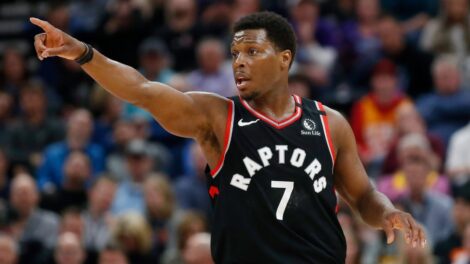
That’s true — the Raptors fared much better in the second quarter, a period that featured some of their best stretches of play on the night, and could provide a blueprint for how the Raptors can come away from Game 2 with a more favourable result. Kyle Lowry was terrific in that quarter, as was Serge Ibaka, who shook off some dicey moments early on to shoot 4-of-6 in the second with two buckets from beyond the arc.
The Raptors played better defence in that second quarter, too, thanks in large part to P.J. Tucker’s never-ending hustle in his own end. When Tucker hit a three-pointer to bring the Raptors within five a little less than five minutes into the quarter, the Raptors were looking as strong as they would all night. If not for Patterson missing a couple unguarded three-point attempts, Toronto may have even taken the lead.
“There were enough positive things in there. We had 22 assists. We missed so many open shots, open looks, that I know that those guys can knock down,” Casey said. “We did enough things positively. I think we can correct some things and bounce back.”
What worked for the Raptors in that second quarter was what’s worked well for them the entire post-season — decisive ball movement out of traps, which quickly found the inevitably open man on the floor. What didn’t work was that the Cavaliers kept scoring. And scoring and scoring and scoring.
The Raptors weren’t able to slow Cleveland down at any point Monday night. When they took away the paint, the Cavaliers hit threes. When they took away shots, the Cavaliers attacked the rim. It’s incredibly hard to limit both those areas effectively, especially when James plays with four shooters. But the Raptors are going to have to as they move forward in this series.
[snippet id=3360195]
“We didn’t play with the force we needed to. We didn’t get close enough to the shooters to make them feel that we were there,” Casey said. “That was the difference in our game. Covering the paint and then getting out. Defensively, I didn’t think we played with the type of physicality that we needed to.”
The Raptors could look to adjust their starting lineup in order to improve their first quarters. Casey’s already gone to that well once, injecting Norman Powell into the opening rotation for Game 3 of Round 1, to dramatic effect.
It’s worth noting the Raptors starting five was a minus-10 Monday (not that any particular Raptors rotation blew the roof off). And it’s also worth noting that Casey turned to Powell and fellow youngster Delon Wright in the fourth quarter when he was searching for a spark.
“I thought both of them created, got us open looks. You’ve got to knock them down. But I thought both of them were aggressive with their speed and quickness, and playing with force,” Casey said. “And I thought that was a positive for us.”
So, there are your points of emphasis for the Raptors in the 48 hours between Games 1 and 2. Start better, defend more physically, better anticipate traps, move the ball with confidence, and bust tail to get out from the paint and take away open looks. You know, just a couple things to go over during Tuesday afternoon’s practice.
“There’s some different things we can do. There’s some different things we have to do,” Casey said. “Know where the double teams are coming from. Know where the rotations are coming from. It wasn’t a surprise. But we can do a better job of attacking to get better looks. Defensively, there’s some [things] we can do better as far as reacting quicker in certain situations. There’s a lot of things we can do better that I know we didn’t do tonight.”
[relatedlinks]