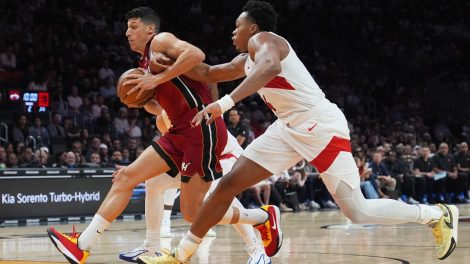
Despite a thrilling ending that saw Kyle Lowry and the Raptors fall short down the stretch (for a change) and LeBron James take over in a 105-101 Cavaliers win, it was Dwane Casey who set the tone before the game even tipped-off.
With DeMar DeRozan sidelined, the starting five has been a popular topic for debate in Raptorland. Is Greivis Vasquez really the right choice? Should James Johnson start? And Terrence Ross move to shooting guard? What about Lou Williams?
And there’s a safe argument to be made for each.
But Landry Fields?
Heading into Tuesday’s contest in Cleveland against the Cavaliers, Fields had played only 22 minutes all season, spread over six games. But that didn’t stop Casey from inserting him into the starting lineup for arguably the Raptors’ biggest game of the season.
That’s not to say Casey didn’t have his reasons. With defence an ongoing concern for the Raptors, Fields offers the coach a sound, reliable defender—something that Casey told reporters would be a key to limiting LeBron prior to the game.
The personnel change also put James Johnson—considered the closest thing to a one-on-one stopper this team has—on notice. And for the most part both wing players responded.
Being given the opportunity to guard the game’s best certainly brought out the best in Fields, who did an admirable job against James (“I’m going to go out and get him thinking about me instead of his team,” he told Jack Armstrong at half-time).
Fields provided fresh legs in a game in which both teams had played the night before, and remained opportunistic offensively, too, playing nearly all of the first quarter while the Raptors took an early lead. When Johnson came in, he was assertive, perhaps eager to prove Casey wrong.
Of course, the starters came up huge early on, too, particularly Jonas Valanciunas who followed up Monday’s 18-point, 12-rebound performance with 18 and 15 on Tuesday. With their phasers set to stun the Raptors dropped 63 on the Cavs in the first half and entered the fourth quarter up 88-81 and shooting 58 percent.
In the fourth the Raptors simply didn’t have an answer for James, who finished the game with 35 points, while the Cavaliers’ frontcourt was especially active to close out the game. Brampton, Ont.’s, Tristan Thompson grabbed six of his eight boards in the final frame. Meanwhile, Patrick Patterson was the only Raptor to sink more than one fourth-quarter basket, as Toronto failed to get to the line (in contrast, Cleveland was 10-for-11 on free throws to end the game).
So Casey’s gamble didn’t pay off tonight. But for a while there it seemed kind of brilliant, didn’t it?
Because his career as a head coach is still relatively young—just his sixth season overall—it’s easy to forget that Casey came to Toronto with a rare and rich pedigree in the field.
From serving as a graduate assistant under Joe B. Hall at his alma mater, Kentucky, to learning under the helm of accomplished coaches like Clem Haskins, George Karl and the legendary Pete Newell, Casey has soaked up every nugget of information along the way. The boxes and boxes of notes—mostly hand-written and accrued over the years—sitting in the garage of Casey’s Seattle home are proof.
It’s safe to say that Casey and his long list of mentors have spent many an hour talking about the various nuances and implications of lineup management.
The strongest benefit, as we saw with the performance of both Fields and Johnson, comes in the form of internal competition—developing healthy rivalries within the lineup. Having players push each other to get better within your roster is a key trait of good teams, and we’ve seen how the Raptors’ depth helps to raise each others’ game throughout the season.
The Raptors couldn’t hold off LeBron James and the hottest team in the East on Tuesday. A winnable game, to be sure, but the Raptors pushed each other for a strong effort even in a losing cause.
So Casey’s gamble may not have paid off tonight. But tomorrow is another game*.
*Actually, it’s Friday. But “Friday is another game” doesn’t quite have the same ring to it.