
It’s been a rough start to the season here in Toronto for these Raptors. Sunday’s double-overtime loss to the San Antonio Spurs seemed fitting; another painful loss played out slowly, teasing fans, players and coaches all desperately looking for a victory. This wasn’t the triple-overtime loss to the Utah Jazz, the one-point loss to Detroit or the other one-point loss to the Bobcats, but it was the same result for an 11th time this season.
Deflating? Of course. Just don’t think that the Raptors locker room is allowing frustration to get the better of them.
While the team has a 3-11 record on the season, there isn’t a player in the locker room that feels as though their record is a proper representation of where they should be as a team, or what they are capable of becoming in time.
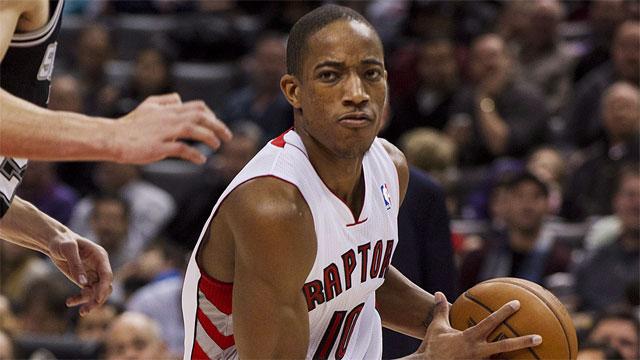
DeMar DeRozan spoke with media on Monday afternoon before the team departed to Houston where they will face the Rockets Tuesday evening.
“We are not a 3-11 team at all,” he said. “Period. I don’t just say that. That’s our record, but it does not define us. That’s not what we are. We lost a good nine games that we should have won. That’s the difference right there. Turn things around and things start rolling for us, we’ll be fine. I think we’ve got a little bad luck spell right now. Once we get over that, we’ll be fine.”
While the improvements and evolution in DeRozan’s game on the floor is obvious, there are other changes in the 23-year-old this season. He’s more talkative and more open to sharing his thoughts on what’s happening with the team. That’ll happen when the franchise has made it clear that you’re a big part of their future.
Toronto has long needed a vocal leader in the locker room. The addition of Kyle Lowry is a start, but in addition to providing a voice, it is mentorship that Lowry, a six-year veteran, is passing along to his younger teammates, DeRozan included.
“I’ve been growing a great relationship with Kyle as a person and as a teammate,” DeRozan said. “He’s a hell of a guy (on the court and off). He helps motivate me in a lot of ways on the court.”
DeRozan was talking about the game in Houston, marking Lowry’s first return to the team that traded him to the Raptors during the offseason. While Lowry has brushed off the significance of it and said he isn’t keeping up with the Rockets, his teammate spoke about his competitiveness.
“You know, one thing about Kyle, it doesn’t matter who he is playing, he’s going to go out there with the same mindset,” DeRozan said. “Go out there and win, run us, be a dog at the end of the day. I already know he’s going to show up.”
While Lowry’s impact is easy to see on the floor and his teammates have spoken about his leadership in the locker room, also occurring is the maturation process of players like DeRozan and Ed Davis. Lowry is no-nonsense; he approaches basketball very seriously. He’s smart with the media, calculated. He’s a pro at compartmentalizing and keeping his focus on the task at hand — all traits that will help a younger player looking to establish himself in this league while not getting caught up in the things that come along with it.
In Lowry the Raptors traded for a solid player, but they’ve also picked up an important piece of the puzzle that has the potential to seriously shape the makeup of their team. They picked up a veteran leader who has needed just eight games with his new Raptors teammates to show that they are willing to follow where he is going to attempt to lead them.
– On Monday, Dwane Casey elaborated on the decision to stick with Andrea Bargnani down the stretch on Sunday against the Spurs despite Bargnani’s 2-for-19 nightmare shooting performance.
“It should let him know he’s our leading scorer. He’s our go-to guy. He just had one of the best nights of his career the night before. In a one-possession game, you’re looking for a three-point shot. You need his body on the floor. His presence, for spacing, helped us. It did open up the lane. He’s our guy and I’ll go with him just like I would with DeMar or Kyle Lowry, some of our leading scorers. In a one-possession game, you do need scoring. I trust Andrea. It should mean that we believe in him and he’s our guy.”
Casey also pointed out that for all of the things Bargnani wasn’t able to do offensively (make a basket to save his life), he was contributing in other important ways.
“If he hadn’t had been defending Duncan the way he had … (He was our) best defender,” Casey said. “He had length on Duncan. It bothered him to a certain extent. JV is learning to guard that position. Duncan has too many tricks for a rookie. JV, it was a good experience for him when he was on him. But Andrea did an excellent job of using his length and not getting tricked in the post.”
It was a tough situation to be in, needing offence and not getting it from your best offensive player, but also needing defence and getting that from the same player who was struggling offensively. If there was a do-over, Ed Davis probably would have seen the floor in that second overtime, but Casey made his reasoning for the move clear and it’s hard to argue with the need to have a defender out there to try and slow Duncan down.
– One player who wasn’t at all surprised that Casey stuck with Bargnani and supported him after the off-shooting night was DeRozan.
“He always backs us up,” DeRozan said. “That’s one thing about coach, he doesn’t care if you go 1-for-25, he still backs you up. It’s part of the game at the same time. The night before, Andrea couldn’t miss. Sometimes you have nights like that. I had a bad night against Detroit shooting. It just happens sometimes. You’ve got to bounce back the next game.”
DeRozan said that Casey’s support helps the team not stress on the offensive end of the floor because they know as long as they’re taking good shots and trying their best to execute defensively they’re not going to get “yelled at or told off or nothing like that.”
Davis agreed with DeRozan about the importance of Casey supporting players on off-nights. He stressed that it makes a difference in the bigger picture.
“One of the best things in this league is to have people have confidence in you or have trust in you,” Davis said. “If you do struggle, you have the coach on your side. That’s just a great thing. There are a lot of guys in this league that can do a lot of things, but coaches don’t have that trust in him.”
For Casey, it’s clear that he recognizes the tough balance between reprimanding his players and encouraging them. With tough losses in close games adding up and wearing on the psyche, Casey has been mindful of how he instructs and teaches.
“There is nothing worse in sports than an amputated spirit,” Casey said. “The one thing I want to do is coach positively, yet still hold guys accountable. If you do see guys coming out of the game a little quicker than normal, they’re being held accountable.”