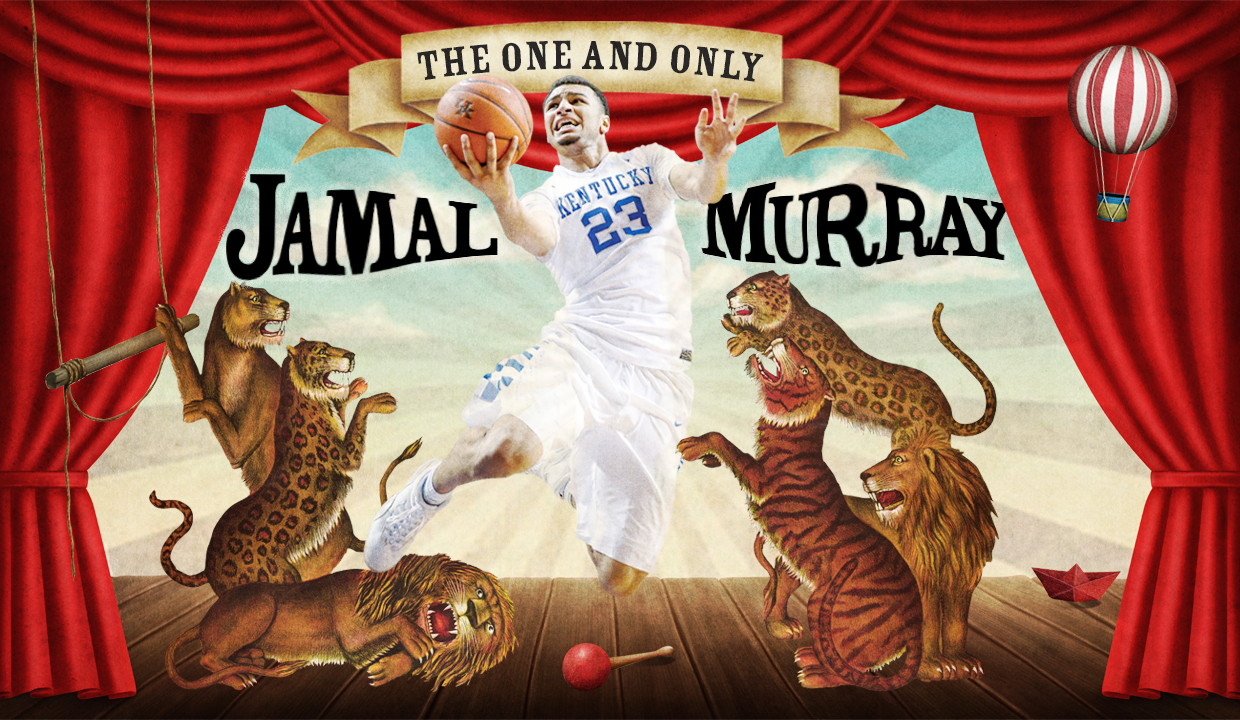

It was halftime during the semi-finals of the 2012 Jane and Finch Championship in Toronto and with his team trailing, CIA Bounce coach Dwayne Ramage knew he needed to make an adjustment.
“Have you ever played the point before?” he asked his newest player. “Uh, you know,” Jamal Murray began to answer, “some, but not really.” But Ramage had already made up his mind.
He’d only been coaching the 15 year-old shooting guard for one week but Ramage, like anyone who’d seen him play—a surprising small list given how prominent a figure he’d soon become in the world of amateur hoops— immediately recognized Murray’s scoring ability. But looking for some kind of spark, the coach told the kid he’d start at point guard to begin the second half. “I started running some Xs and Os with him,” recalls Ramage, “and I was astounded.”
Murray picked it up instantly—reading-and-reacting like a seasoned vet, coming off of screens and finding teammates in transition or surveying the defense to find open lanes to the basket. Behind his performance, CIA Bounce stormed back and won the game, Murray hitting virtually every shot he took.
“They were shots that I don’t necessarily like to see as a coach,” says Ramage, “but because he’s so comfortable in how he scores, he made it look easy.” Besides, it’s hard to argue with results. CIA Bounce won the game, and the tournament. Showcasing the scoring acumen that college fans and pro scouts would come to know, and the playmaking ability they’re still waiting to see consistently, Murray took home MVP honours.
“A lot of people were wondering who I was because I wasn’t from the area,” says Murray, a native of Kitchener, ON. “But coach [Ramage] saw that I could play. He didn’t know my game at first. But he got to know it soon enough.”
In the years since so too has the rest of the basketball world.
His standout performances at the past two Nike Hoops Summit’s (MVP in 2015) put him firmly on the radar of scouts and NCAA recruiters, while his Pan-Am heroics last summer had the same effect for basketball fans across Canada. This season Murray broke Kentucky’s freshman scoring record, ending the season by scoring at least 20 points in 12 of the Wildcats’ last 13 games en route to the SEC championship. As March Madness tips-off Thursday Murray has become one of the biggest names in the tourney. And one that scouts at the next level are still struggling to get a read on.
Which, to be fair, isn’t easy. As Ramage learned four years ago, Murray’s game is unorthodox. His shot selection is unique—a series of floaters, acrobatic drives, and off-balance jumpers— and wholly unpredictable. He’s like the lead guitarist on stage in a jam band, off on an extended solo, improvising until he finds the perfect pitch. Hell, his own teammates hardly know what he’s about to do. “He makes a lot of plays where, as it’s developing, you don’t really know where he’s going with it,” says Kentucky senior (and Windsor, ON native) Mychal Mulder, “but it seems to always work out.”
If it’s hard to find a comparable player—a device scouts often use to project a player’s pro potential—just know that it’s not an accident.
“Everybody’s copying somebody else now,” says Murray, after a recent Kentucky practice. “Nobody has their own style. Growing up I always wanted to create my own.”

As the season progressed at Kentucky, the program and its fans learned to embrace Murray’s quest to be different (again: you don’t argue with results), even though head coach John Calipari remains hesitant. “We’ve got that kid Jamal Murray, but he shoots too much,” he said after the Wildcats clinched the SEC title, mostly in jest as Murray lingered nearby. “I’m trying to get him to stop shooting, but he shoots it anyway.”
Early in the season, it wasn’t just the volume of shots that Coach Cal took umbrage with. “He’ll take a shot,” teammate Mulder explains, “and Coach will say ‘Jamal, was that a good shot?’ And Jamal will say ‘…Yeah’“
“’Jamal, you threw it up over your head with your left hand! Was that a good shot?’” And Jamal will be like, ‘…And I made it.’ It’s so funny to watch.”
In some of their first practices together, Calipari and Murray would go through this routine like seasoned Vaudevillians. As the coach would yell and throw his hands up in dismay following an off-balanced jumper or a pull-up floater from the free-throw line, Murray would often have the same response: “Coach, that’s my shot—you’ve barely seen me play before!”
Murray wasn’t wrong. Kentucky was late to the recruiting process, only getting involved in the second half of the recruiting calendar, eventually edging out Oregon as Murray’s top choice.
Like everyone, the Kentucky coaches were impressed by the guard’s scoring prowess in high school (Murray attended Orangville, ON’s Athlete Institute) and were floored by his competiveness.
It’s something that immediately stood out to Dwayne Ramage the first time he saw Murray play, during a CIA Bounce AAU tryout at Humber college one week before the Jane and Finch tournament.
“When I first got the call from a colleague about this kid from Kitchener coming by [the tryout], I took it with a grain of salt,” says Ramage. Murray was relatively unknown, but it didn’t exactly take long to make an impression during the first scrimmage.

Ramage tells the story: “So he arrives, suits up, steps on the floor, and right away he and Jalen Poyser (future AI teammate and a freshman star at UNLV this season) started going after one another. And this was early—the first couple of trips up the floor. Some of the other players started making jokes about Poyser, that this new kid was coming in here trying to put work on him. Jamal would come down the floor, get by him for a layup. Next trip up he pulls up and hits a jumper. And it kept going like that. All the hype, the talk, did was fuel Jamal even more. He really got off on the fact that he was playing so hard against this guy and that obviously it had garnered attention from it. It got to the point where the run sort of stopped, the other four guys on each team just started jogging and watching these two go at it. I got back on the phone and dialed up my colleague: ‘Dude, you need to get down to the gym and watch what’s happening. This guy has serious potential. And I don’t mean high-major, I mean potential pro.’”
Murray recalls the scrimmage vividly, but maintains he wasn’t trying to make an impression. “It was the same then as it is now,” he says, “I’m trying to focus on my game instead of who’s watching me.”
“I think how his dad raised him,” Ramage says. “He raised him to have that mental preparation and not have to worry so much about making an impression.”
Though he never played competitive ball himself, Murray’s father is a long-time martial arts practitioner who is heavily involved in his sons burgeoning career. He taught Jamal meditations and breathing exercises that he still practices before games and practices. “The discipline, the mental toughness required to train for martial arts,” says Ramage, “definitely played an integral part in Jamal’s development.”
Needless to say, it wasn’t exactly a common sight for a 15 year-old to be off in his own world, meditating pre-game. Murray also didn’t study tapes of other players like most of his teammates did.
“Like I said, I’ve always wanted to create my own style,” he reiterates. “That’s why I have certain things- my stock rolled down a certain way, the T-shirt under my jersey…My motto is ‘Be More’- that’s MY thing, this is the way I’m creating my brand.”
Read that last sentence and the next chapter in Murray’s story is crystal clear. With each passing week he seems to vault higher and higher up NBA draft boards, and a strong showing at the tournament could see him drafted in the top three by June.
Detractors will say that, at 6’4’’ and barely 200 pounds, he doesn’t have the size to be a shooting guard at the next level, and that he hasn’t demonstrated he has an ability to run an offense as a point guard. A lot of that has to do with the Kentucky roster—backcourt mate Tyler Ulis has manned the position all season.
Eyeing a trip to the Final Four, with Kentucky’s first game tipping off Thursday night, Murray isn’t ready to think about what comes after the tournament.
“I’m not paying attention to what’s next,” he says. “I need to focus on what’s going on right now.”