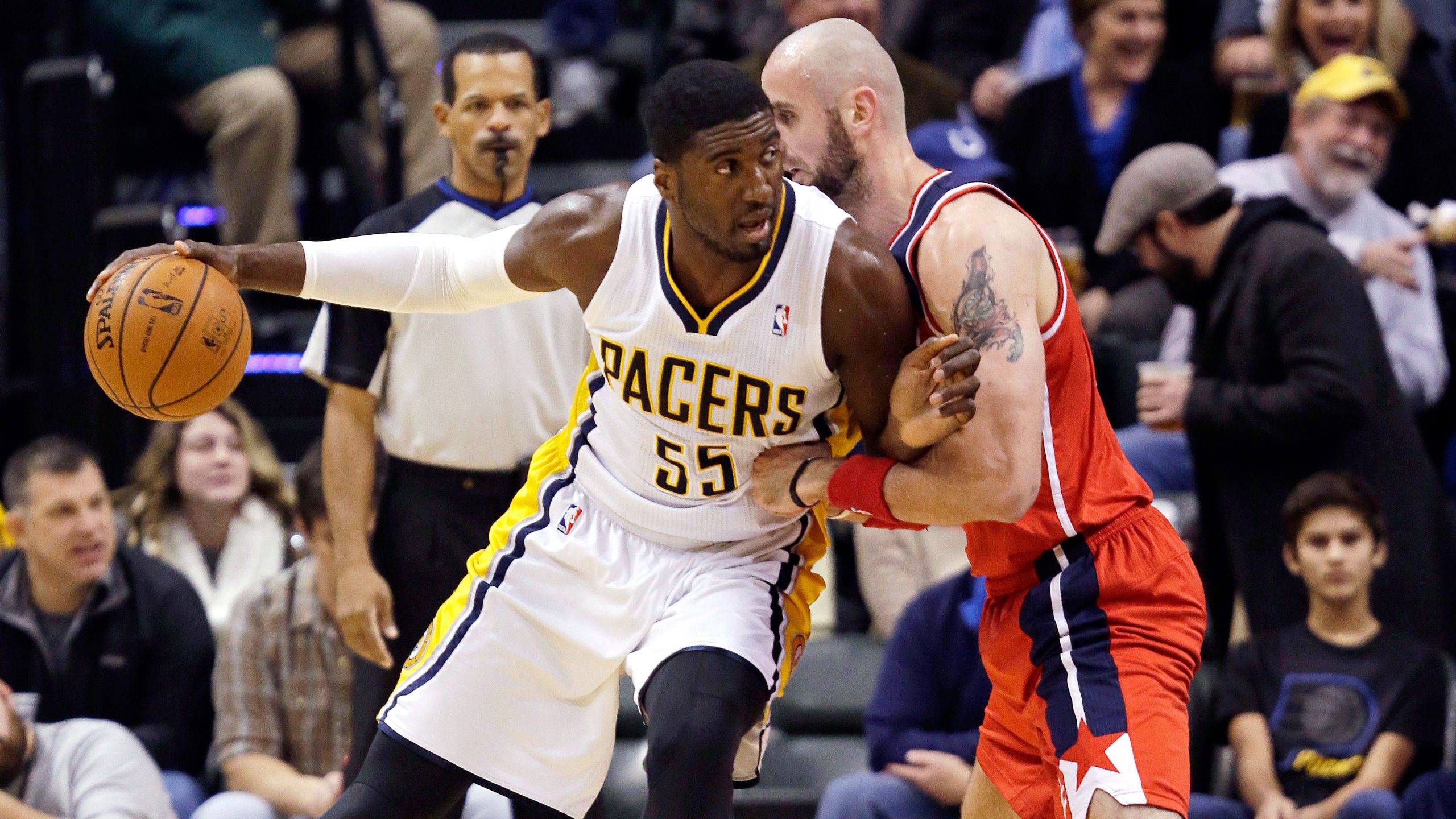

Roy Hibbert finally played like an all star last night, dropping 28 points on 10-for-13 shooting and collecting nine rebounds in the Pacers’ 86-82 Game 2 win. His 17 first-half points were more than the 13 he’d totalled across Indiana’s four previous games and, most importantly, because he was rolling, Indiana was able to slow down the Washington Wizards.
With Hibbert in the groove, a lot of the Pacers’ offensive possessions were spent feeding the big man down low, spreading out in case a double-team came and watching the beast chew up Washington’s interior defence. The Wizards couldn’t up the tempo of the game (the way they did in Game 1) because Hibbert generally shot with about five seconds left on the shot clock and, vitally, was actually scoring. That prevented the Wizards from grabbing rebounds and leaking out, and forced them into a half-court style that’s still a work in progress.
Hibbert is the catalyst when the Pacers are successful precisely because he allows them to slow things down. When that happens, Indy’s defence is able to get fully set and has the capability to shut down almost any offensive option other teams throw its way.
The Wizards’ lack of offensive discipline
As large a factor as Hibbert was, the Wizards still had their chances. But they ended up squandering them due to poor decision making on the offensive end.
John Wall struggled mightily in the contest, going 2-of-13 for just six points, and ended up forcing a number of shots—particularly down the stretch.
Most notably, with 2:25 left to play and the Wizards down three, Washington big man Marcin Gortat fought to tip out an offensive rebound only to have Wall immediately chuck up an awful three-pointer that didn’t even catch rim. Wall was also stripped by George Hill attempting a pull-up jumper with about 45 seconds left to play.
Those two shots are just a small sample of the head-scratching offensive decisions Washington made throughout the game. The Wizards looked out of control and didn’t play with any of the poise they showed in Game 1 and all through their first-round series with the Chicago Bulls.
The pace of the game may not have been to their liking, but they were still in it. They also had the pick-and-pop with Nene and pick-and-roll with Gortat working. Why go away from these actions in favour of half-baked hero ball?
OKC gets physical with Griffin
The Oklahoma City Thunder’s electric tandem of Kevin Durant and Russell Westbrook rightfully stole the headlines in their big Game 2 win over the Los Angeles Clippers, but another big factor played into the victory.
Blake Griffin came away with just 15 points on 5-for-13 shooting and never got any sort of rhythm going thanks to the physical punishment dished out by the likes of Kendrick Perkins and Steven Adams.
Griffin put up a lot of mid-range shots because Perkins did an exceptional job of bodying up and muscling him out of the painted area. Adams, meanwhile, simply wouldn’t let Griffin do anything in the air and seemed to be out there with the express purpose of chopping the Clippers’ star down.
On a number of occasions, Adams came down hard on Griffin but did it in such a smart way he avoided getting called for a flagrant. Most notably, midway through the fourth quarter, with the Thunder up 14, Griffin pump-faked Adams out of his shoes. Instead of allowing Griffin to fly by, though, the big New Zealand native dropped his left elbow on the back of Griffin’s neck, but was only called for a technical because he successfully hid his intentions.
Griffin takes contact better than he ever did before, but the strategy of getting physical with him can still force him out of rhythm and the Thunder’s bigs proved that.