
MISSISSAUGA, Ont. — Jesse Mermuys is a sunshine-and-rainbows type of guy. His brand of upbeat, can-do energy made him an ideal skill development coach over the past two years with the Toronto Raptors and a good choice to be the first head coach for the team’s fledgling NBA Development League team.
At five-foot-eight, he looks up to every player on his Raptors 905 roster, but he can fill a room with his enthusiasm, which works well when trying to get guys who rarely play to work on their games or — in the case of the D-League — guys who are on the outer fringes of the NBA to believe their dream is at hand.
But in the moments leading up to the 905’s home opener at the Hershey Centre, Mermuys looked more stressed than his norm.
It’s like the challenge he’s taken on has hit him all of a sudden.
"There are a lot of moving parts down here, which is kind of what is great about the job and why it’s attractive because you’re getting an intense training," he said. "There are a lot of challenges and I’ve decided to embrace them with a positive attitude and really celebrate the challenges and why that should make me a great coach after I complete this mission."
Right, the mission.
Normally the measure of coaching success is pretty straightforward: the more you win, the better you have coached.
But in the D-League, and in particular with the 905, winning is — in theory — at best a secondary goal.
The primary one is where the league gets its name: develop players to play in the NBA.
But that’s where things can get complicated. Take the case of Raptors’ long-term project Bruno Caboclo, the 20-year-old Brazilian taken 20th overall in the 2014 draft.
If it’s possible for a D-League team to have a franchise player, Caboclo is it. The Raptors had been kicking around the idea of acquiring their own D-League team for years, but when Raptors general manager Masai Ujiri drafted Caboclo — a player long on potential but woefully short on competitive experience — and had him languish on the Raptors bench last season, getting a team up and running for this season became an urgent priority.
The challenge is being a franchise player in the D-League is not like being one in the NBA. In fact, the fastest way to not be one of the 170 players with D-League experience who were in the NBA last season would be to try and play like the second-coming of Kevin Durant.
As Maine Red Claws head coach Scott Morrison — the former CIS head coach from Prince Edward Island is one of the small handful of Canadians making their mark as coaches in professional basketball, at any level — put it:
"For our guys, the first message I try to tell them if they’re anywhere close to being considered by NBA people is that the NBA is not looking for the next Kobe or the next James Harden in the D-League," said Morrison, who is in his second year with Maine, a Boston Celtics affiliate. "They’re looking for guys that can fill the end of the bench, play a small role, be good energy guys, be good team guys, maybe hit an open shot and space the floor, play some defence, little things like that. For me, if I can convince the guys that’s how they’re gonna best get scouted to the NBA or given a chance in the NBA, that also works out well for our team, because that’s what it takes to win games."
Which brings us back to the challenges facing Mermuys in getting a talent like Caboclo NBA ready.
For Caboclo, after spending nearly two years training but almost never playing, this is a chance to finally use all those skills he’s been honing so tirelessly: the deep three-point range; the dribble drives. It’s go time.
"It’s very fun. I’m getting a lot minutes. The team is very good, very talented. Coach Jesse is really cool," said Caboclo. "It’s a long time, I don’t play games. I need games to show what I can do."
For example, in his first two games this season, road contests against the Fort Wayne Mad Ants, Caboclo took 34 shots, 17 of them threes. There might be a week in which Caboclo takes 34 shots as Raptor, but it likely won’t be until 2019 at the earliest.
If Caboclo is going to make it to the big team sooner than that, it’s going to be in a fairly specific role as a defensive disrupter, lane runner and spot-up three-point shooter. The Raptors already have a guy name DeMar DeRozan playing the role of DeMar DeRozan.
"He’s not taking those shots with the Raptors so as a coach how can you get him better to where he feels the experience of taking those shots, having success and failures, learning from those and kind of staying in his lane where he would be if it got real if coach Casey had to sub him in?" says Mermuys.
How do you get a kid to reach his potential without limiting his role as he develops?
It’s tricky stuff, which explains in part Mermuys’ stress.
"I don’t want to be constantly subbing those guys out and constantly teaching lessons and pounding things into them when they really do need to play a ton of minutes," he says. "You have to have a little patience with these guys, let them play and coach them through some of their mistakes."
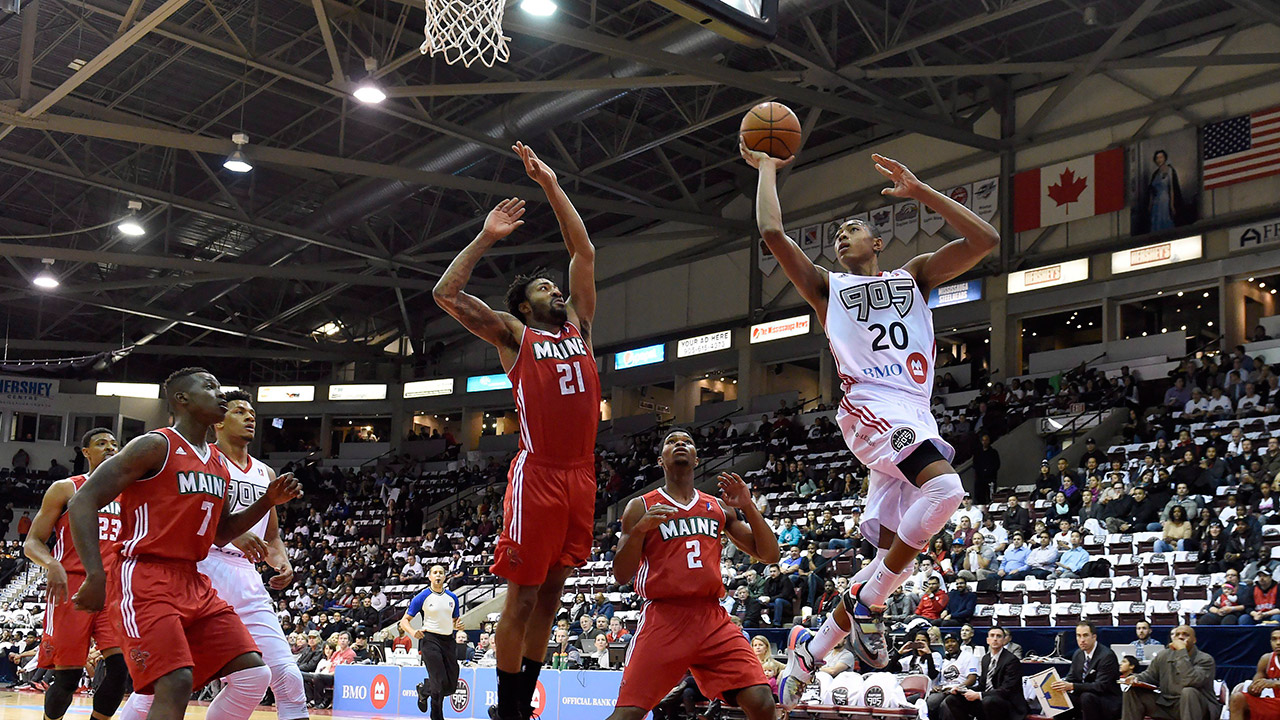
Caboclo didn’t waste much time flashing his potential against Maine on Thursday night. In his first six minutes he hit a textbook corner three, a slick pull-up two off the dribble, as well as missing a three in transition that Steph Curry might not have thought a good shot and dribbled off his leg and out of bounds.
Hey, if your franchise is going to buy a team for you to play on, why waste a minute, right?
"When I get more comfortable on the court, I won’t be afraid to do a lot of things," Caboclo said before the game.
Based on his willingness to shoot a split second after most of his catches, he’s already pretty comfortable. Maybe a bit too comfortable.
He was more in rhythm as the game went on, chipping in a baseline runner and a nice turn-around in the lane in the second half. He looked professional using a screen by fellow Raptor Lucas Nogueira to get open for a long three in the fourth quarter as the 905 were making a run, even if it didn’t drop.
"He’s a good kid and he’s got great heart and he’s a competitor and he wants to win," says Mermuys. "But his shot selection isn’t always the best. He’s a long ways from knowing a good shot from a bad shot and how to feel the difference."
That will be a work in progress as Caboclo and Mermuys work together to find the right balance between playing with the ball in ways that are roughly transferrable to his most likely near-term role with the Raptors, while allowing him to push his own limits of what kind of player he can be.
But that’s on offence. On Defence? That might be how Caboclo finds his way into the NBA sooner than later. Mermuys spoke glowingly of the way the six-foot-eight Brazilian was beginning to grasp how to be sound off the ball so his physical gifts can best be used to disrupt opponents.
Caboclo, in the end, looked both good and bad offensively in the opener won 109-105 by Maine. He finished with nine points 11 shots, connecting on just one-of-seven three pointers.
But he made some eye-popping plays defensively; sliding from the foul line to cut off a baseline drive; reaching across the lane to challenge an otherwise sure lay-up. Time after time, Maine players missed otherwise open shots after Caboclo’s length got up on them faster than they expected.
"Defensively he’s doing some things that are NBA-like, positionally," said Mermuys. "Recognizing where he needs to be when the ball is in certain locations and that’s huge for us because that’s when we say: ‘Man, Bruno is starting to get it.’"
Which in the context of the D-League, is all you can hope for in a franchise player.