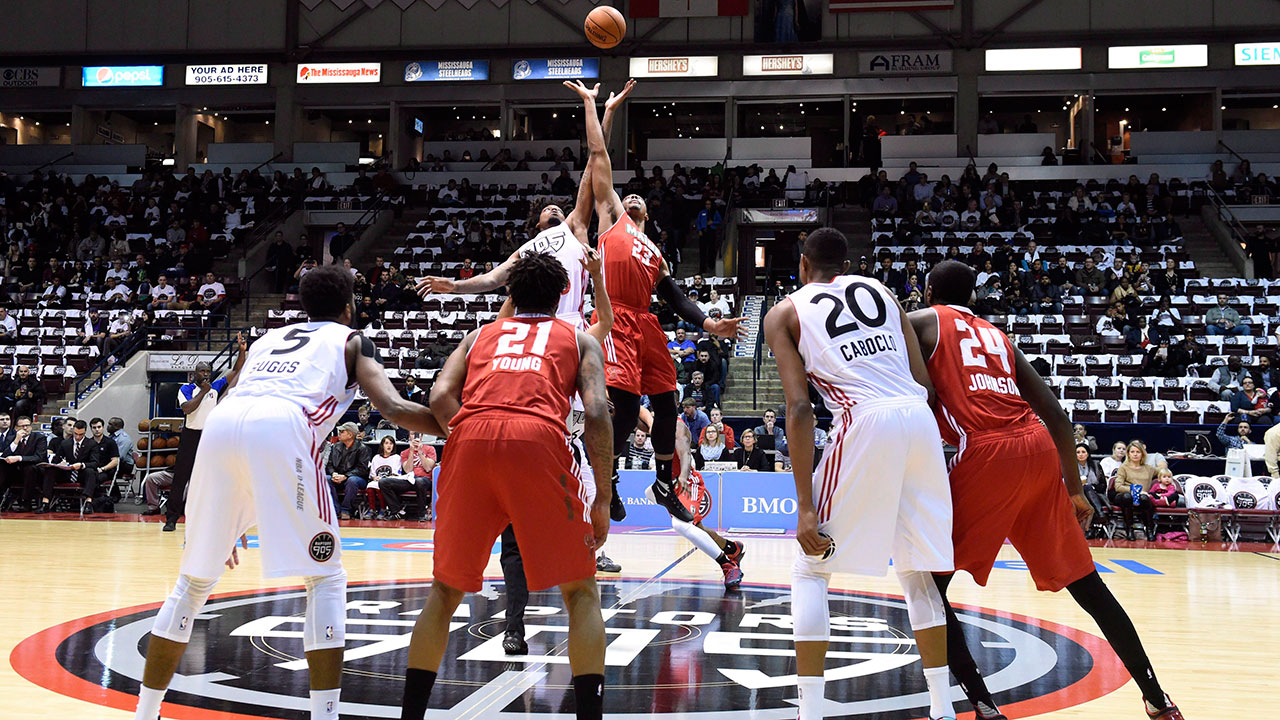

The inaugural Raptors 905 season was a tale of two halves.
Through the first 23 games of the franchise’s first year in the NBA’s D-League, 905 was like any other expansion team, going 5-18 and scraping the bottom of the standings.
Then, as if by magic, they suddenly turned it around, winning six straight, jumpstarting what would end up becoming an 18-9 stretch through their last 27 games for a total record of 23-27 and a sixth-place finish in the Eastern Conference.
Except, it wasn’t some magic trick. It was the result of having clear goals and a strong group—from upper management to the last player on the bench—operating on the same page. Here are some final thoughts on the 905’s first-ever season.
How they turned their season around

(Frank Gunn/CP)
Despite how bad the first stretch of their season went, the 905 actually weren’t that bad from the onset. Of those first 18 losses, six of them came by four points or less. So they were competitive, but just didn’t know how to close.
“Even in training camp I felt like we had a good team,” 905 second-leading scorer Scott Suggs said at locker clear out day last week. “We were just so young and kind of inexperienced playing together. So I think we all felt like we were able to get it done because we were in a lot of games at the beginning of the year that we just lost by one, two, three points. We just needed to get over that hump and we eventually did.”
That vibe Suggs talked about from training camp is likely a result of an expansion franchise that, thanks to the heavy influence from the team’s parent club Toronto Raptors, from the very outset had a lot of unity and stability that most new teams don’t have the luxury of.
“In the beginning I wasn’t sure what to expect,” Suggs said, “but they work really closely with the Raptors and work really well with them.”
This strong organizational steadiness also probably helped smooth out the feeling-out process at the beginning and willingness from all parties involved to adapt on the fly as the season was going along.
“There’s just a huge learning curve, and a huge growth process,” head coach Jesse Mermuys said, “In the beginning of the season I was trying to coach it like it was the NBA, and that didn’t work. These guys needed more help and I probably, to adjust to that, went overboard and maybe gave too much help. But as the season went along and we all got comfortable and I kind of found a sweet spot.”
All this building eventually culminated into a team that finished five games out of a playoff spot, and an 8-2 record in their last 10 games. It’s fair to say that had the regular season kept going there’s a good chance the 905 could’ve seen some post-season play.
Not bad at all for a franchise that wasn’t supposed to do anything in its first year.
Bruno’s late-season surge

(Frank Gunn/CP)
As the 905 ascended this season, so did Raptors 2014 first-rounder Bruno Caboclo.
For the season, the 6-foot-9 Brazilian averaged 14.7 points per game on 40.3 per cent shooting, but from the beginning of that 18-9 stretch he put up 15.7 points per on an improved 43.9 per cent from the field, that included a fabulous final month of March where he averaged 18.4 points on 44.7 per cent, and saw him come up with 27-, 29- and 31-point performances.
Coming into the season, the 905 was mostly viewed as a Caboclo development house, and if you still adhere to that train of thought, those stats are definite proof that some improvement has been made.
Looking deeper, Caboclo’s shot selection also vastly improved from the beginning of the season to the end, something that’s been chalked up to the 20-year-old maturing over the course of the year.
“I remember at the beginning of the season his frustration and you could tell he was visibly upset during the game,” Mermuys said. “And then I remember— it was definitely in the second half of the season— I got upset after he took two bad shots in a row, we sat him down and I looked over and he was sitting there like a pro. There was no emotion, there was no frustration. He looked like a guy who was just engaged in the game, waiting for his turn to go back in. And that was a huge moment for us to see that growth, that maturity to see that he was able to take that criticism. …
“That mental part of the game is extremely important in the NBA because this is a hard, hard league and there’s going to be tons of ups and downs. And if you have the fortitude to handle it, it’s really important. And that maturity off the court was almost as important as on the court.”
So while Caboclo is certainly still very raw, this season was a step in the right direction for him. Whether or not that translates into him turning into a real, polished NBA product in the near future, however, is still very difficult to say.
How the D-League helped Powell figure things out

(Chris Young/CP)
Norman Powell’s stepped in as a key contributor in DeMarre Carroll’s absence for the Raptors in his rookie season despite being a second-round pick and he owes a lot of the success he’s had to his time down in the D-League.
Powell averaged 24.9 points per game on 50 per cent shooting in eight games played with the 905 and while with the Mississauga club he worked on that reliable shot that’s become so familiar to Raptors fans over the last little bit and how to properly play NBA defence.
“I thought he learned how to be aggressive, but not be tunnel-vision, a one-trick pony guy, and that, I think, has really carried over to the big club,” Mermuys said of Powell. “You can see the more minutes that he got up there he’s just starting to figure it out. That he can be aggressive, but also still make the right play and make easy plays, and he wasn’t able to do that when we got him.”
Powell was probably the greatest example of the young Raptors who came down to work on their games making the best use of the opportunity given to him with the 905, but that isn’t to say that the likes of Delon Wright and Lucas Nogueira’s time down at Hershey Centre was a waste as the freedom provided to them certainly helped them become better players from the start of the year.
“In the D-League there are no veteran guys. It’s just a bunch of young guys figuring it out,” Mermuys said. “So you’re experimenting, you’re failing, you’re figuring it out and then you go up there and get some of that mentorship, and it really puts it all together.”
Giant step for Sim

(Chris So/Getty Images)
One of the (pun fully intended) biggest stories coming into the season was the 905’s acquisition of 7-foot-5 Brampton, Ont., native Sim Bhullar.
Fighting through an early-season conditioning stint that wasn’t seeing him travel with the team on the road, when he was deemed good to go Bhullar played well, coming up with 10 double-doubles on the year.
The 23-year-old says the chance to play so close to home was a major contributing factor to the success he enjoyed.
“It was huge for me to have my family come out to pretty much every game and to be able to go home and to just be able to have a stable home out here,” Bhullar said. “Most of the coaches I knew from before and it felt good to have them around and a couple of the guys on the team I knew from college and growing up in camps and AAU, so it was a really comfortable feeling when I first got here and I definitely grew a lot of friendships out here. It was great for me having it in my backyard, and having the support that I had was huge for me.”