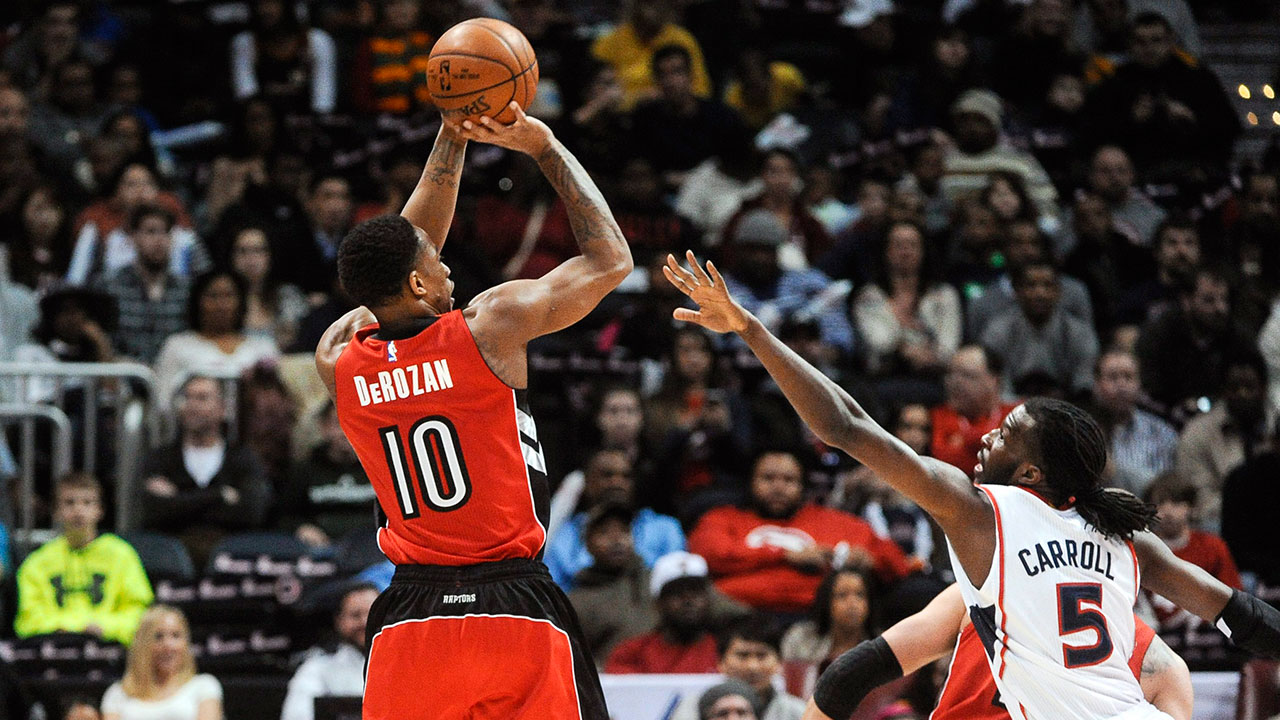

Back-to-back losses to Houston and New Orleans only highlight the fact that the Toronto Raptors are far from a finished product. But at a time in which the Eastern Conference is ripe for the taking, the team must still walk the fine line of trying to win now without mortgaging the future—a challenge faced on a daily basis by both the head coach and the general manager.
Dwane Casey must develop young talent and win at the same time. That combination rarely succeeds, but for Toronto, it has thus far. Look to Jonas Valanciunas’s rebounding and post game and Patrick Patterson’s defence and versatility as prime examples. Those two are not without flaws, but Casey has done more good than bad in keeping the Raptors on a progressive path.
Masai Ujiri must weigh what he has against what his team still needs. He has to assess who should stay and who should go, and evaluate the impact that any potential move could have on the one thing that his team has truly become known for: chemistry. The former Executive of the Year already tipped his hand in some senses—refusing to throw the future away for a quick-fix on trade deadline day last week—but Ujiri will strike when ready.
“Your make up has to start with patience [and] it has to start with an eye to identify talent and put it together, like a puzzle,” said former Raptors guard, Alvin Williams.
Eighteen months ago Toronto was on the brink of a rebuild. One trade turned that around. And since the deal that made Rudy Gay a Sacramento King, the franchise has won a division title and is well on its way to a second straight. Yet the Raptors lack overall size and strength, and the facet of the game that was once their trademark, hard-nosed defence, is now wildly inconsistent.
But Williams believes this is part of the puzzle-building process. A team can’t be expected to jump from years outside the post-season picture to the conference finals or NBA championships in less than two years. Hence, the Chicken Little mentality that exists among many critics—those that rise and fall to the ultimate depths with every Toronto win or loss—is off-base.
“Winning is a process,” said Williams. “If you’re not willing to go through the long haul with the process and reap the benefits of winning, then it’s never going to happen.”
Williams was one of the biggest advocates of the Raptors not making a move last week.
“I loved it,” he said. “You see teams throughout the league—change over change, whether it’s management, whether it’s coaching, whether it’s players—those teams are going to have a hard time trying to win.”
And that was Toronto for years. Williams experienced it at times.
The organization has (generally) stuck with its coaches and management teams for long stretches. But roster turnover has been the club’s Achilles heel. On one hand, if a core of players isn’t good enough you want change; you need it. But the other side of the argument says constant change doesn’t allow a team to grow together and develop a synergy on the floor—a connection like the one Toronto has right now.
“You look at the success of Toronto and their success has been their team, the make up of the team,” said Williams. “Whether it’s the bench, whether it’s the starters or the coaching staff—that whole camaraderie is why they’re so good right now.”
A blowout win over Atlanta on Friday night made that statement sound strong. A blowout loss to Houston on Saturday and last night’s fritter-job in New Orleans poked holes in it.
Big picture, the Raptors are the best team in the Atlantic and among the top five teams in the East. They’re good but certainly not great.
“[Ujiri] showed a commitment to what he’s building and I think that’s the process of winning. I’m happy that [Toronto] didn’t make any trades or make any moves,” said Williams. “It’s a great thing for young [players] to see: You’re only as good as the success of your team.”