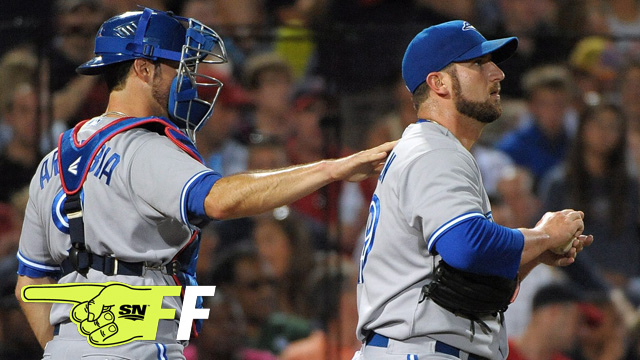

In this week’s edition of Blue Jays Central: Ask the Insiders, the Insiders answered several fan questions including what the Blue Jays need to do to avoid another cross up on signs between J.P. Arencibia and his pitchers plus what they think of George Brett becoming the Kansas City Royals hitting coach.
John asks: The other night Arencibia and Lincoln got crossed up on pitching signs. I agree with Buck that it’s unacceptable, but now what do they do? Whose responsibility is it? Seems to me like it isn’t the first time this season.
Jack Morris: J.P. has had more cross ups than any catcher I’ve ever seen in the big leagues. Make of that what you will. The coaches just need to keep reminding him.
Gregg Zaun: John, cross ups happen. They really shouldn’t when you only flash three signs. The responsibility lies with the guilty party. Only they know who it was. In my unbiased opinion, LOL, it tends to be the pitchers that forget the signs. Buck is right though. Shouldn’t be happening this deep into the season and definitely not with such simple signs.
Dirk Hayhurst: Buck is right, at least from the ideological perspective that Major League players should know the signs and what they mean. But, major leaguers still make mistakes. There are numerous areas where players shouldn’t have brain farts because, “they are in the Majors, and Major Leaguers shouldn’t do that.” They shouldn’t but stupid stuff still happens in this sport every night, at all its levels.
The best thing JPA and Lincoln can do from here on is learn and move on. Think about how many pitches are thrown that are not crossed up. It’s futile to pick out the one or two times it happens and fan it into something more that it is — a mental mistake.
Shi Davidi: The primary responsibility is on the catcher since he is the one putting down the signs and decides on the sequence. He must make sure the pitcher is on the same page. At the same time, the pitcher better be sure he’s straight on the signs, too. There have been some other such incidents this season, perhaps as a by-product of all the different pitchers that have been used to his point. Still, that’s no excuse and is something the Blue Jays must clean up.
 Have your say: Have an opinion on the news of the day? Better yet, want to become a Fan Fuel blogger? Email us here. | Read more Fan Fuel blogs here
Chris asks: I’m curious to hear what you guys think about George Brett joining the Royals as their interim hitting coach?
Pat Tabler: George Brett is going to do a great job with those young KC Royals hitters. Even though George was a great hitter, he had to work very hard to become the Hall of Famer that he is. Hours spent with Charlie Lau, his hitting coach in KC at the time, turned him into the best that they have ever seen. George has said that he is going to take those lessons and apply them to these hitters. If you can’t listen to a Hall of Famer then you have no chance of succeeding. You wait and see. Watch their batting averages go up!
Gregg Zaun: Chris, I’ve known George since 2001. He, unlike other great hitters, is a great instructor and has a tremendous understanding of the swing. There are many great ex-hitters who simply don’t understand why their pupils can’t do what they could do. George is not one of them.
Have your say: Have an opinion on the news of the day? Better yet, want to become a Fan Fuel blogger? Email us here. | Read more Fan Fuel blogs here
David asks: How effective are these closed door meetings that teams hold? For those that played baseball, did you find they helped at all?
Jack Morris: I think they can help. It’s all about timing and it’s all about how the players respond. I never called a closed door meeting, none of the players did. When you had managers like Sparky Anderson, Tom Kelly and Cito Gaston they knew when to call them.
Gregg Zaun: David, closed door meetings are very effective for airing grievances or addressing behavior. They are less and less effective at motivating tougher more intense play. In my opinion, players today are more aware of themselves and it shows up in their playing styles. You can’t inspire the uninspired. Players at the highest levels should be self-motivated and selfless.
Dirk Hayhurst: Closed door meetings in baseball are a lot like a department wide meetings in any business: everyone is called together to talk about something that really only focuses on a certain chunk of the population. But doing it en masse doesn’t single anyone out, which is important to maintaining the concept of “team.”
When Mark DeRosa held his closed door meeting to address the negative atmosphere he felt was creeping over the team thanks to a rough April, there weren’t a lot of players anxious to jump up on the soapbox behind him. That didn’t make what he had to say wrong, it just meant that it wasn’t a major issue that warranted a full night’s worth of discourse. He made his point, it was affirmed, and that was that. No personal interventions needed.
And really, the team is what the meetings are about. You have closed door meetings to make sure a small perceived issue doesn’t spread and become a much bigger one, destroying the team in the process. And outsiders aren’t welcome because their views and comments are not valid since they aren’t a part of the team organism.
Shi Davidi: It depends. The St. Louis Cardinals held one in August 2011 when they appeared finished in the standings, chased down the collapsing Atlanta Braves for the wild card and eventually won the World Series. For other clubs, it’s just an event that doesn’t alter the course of a long season. So ultimately, it depends on how the players react to things afterwards.
Ken asks: For those that played in the majors, how has the clubhouse food/catering changed since you were a player?
Pat Tabler: The clubhouse “spread” has really changed from when we played. Gone are the baloney sandwiches and potato chips that were served at the beginning of my career and replaced with healthy alternatives. The players have choices and lots of them. The downside is clubhouse dues are way more expensive now. Somebody has to pay for all that good food! For those that don’t know, clubhouse dues is money you pay to have all the services done. Wash uniforms, clean spikes, equipment problems and food. Back in the day I think they were $35 a day. Now they might be $90 per day. Inflation!!!
Tnorgren asks: During the first inning vs. the Braves the other night, Emilio Bonifacio was wearing a mitt of some sort when running the bases, what was that?
Pat Tabler: Emilio Bonifacio was wearing a pad on his hand while running the bases as protection so when he slides into the bag he doesn’t jam up or get his fingers stepped on. Rajai Davis started wearing this sliding pad last season and it really helped him after he got spiked in his fingers on a steal attempt. I think you will be seeing this a lot more from players who are base stealers and who slide head first.
Shi Davidi: Bonifacio had surgery on his left thumb last year and re-injured it later in the season. The mitt is designed to protect his hand while sliding.
Dirk Hayhurst: Rajai Davis also wears a mitt like that when he runs. We call it the oven mitt. It’s because they are really big fans of baking. There is a whole underground movement in baseball that revolves around who can make the best baked goods. Huge off season tournaments are held pitting teammates and opposing players against one another. Some players specialize in cakes, others in muffins, others in pastries. Players who can’t bake are often ridiculed as being lesser men than those who can. Just another one of those insider baseball things…
Actually, it’s a safety device. Not from heat, but from sliding in head first and getting your hands stepped on or caught on the bag.