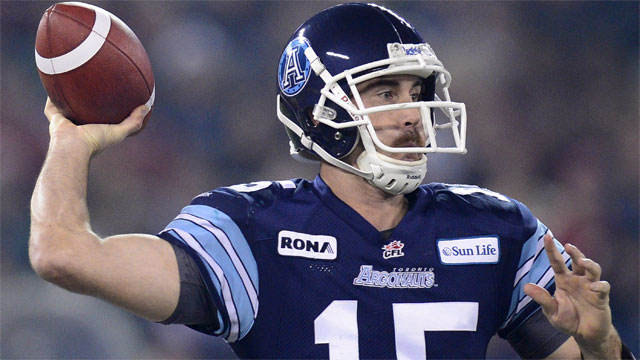

The Toronto Argonauts’ investment in Ricky Ray through the 2015 season looks great for optics, but time will tell whether the quarterback is in the same uniform by the time the contract expires or even longer, possibly for the balance of his career.
The Argos, who announced the extension on Friday, have a 33-year-old pivot who could conceivably play for another five to 10 years without having to worry about him jumping to the National Football League or any other league – if miraculously one surfaced and started to shell out huge deals like candy at Halloween. It’s really all about performance and protecting their asset.
The acquisition of Ray from Edmonton in December 2011 will go down as one of the most important in the franchise’s history – culminated in the Argos winning the Grey Cup at home in the 100th anniversary of the game.
This trade will be one Eskimo fans rue for some time – or at least until the franchise wins another Grey Cup or finds a dependable quarterback. With Ray, the Eskimos won two Cups, the last one in 2005, which is also the last time they won the Cup.
Toronto’s Grey Cup win last year ended a drought that goes back to 2004, the second year with quarterback Damon Allen, who had been acquired in a trade the year before. Previous to that, the Argos won the Cup in 1997, following up on a win the year before, their first with Doug Flutie, who quarterbacked the repeat. In 1991, they won the Grey Cup with quarterback Matt Dunigan, acquired the year before.
You can begin to see the pattern – and it goes back even further.
But the Argonauts have historically been an organization that doesn’t hold on to its good quarterbacks for a long period for one reason or another, certainly for more than five years. Allen played from 2003-07. The last one to have such lengthy service was Condredge Holloway, who played from 1981-86. Holloway won the Cup with Toronto in 1983, two years after the team acquired him from Ottawa in a trade.
The one with the longest consecutive period of service was the late Joe (King) Krol, who quarterbacked the team from 1945-52. He was acquired via free agency and led the Argos to five Cups.
Argos GM Jim Barker, who engineered the trade to bring Ray to Toronto and who was involved in the decision to extend his current deal sooner rather than later, knows that he has solidified the most important position on the team. Barker’s success and that of his team will only go as far as Ray is actively on the field and playing to the level that has made him one of the best of his era.
To suggest Ray could some day eclipse Montreal’s Anthony Calvillo as pro football’s all-time leading passer is not a stretch. Calvillo enters this season with more than 78,000 yards. Who knows how much longer he will play? He turns 41 in August.
Calvillo didn’t hit his peak until 2002 when he became a full-time starter with Montreal and has averaged in excess of 5,000 yards a season. In nine seasons as a starter, Ray has totaled 41,607 yards, averaging slightly more than 4,600 a season. The difference between the two is Calvillo has played for the most part in a pass-happy offence and in a division in which the Als have routinely been the best, while Ray has been featured in more balanced offences, many times with sub-par or underachieving teams.
And this is not to discount or disrespect Hamilton’s Henry Burris, whose career yardage is more than 5,000 ahead of Ray. He is also five years older. Burris’ body of work over the 10 years in which he has started has him averaging about 4,500 passing yards per season. Last year he tossed for a career-high 5,367 yards, so who knows how long Burris can keep playing and whether he can pull a Calvillo and continue stockpiling yards at a point in his career when his play should be declining?
Allen found a way to make plays well beyond physical nature intended, both passing the ball and running with it.
Going forward this season with the same head coach, Scott Milanovich, the Argos merely have to pick up from where they finished last season, essentially with the same offensive personnel. This is what makes teams successful from year to year – maintaining a consistency with the same coach, the same quarterback and generally the same players, or at least allowing for a seamless transition.
The best CFL teams have identified a quarterback and kept him under contract for a long period of time, or developed an understudy for that time when age, performance, retirement or some other circumstance leads to a change. The Eskimos have historically done that better than any other CFL franchise, which is why they have had so much success, employing one quarterback for a lengthy stretch while tutoring one or two for the eventual transition.
The B.C. Lions have done that as well, in particular under the direction of Wally Buono since his hiring from Calgary in 2003 as GM/head coach. During his time with the Stampeders as head coach from 1990-2002, Buono consistently developed quarterbacks, much like Edmonton.
Calvillo, signed as a free agent by Montreal in 1998 when he appeared to be a young player with little confidence after three frustrating seasons in Hamilton, apprenticed under Tracy Ham. Who could have ever predicted Calvillo would develop into the great player he became? But that’s a testament to identifying talent and developing it through a nurturing process of time and patience. It worked for the Als and Calvillo.
The Argos have routinely gone for the quick fix to get the instant reward and have usually done well, but they have also failed to keep their quarterbacks and the results have been predictable. So Friday was a good day for Toronto announcing the contract extension of Ray. Let’s revisit this in a few years and see if Ray is still an Argo or he has moved on to another team.