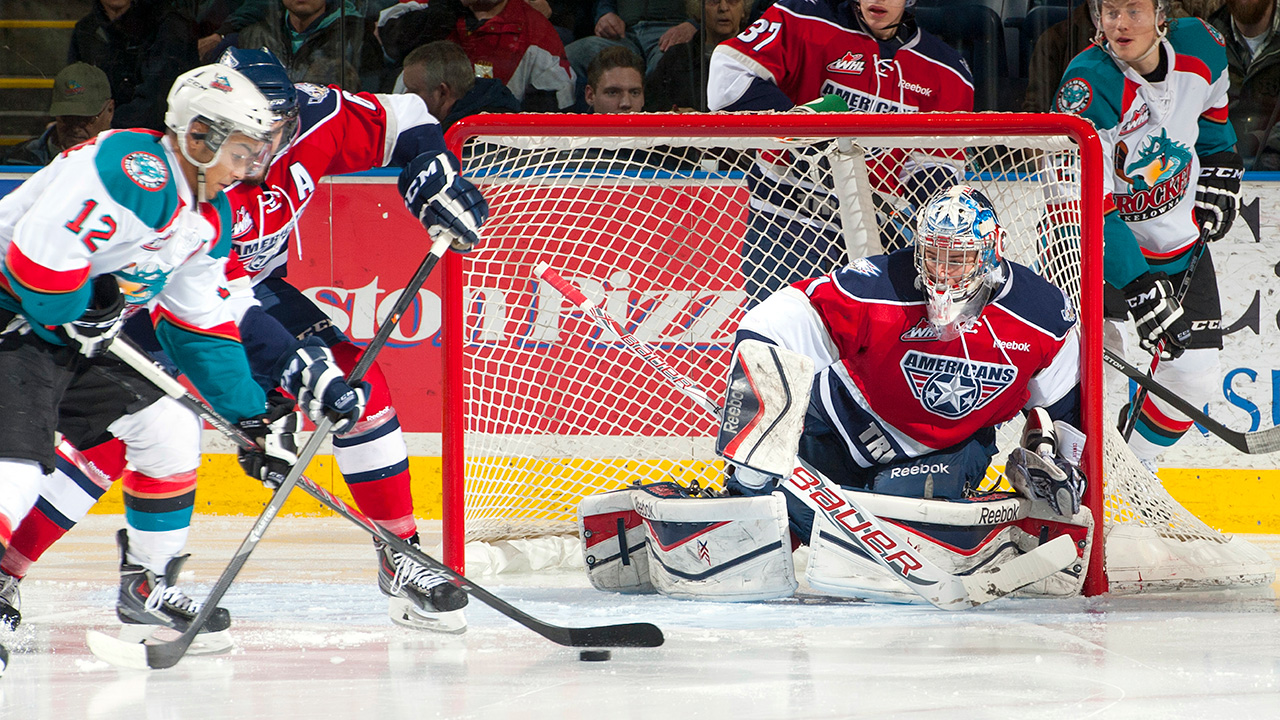

With a time out on the ice, Eric Comrie skated to the Tri-City Americans bench. While his teammates received instructions for the ensuing faceoff, Comrie dropped to one knee. He stared out at centre ice and leaned on his goalie stick. His team trailed by two goals to Seattle midway through the second period of an early December game, and the deficit would have been worse if not for his play. Falling behind further would put the game out of reach. He couldn’t let that happen. He focused, stayed in a zone, ready for more shots, more traffic in front of him. Ready for the pressure. Comrie would shut the door the rest of the way but his mates could not come back for him. Despite the loss, Comrie had kept his team in the game and as he does every night, gave them a chance to win.
As the World Junior Championship draws nearer, Comrie is preparing to face more pressure than he ever has before. He’s one of two goaltenders in Team Canada’s World Junior Championship camp—there may not be another position in sport that comes under as much scrutiny. Some players wilt under such circumstances; Comrie welcomes it. “That’s why you want to be a goalie,” he says. “You want the pressure. You want that extra little bit put on your shoulders.”
Comrie grew up with hockey playing a big role in his family. His two older brothers, Paul and Mike Comrie, both played in the NHL and his younger brother, Ty, is a teammate in Tri-City. His father, Bill, turned down a chance to play for the Chicago Blackhawks in 1969 in order to start a furniture business. That business turned into the Brick national chain. Eric was born in Edmonton but the family moved to California when he was nine. He spent his formative years developing his hockey skill in the greater Los Angeles area. When you imagine breeding grounds for Canadian goalies, Southern California is not the first place you think of but Comrie has said that the hockey culture there was one of the best that he’s been around. Still, Comrie’s loyalties remain Canadian. “Every Canadian growing up dreams of playing for Canada,” he says. “Putting on that sweater and representing your country, representing your family. I remember growing up in Edmonton watching the world juniors every single year and just wanting it so bad.”
The Americans drafted Comrie in the first round of the 2010 WHL Bantam Draft, and he made a splash on the junior scene when he took over the net as a 16-year-old in 2011, backstopping Tri-City to a Western Conference–best 50 wins. Comrie appeared in 31 games that year and won 19 of them. Since then he has been the rock for the Americans, with a career save percentage of .918 to go with a 2.59 goals-against-average. Despite suffering from a hip injury that caused him to miss the majority of a season in 2013, he was selected that June in the second round of the NHL Draft by the Winnipeg Jets.
One of the strengths of Comrie’s game is his tremendous anticipation. He seems to know where the puck is going and where the dangerous shooters are at all times. And he’s been waiting a long time to show what he can do at world juniors. He will be competing with Zach Fucale from the Halifax Mooseheads for the top spot on Team Canada. The two goalies have teamed up in the past, winning gold at the 2012 Ivan Hlinka tournament. Comrie says they are friends and have already texted each other, excited to play together again. He says he’s not too worried about who will get the most starts—he just wants to win.
There is a faction of WHL fans who thought Comrie should have been in the mix last year for Canada and that perhaps he fell victim to a perceived anti-WHL bias when it comes to goaltending. Comrie isn’t buying any of that. “I think Canada chooses the best goalies they see fit for each tournament,” he says. “I don’t think there’s a bias in anything they do. People like to create stories sometimes. I think they choose who they think is best.”
This year he’s the best and while he’s excited to represent his country, he also sees this as a chance to represent his team and league. “Being able to represent the Western Hockey League is a huge honour for me,” Comrie says. “I love this league. The Tri-City Americans have brought me in and been unbelievable to me.”
With Tri-City, Comrie dons a red, white and blue mask with an image of Captain American on it. It is one of the more unique masks in hockey and suddenly it feels inappropriate. He chuckles and says he will be wearing a different one with Team Canada. He also realizes that most of his Tri-City fans will be rooting for Team USA in the tournament. “They love hockey,” Comrie says of his American fans. “I don’t think they’ll be too upset if we win. I hope not anyway.”