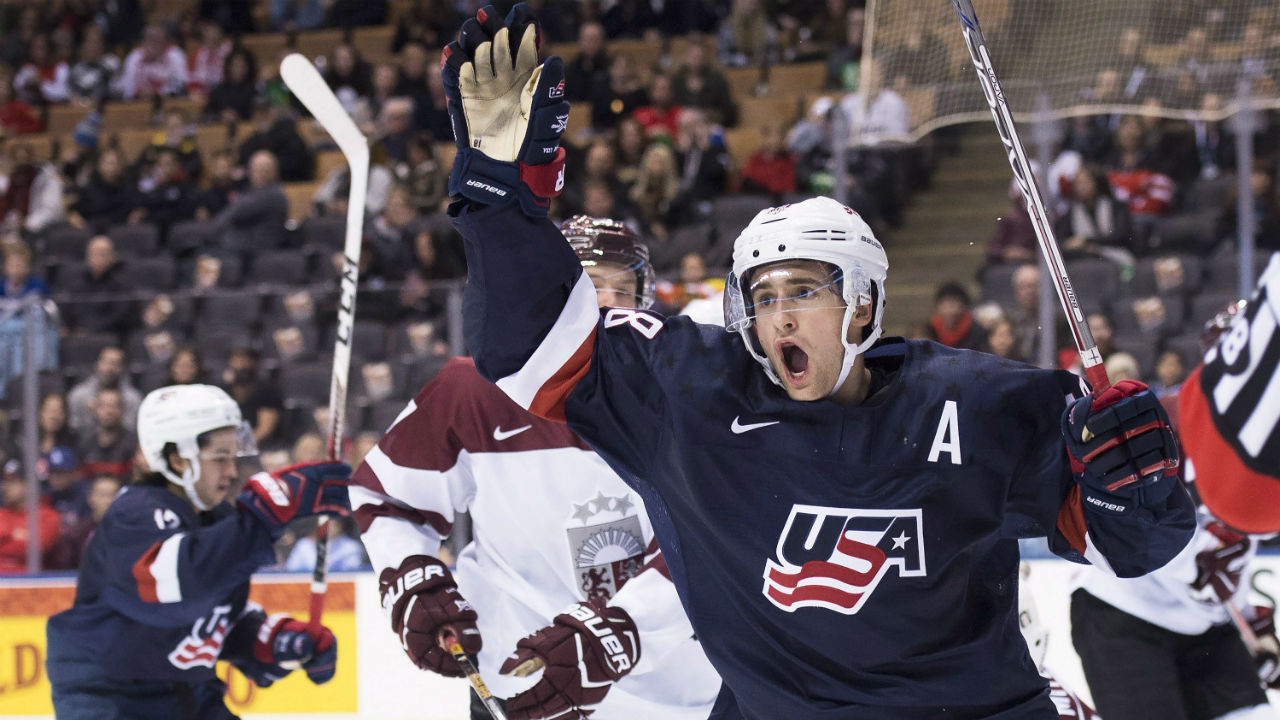

You’d presume that Latvia would be little more than a speed bump for the U.S.
Like a lot of the minnows who earn promotion to the top pool of the under-20s, the Latvians are looking for any sort of point in the opening round, a decent bit of resistance in games against the heavyweights and a win in the relegation to return next year.
The Americans’ 6-1 win over Latvia was routine. Even though the game was tied one-all after 20, you never really harboured a serious belief that the U.S. was going to threatened. When Renars Krastenbergs scored with a shifty deke and backhand on a breakaway with five minutes left in the first period, it was only the second and last shot U.S. netminder Tyler Parsons faced in the period. And though the Latvians were trailing by a goal when they had a five-on-three power play for a minute and a half in the second period, they couldn’t generate a single scoring chance.
The Americans came on in the third period—they registered 30 shots on goal for the game but half of them came in the third. Teams who’ll face the U.S. in coming days probably couldn’t get much of a read on what to expect—the Americans were as good as they had to be, not much more really.
Odd-man rushes
Up to the mid-point of the second period, while the game was still relatively close, the Americans gave up, in no particular order, a breakaway, a partial breakaway that led to a penalty, a two-on-one, another looming two-on-one that led to a penalty, and a three-on-one. That could have been the U.S. blue line playing with too much confidence—you’d have to think so. The Latvians weren’t quite deft enough to make the Americans pay a price other than on Krastenbergs’ goal. Russia, Canada, or Slovakia would get something more done with those opportunities.
Clayton Keller
A few U.S. forwards generated chances but none as consistently as the Boston University winger, Arizona’s first-rounder last June, who potted two goals. Keller’s first was just a tap-in of a chance created by Tage Thompson but the second was a surgical snap of the puck through traffic as he skated into the slot, beating netminder Mareks Mitens high on the glove side. A few Americans showed some real puck skills—Keller’s centre Colin White, who scored what turned out to be the winner, and Jeremy Bracco stood out. Still, the diminutive Keller seemed to do something with his speed and skill ever shift. (A little shout out should go here to Latvian Martins Dzierkals, who for the first 30 minutes showed energy and nerve like Keller’s.)
The Americans’ physical play
Didn’t see it. In fact, most of the big hits were generated by the Latvians in the game. The Americans’ blue line has Joe Cecconi, who is listed at 6-feet-2, 222 pounds, but no one else really close in size and physical presence. They also have, in defending order, Casey Fitzgerald at 5’11″, Adam Fox at 5’10”, and Jack Ahcan who is all of 5’7”. Okay, I get that the U.S. stressed mobility on its defence but we’ll see if bigger forwards than the Latvians can cycle the puck with a significant effect as the tournament wears on. A couple of times, Latvians smoked American defencemen who chased dump-ins—on the biggest hit, U.S. defenceman Ryan Lindgren was levelled by Filips Buncis. The American forwards have a couple of big boys—Thompson and Jordan Greenway are both listed at 6-feet-5 (and Greenway at 230 pounds) but still it seemed that the hard rub-outs on the boards were mostly Latvian-on-American.