
A regular “31 Thoughts” wasn’t possible this week, but I did want to contribute something. Below is an extended profile of Sean Day, a look at where things stand between the NHL and NHLPA, and Anaheim GM Bob Murray’s comments from Wednesday.
But first, I wanted to re-post this week’s two podcasts. The first is with Kim Davis, the NHL’s Executive Vice-President of Social Impact, Growth Initiatives & Legislative Affairs.
The second is with Jarome Iginla and Connor Brown.
This is not the week to take anyone’s else ideas or commentary and claim them as your own. So, their words are presented in full in those links above.
[snippet id=3816507]
31 THOUGHTS
1) Sean Day was surprised at the question.
“There are people,” he was told, “who saw the news that the Rangers were terminating your contract as a sign that you wanted to quit.”
“I’m playing (next season) for sure,” he replies without a pause.
There isn’t a ton of hockey news at this time, so anything that does occur gets extra attention. Last weekend, the New York Rangers placed Day on waivers to terminate the final season of his contract. When no one claimed him, the deal was dissolved, making him an unrestricted free agent. There were a few tweets and Direct Messages from fans along the lines of: “What happened here?”
I’d never spoken to Day before Wednesday, but Canadian junior hockey fans know him well. In 2013, the smooth-skating defenceman became the fourth CHL player given “exceptional status,” allowing him to play in the Ontario league at age 15. His first OHL team was the Mississauga Steelheads.
“That first year went smoothly,” said James Boyd, who coached that team. (Two weeks ago, Boyd was named OHL GM of the year for his work in Ottawa.) Day had 16 points in 60 games on a 24-38-6 team that lost in the first round of the playoffs.
“I thought he’d have a lifetime in hockey. Every day, he’d do something that would make you say, ‘Wow.’ His talent was incredible. In year two, the pressure Sean felt. We were happy with him, and we’d tell him that. But you could tell he wasn’t having much fun. The articles being written, what was said… how he played was never good enough. We felt bad for him, because you could feel the weight of the world on his shoulders.”
The first three OHLers given exceptional status were John Tavares, Aaron Ekblad and Connor McDavid. Day could not escape those long shadows.
“Obviously I have a lot of critics, but a lot of people don’t know me,” Day said this week. “When this whole thing came out (with the Rangers), it was pretty hard for me. I don’t have Twitter, but a bunch of my buddies kept sending me stuff… what people are saying about me. None of (those people) know me. If they knew me, they wouldn’t say half this stuff.”
(Note to Day’s friends: Stop sending him those tweets. It’s not helping.)
In conversations both on and off the record, it’s clear people who do know Day really like him. He laughingly calls himself “a goofball.”
“I love being the class clown,” he says. “I love being everybody’s favourite teammate, and I love hanging out with anybody who wants to hang out.”
This season, when he was sent from AHL Hartford to ECHL Maine, Day said approximately 14 of his teammates took time to wish him the best. That meant a lot to him.
While his fun-loving approached worked on a personal level, it didn’t always help him on the job. By his own admission, when he was younger, Day relied on his prodigious talent, and, at that time of his life, did not put in the work. In researching this story, I learned that his combine performance for the 2016 draft is still discussed by people who were there. Day showed up “with a total bedhead,” according to one source, and did very poorly in testing.
He fell to 81st, where New York — with no first- or second-round selections — took a shot. It seemed like a great gamble.
“I remember talking to the Rangers’ guys after the (2017) Memorial Cup,” says then-Windsor coach Rocky Thompson. “They were so excited about how he played.”
Day was traded to the Spitfires in 2016–17. Mikhail Sergachev was his partner, and the pair formed an outstanding top four with Jalen Chatfield and Logan Stanley (although Stanley missed time with an injury).
“Sean did an outstanding job for us,” said Thompson, who now coaches AHL Chicago. “A lot of the credit goes to (assistant coach) Trevor Letowski.”
[snippet ID=3322139]
Thompson stops and laughs.
“I can be a real pain in the ass when it comes to body position and stick position. Dogmatic. I’d get on him about it, and Sean would say, ‘It’ll work better if this comes from Trevor.’ Pushing him hard didn’t work. So I’d say to him, ‘How can I hold you accountable, then?’ He’d say that Trevor’s approach worked better for him. I agreed to let Trevor handle it, but I also told Sean it had to work. If it did, I would back off. I’m not a yeller and a screamer, but I have the ability to take away ice time. To Sean’s credit, it worked. He lived up to his end of the bargain.
“Sean was a horse for us. When we won the Memorial Cup, he was basically playing every other shift. His defensive game got so much better. Erie (beaten by Windsor in the Memorial Cup Final) was basically an all-star team and he was out there against NHL-level players. He was a big reason we won.”
“(Rocky and I) weirdly hit it off,” Day laughs. “When I got there, everybody was saying, ‘You can’t crack jokes around him, you can’t be loose, you gotta be strict.’ I remember my first day there, I made him cry laughing in one of the meetings. And everybody was like, ‘What did you just do?’ I like him. He knows what he’s doing. He believed in me.
“But the one thing I hate is when a coach gets right in your face and screams at you. I get it — some people like it. Some guys you need to coach them differently. For me, I learn best when I know that you trust me.”
Day finished his OHL career in Kingston. He spoke highly of then-coach Jay Varady, who he said used to have him over for Chinese food. (Varady now coaches at AHL Tucson, the Coyotes’ affiliate.) He added that Varady and then-assistant Kurtis Foster, who played 405 NHL games, were instrumental in getting him to start realizing the importance of conditioning.
“When Sean was sent to us, I called Jay,” said ECHL Maine coach Riley Armstrong. “He said, ‘You have to find a way to have Sean Day trust you. If he doesn’t have that trust, the wall goes up. I let him go and play — 14 days go by and he asks to do some video with me. That’s what I was waiting for, to let him be comfortable working with me. If he feels you have his back and will fight for him, he will fight for you.”
The Rangers declined to comment for this story, saying simply they wanted to wish Day the best. (It should be noted no one from the organization reached out to say anything negative off the record, either.) According to several sources, the team explored trades for Day last season, but couldn’t find anything to its satisfaction. It’s kind of like Jesse Puljujarvi in Edmonton. The team wants value based on potential, but opponents look at it like, “Well, we haven’t seen that yet.”
“It was not a good fit for New York, [but] I’m not going to sit here and bash them,” Day said. “They did give me the opportunity to play pro hockey and they drafted me. I’m overly grateful for that. It is just time to move on. I wasn’t in their [future]. I could tell that.”
That brings us back to the retirement question at the top of this story. Day thinks that’s an outdated opinion from people who don’t know him.
“I love hockey, and the last two years, I’ve done enough to show people that I really do care about this sport and I want to do it for a living.”
He was really happy with the way he finished his first professional season (2018–19). He felt he showed up that year in much-improved condition and credited the Rangers’ nutritionist for teaching him things he needed to know. But hip surgery loomed large.
“I knew it was coming, and I said to myself that I can’t let this be a setback. Everyone thought I wouldn’t be back until a month into the season. For me, my goal was to make it to opening night.”
[snippet id=4167285]
Day invested in blood and saliva testing to determine what his body was allergic to and how he could maximize his recovery. He said his energy levels were low in the morning and wanted to correct that.
“Eggs, cheese, celery, corn — foods that you typically eat a lot of, thinking that they’re healthy. The whole time I’m thinking that it’s bread… that you need to cut out carbs, [but] it wasn’t. I could have the carbs. (The problem was) the things that I was still eating. I was begging to be on the ice last summer. I was sneaking on when my doctor was telling me not to. I just went to the one end to see how it felt. I went into camp and ended up testing the best I ever did in my four years in New York.
“Whenever somebody says, ‘Do you want it?’ Well, I had hip surgery and I came back a month early, just to prove to everybody that I want this.”
Day is still learning the defensive side of the game. Another team did indicate that, if you look at Hartford’s roster, Day’s quicker-than-expected recovery might have overloaded their blue line, causing a numbers game he lost. In December, he was sent to Maine.
“I know the Rangers were excited how Sean’s body changed,” said Armstrong. “He understands how he’s got to take things more seriously. This is not junior hockey, where you can walk in, play 35 minutes and get four points. The ECHL to the AHL is a pretty big jump. At this level, the way he skates, he’s a one-man breakout. He’s working on his defensive side. There was one game late in the year, where he had three points, and said, ‘I was garbage tonight.’ He started to understand how he needs to play.
“Inside the locker room, he is still a goofball. There’s not a guy who didn’t like him. He’s that guy who took more time to grow and find himself. I just feel the way he skates, he’s worth it.”
There is interest in Day, although COVID-19 has thrown next year’s schedule into uncertainty. Day feels strongly that Armstrong (who he loved playing for) is right about maturation.
During the 2017 Memorial Cup, Day spoke to Sportsnet’s Damien Cox and discussed a family situation he usually shielded from the public.
“I remember watching my brother, Scott, play, and ever since then I wanted to be a hockey player,” Day told Cox. “He was my role model growing up. He’s the reason I wear No. 4.”
In October 2014, Scott was driving his pickup truck when it slammed into another vehicle. A 62-year-old woman was killed, and police found his blood-alcohol reading was twice the legal limit. In 2016, Scott Day was sentenced to prison for no less than 57 months and no more than 15 years. He was released last December.
“I don’t think a lot people know what I went through when I was being labelled as immature,” Day said. “Honestly, it’s tough to talk about. My brother was going away to prison. I wasn’t able to be there, to see him and go to his trial. Also, my mother was in the hospital with different blood disorders. She has lupus and celiac disease and her blood would get really thin. I didn’t know how serious it was at the time…. Now she has a little more control over it and I don’t get as worried. Back then, it just started happening. It was kind of scary. I’m dealing with that while being away from home. And you have to ask, how would a normal 17-year-old handle that?
“I think I handled it better than a lot of people give me credit for. I just want to play, I want a spot where I’m not judged off my past. If people thought I was immature, fine. But that was when I was 17. I’m 22 now.”
[relatedlinks]
2) The major NHL news today was the finalization of the playoff format. Initially, the league preferred “bracketing” the post-season after the “play-in” round, but chose to give the players the final decision. They preferred the highest-remaining seed against the lowest after each round, and that will be the way it goes. Every series after the opening qualifiers (which are best three-of-five) will be best-of-seven.
The top four seeds in each conference will be determined by the results of the three-game round robin, with regular-season points percentage serving as a tiebreaker if needed.
We should see by the end of this week if the NHL and NHLPA can implement Phase 2 of the NHL’s “Return to Play” protocol. It’s not mandatory for players, and I’m not sure we’ll see too many participate. Phase 3 (training camps) is mandatory, and a huge step. It won’t begin before July 10, and there’s a lot of work to do. The playoff-structure debates got the most attention, but negotiations on the protocols were even harder, I’m told.
So you can imagine the necessary grinding for something that would be mandatory, from testing on down.
However, there are plenty of rumours that the NHL and NHLPA are working hard on a CBA extension, with multiple sources indicating there is a legit attempt to get something done by the time play resumes.
The league wants long-term stability. The players want a cap on escrow, and word is that it is being considered. If the season does not resume, their hit would be 35 per cent. Even if there are games, they are looking at 27 or 28 per cent. I heard rumblings of a 20 per cent escrow cap over the next few seasons — others said they heard slightly less.
A flat salary cap of $81.5 million for a few seasons is possible, too.
Health care is a huge issue, too, since no one really knows the long-term effect of COVID-19 — even on a healthy athlete’s body.
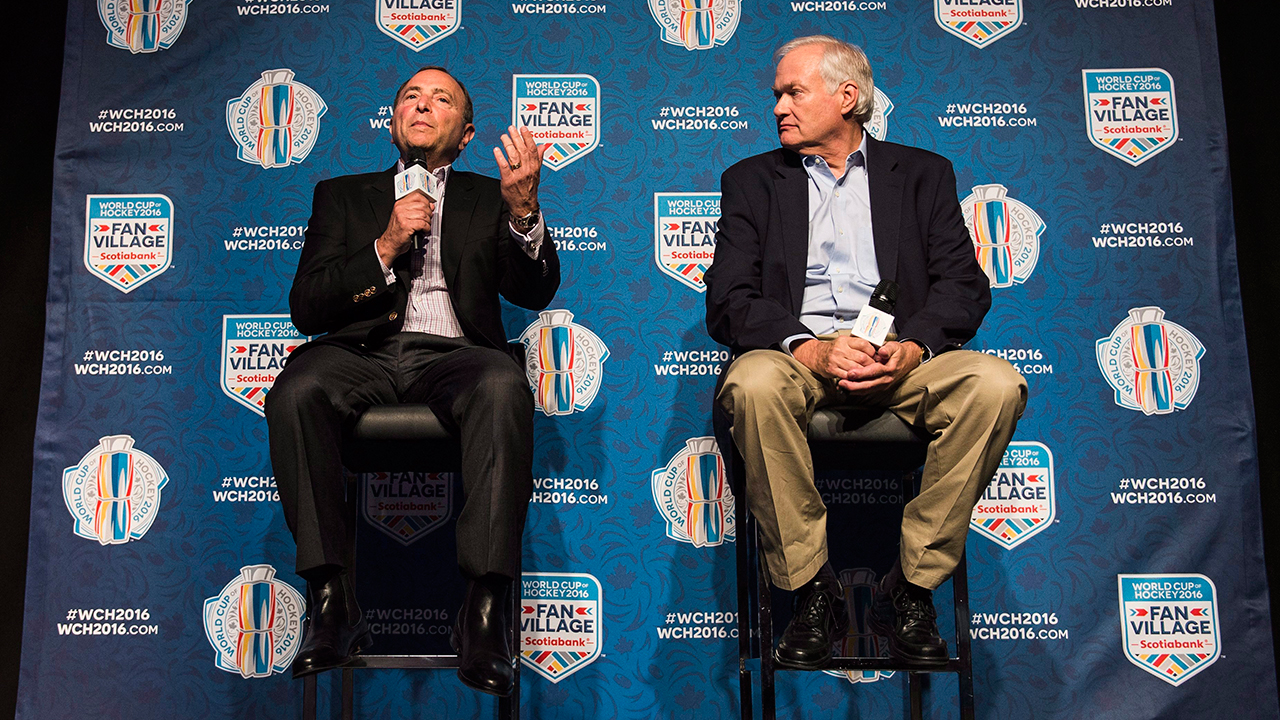
Now, it’s important to remember that these are discussions and nothing is done until it is done. Both Commissioner Gary Bettman and NHLPA Executive Director Donald Fehr will have constituents feeling very differently about these solutions. And fans do not want to hear about disputes right now.
But an attempt is underway to see if there is common ground.
[snippet id=4888368]
3) Finally, Anaheim GM Bob Murray raised eyebrows with his comments about Dallas Eakins’s first season during a Wednesday conference call. Murray is blunt, and I’ve learned with him that just because he’s honest doesn’t mean he’s overly reactionary. When it comes to coaches, he’s probably been a lot more patient than some of his peers.
But I did ask for the transcript of the call to read for myself in full context. Here’s the question and answer about accountability:
Q: What did you like/dislike about your club’s 2019-20 season?
A: “The record wasn’t where I wanted it to be, or where anyone wanted it to be. The question is why? Again, I’m encouraged. There were some stretches of very good hockey played by this group. Definite steps in the right direction of playing faster, quicker and doing some things the proper way. Far too inconsistent. We’d play good games against good teams and show we could play, and then we failed to show up. Why? Special teams, a major concern. If you put us in the middle of the pack on special teams, we could be one of the teams playing right now. We’re so far down the totem pole, and that’s inexcusable. That’s on the coaches, players and everybody. That has to be fixed. Certain things are going to change. I’m going to be pushing very hard. The inconsistencies cannot be allowed to happen with the way they were.
“In hindsight, because of the year before and what happened at the end, I kind of backed off and gave everyone space. I didn’t feel I could be around as much. In hindsight, that’s a mistake. An error in judgement. My people argue with me on that. That won’t happen again. Everybody talking about the young guys, it just led players, at times, to say it’s just a rebuilding year, and that it doesn’t matter. Up and down the lineup, some of the kids were allowed to get away with murder this year. That’s over. Accountability in this group is going to change. I’ve said that a couple times. I’m hellbent on that happening going forward. The coaches are going to hear that loud and clear. They already have. That goes right from the lowest ice time to the most ice time and the most veteran guys to the younger guys. That leads to the inconsistencies. Some of that was, ‘Okay, we have some of the young guys. We’re going to be young.’”
Twelve questions later, Murray was asked specifically about Eakins:
Q: What did you think of the job Dallas Eakins did in his first season behind the Ducks bench?
A: “I thought he was very organized and well prepared. I thought the communication was good early. It got off track a little bit. As I’ve said before, he had to get rid of some of the things that came from Edmonton. I think those are gone now. He was very hard on some young people in Edmonton and it kind of backfired on him. I’m not saying it’s all his fault, by the way.
“He took the foot off the gas a bit with them. He’s going to be much more consistent and on point with everybody next year. He had to get a few things out of the way, and he did.
“We were a decent hockey team a lot of nights. That’s why I expect much more next year. We showed we could play the game. They have to get better on special teams. They’re working on it. You can’t watch certain teams’ power plays. I’ll use Boston [as an example]. That’s a pretty damn good power play. We don’t have those players, so we have to have a different sort of power play. You have to work with what you have. You can’t recreate a Boston, Tampa Bay or Washington power play. We can’t try to do that because we don’t have those people at this point. We’re getting some. We’re starting to draft some of those high-skilled people. For now, we’re going to have to do it a bit different. That’s my message. We can get better on special teams. That’s on coaching and the players. That’s something they’re working on.”
I see this as a very blunt GM being … very blunt. He criticized himself, too, by not giving his coaches the kinds of players they needed to have a better power play, too.
I’d bet Murray regrets mentioning Edmonton, but, with his history, I don’t read that as Eakins being in trouble. I read it as Murray hates losing and doesn’t want to see any more of it.