
The attraction of sports is that they’re played in the arena, not the office or the factory floor. Those of us who while away our time with mundane work love sports for exactly that.
They echo back to ancient times when the stakes were higher than fighting traffic or deciding what’s for lunch: fight well and live, have an off day and you die. They tingle our warrior brains.
We’ve come a long way since the days of bloody combat in the Colosseum; we keep score instead of body counts. Combatants are well paid.
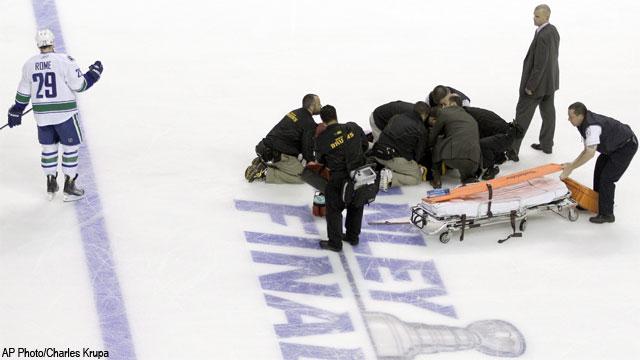
But there’s still something visceral in the knowledge that the games we pay to watch come with risk. Everyone says they don’t want to see anyone hurt, let alone maimed, and most even mean it. But the courage our favourites show in the face of the risk is a big reason sports keep our attention to the point where a perfectly good public company will pay $5.2-billion for the right to show even more hockey to Canadians.
What often gets overlooked is that for those doing the sweating and the bleeding, the arena is their office or their assembly line. It’s a job. The field of play is their work place. And preventing people getting injured or worse at work has been one of the major underlying themes of the past 100 years or so and employers have generally been held accountable for increasingly higher standards of workplace safety.
It’s a thought worth keeping front and centre while keeping an open mind about the implications—both moral and legal—of the concussion lawsuit that landed on the NHL’s doorstep this week.
More than 200 players have signed on, claiming that the league ignored mounting medical evidence about the cumulative effect of “concussive” and “sub-concussive” impacts sustained by NHL players and that the league’s “active and purposeful concealment of the severe risks of brain injuries exposed players to unnecessary dangers they could have avoided had the NHL provided them with truthful and accurate information and taken appropriate action to prevent needless harm.”
The suit cites studies dating back 85 years about the brain damage suffered by boxers and “scores of peer-reviewed articles” published over the decades since to argue that the league should have known the risks to players’ long-term health and brain function and more importantly done something about it sooner, or at the very least taken steps to find out what could have been done.
A common reaction to the suit, which names players whose NHL careers date back to the late 1970s and early 1980s and 1990s is that times were different then; the league and teams and players themselves didn’t understand the significance of concussions because they couldn’t have understood: there was little to know and even less incentive to know it.
And it kind of makes sense when the NHL is viewed as an arena for metaphorical combat, rather than a place to come to work. No one ever pretended hockey wasn’t dangerous—that was part of the attraction for players, owners and fans alike.
The settlement of the claim will likely depend on whether or not there is a smoking gun of sorts, if—for example—it’s that shown the league actively suppressed knowledge about brain injuries via the league’s concussion program established in 1997. The context is important.
While hockey was going about its rock-’em-sock-’em ways over the past 30 or 40 years, almost everyone’s job—almost everyone’s life—has gotten a lot safer due to government oversight and regulation and increasing general knowledge about what’s good and bad for us, and what risks are worth taking.
Mines became safer. People got electrocuted less. There were less catastrophic fires in the garment industry. As we moved to more office-based work we stopped smoking inside. In the past 20 years as computer screens have become more a standard part of people’s workplaces, many companies have worked to make their employees aware of ergonomics.
This echoed how we were living our lives outside of work, too. Through the courts, government legislation, public awareness and common sense we came to wear seat belts when we drove and are warned not to operate heavy machinery while on cold medication. We slather on sunscreen and wear bike helmets.
Is this all the pansification of life or good public policy?
Whatever your view, when considered in that light the concussion lawsuit doesn’t seem as jarring or even nuisance-making as it might seem at first glance, at least in some corners.
Viewed in that light the NHL was a workplace that operated in a vacuum: While the rest of the world was on a health-and-safety kick, the NHL was all about shaking it off and skating to the bench. No trainers.
Helmets weren’t even mandatory in the NHL until 1979, and even then they were grandfathered in. Incredibly, this is the first season that players coming into the league must wear visors, although veterans can still go without.
The one difference between the NHL and the workplace outside of it is that in most cases in the greater world it was organized labour that was at the forefront pushing for greater safety, while in the NHL the players’ association has always seemed relatively passive on the issue.
But it’s easy to understand why hockey players—the workers—weren’t smarter about the risks they were taking.
For the most part theirs wasn’t a job but a passion that came with hard-won knowledge and daily reminders that there were hundreds behind them waiting to replace them at the first moment of weakness. Injuries were the first sign of weakness and playing through them both a job requirement and badge of honour.
Head injuries came with the added complication that they weren’t always easy to detect and were almost always easy to suppress. For players raised in a warrior culture to compete in a sport that was a modern-day battleground, it was second nature.
But hockey players aren’t gladiators—never have been—no matter how we view them or how they view themselves. They are employees and at the end of the day, they have a job and they go to work and in that they have everything in common with the crowds that come to watch them play—everything except that for most of the past 50 years their fans’ jobs were getting safer all the time.