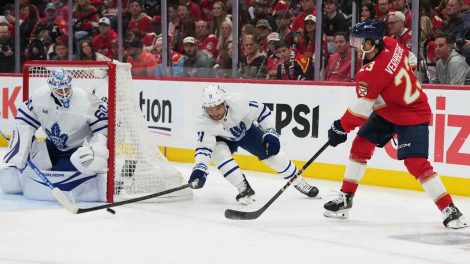
The Calgary Flames finished off the Vancouver Canucks by a final score of 7-4 in Game 6, advancing to the second round of the post-season. Not bad for a hockey team most people expected to compete in the Connor McDavid sweepstakes. Here’s a look at what we learned in this heated Western Conference series.
A Charmed season
On Saturday night the Calgary Flames erased a three goal first-period deficit to eliminate the Vancouver Canucks and punch their ticket to the second round of the Stanley Cup Playoffs.
STANLEY CUP PLAYOFFS: | Broadcast Schedule
Rogers NHL GameCentre LIVE | Stanley Cup Playoffs Fantasy Hockey
New Sportsnet app: iTunes | Google Play
After erasing that three-goal deficit, they erased a one-goal third period deficit. Then they managed to win the game in regulation.
Vancouver outscored the Flames 3-0 in the opening 10 minutes. The Flames proceeded to outscore the Canucks 7-1 the rest of the way.
It was Calgary’s first playoff series win in over a decade. It’s just the second time the Flames have been beyond the first round since 1989.
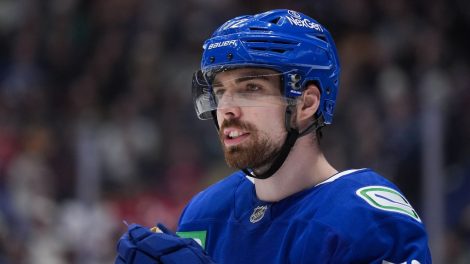
“They played that series like they played all season,” a deflated Radim Vrbata said after the game. “They never gave up.”
The win was monumental and feels even more significant because of how improbable this entire run has been. Forget the three-goal deficit in Game 6, the majority of hockey experts left this Flames side for dead – myself included – the day training camp opened.
The Flames didn’t listen. They kept winning, kept working. They kept coming back.
The Flames are the first team since 2007 – in the so-called behindthenet era – to post a 5-on-5 shot attempt differential below 45 per cent in the regular season and advance to the second-round of the Stanley Cup playoffs.
Appropriately, Flames coach Bob Hartley credited the hockey gods in his postgame press conference.
“There’s a very fine line between winning and losing in this business,” Hartley said graciously following Game 7. “Yes, we played well, but the hockey gods were on our side.”
They have been all year. And so a charmed season continues.
The Right call
This game turned over more than a middle-aged man with sleep apnea, but perhaps the most crucial turning point was the penalty that Brandon McMillan took about five minutes into the third period.
Many watching the game believed it was a goaltender interference call. It wasn’t. It was a standard interference call, and the referee furthest from the play blew the whistle because McMillan hit Flames defenceman Dennis Wideman in the slot, when the Flames defender was looking the other way and was away from the puck.
It’s a tough call, particularly considering the stakes. It was also the right one.
“It’s a hitting game,” said McMillan, who opened the scoring for Vancouver. “It’s a tough call in the third period of a tight game.
“I’m standing my ground. I’m going to the net hard. It’s not like I put my shoulder into him. I just stood my ground.”
The Canucks have seen their fair share of ‘staying in your lane’ hits this season. From the non-call on Jacob Trouba, to the major that Alex Burrows was assessed for doing the same thing to Paul Gaustad.
This was unlike either incident, frankly.
It probably hurts for McMillan and for Canucks fans. Maybe the referees could have let it slide considering the game-state and all that was let go in this series. In a vacuum, though, it was the right call.
Work pays off for Sbisa
Luca Sbisa struggled defensively in his first season in Vancouver. He struggled offensively too.
He didn’t struggle financially, thanks to a lucrative three-year contract extension, but when even local wait staffs are saying you’re “crappy,” you know you’ve had a tough year.
Sbisa, to his credit, almost had the game winner on Saturday. His go-ahead second period goal may have held up if not for McMillan’s lack of discipline and Ryan Miller’s continued ill health.
For all the abuse that Sbisa has taken, that goal was the result of a shot that he’s been working on for weeks with Canucks assistant Doug Lidster – who runs the defence.
“After every practice I worked at getting pucks through,” Sbisa said of his second-period goal. “The first three or four games I might have had 1 shot on net and probably 10 shots blocked.
“We knew going into the series that they’re really good at blocking shots and getting into lanes so we worked on that after practice every time a little bit and that was nice to get one through and have the work pay off.”
Hartley’s quick hook
Save percentage numbers would suggest that Jonas Hiller was dominant in this first round series. Sometimes numbers lie, and this is one of those occasions.
Hiller struggled with rebound control throughout this series. In a crucial Game 6 on Saturday night, he was beaten on two of the first three shots he faced – and he should’ve absolutely had the second one.
Hartley gave him a quick hook, but he told the media after the game that he made a point of apologizing to Hiller in front of the team for replacing him early on with backup Karri Ramo.
“I didn’t pull him because it was his fault,” Hartley said. “We needed a jump start. I felt like there was water in the fuel.
“I said there’s no way that I’m going back to Vancouver,” Hartley continued later during his availability. “If we’re going to Vancouver then my job was to go down tonight striking, not looking.
“Sometimes just change the goalie. It changes the pace of the game. It kind of creates a reaction (from) the players.”
It worked on Saturday.
The Coaching contrast
In pulling Hiller, Hartley was reactive. He used every tool in his kit to get his club’s engine going.
The contrast between him and Canucks coach Willie Desjardins couldn’t have been more evident than in how the two bench bosses dealt with their respective netminders in Game 6.
Where Hartley was wiling to risk it all to try and motivate his team, Desjardins left a clearly struggling Miller in net. It cost him and the Canucks. Repeatedly.
This isn’t to blame Miller, who consistently told the press that he was “months” away from being 100 percent and was still in “injury recovery” mode throughout this series.
“It’s frustrating,” Miller said. “I tried working my way back to make a difference. It’s hard to accept that it’s over after tonight.”

Sportsnet Magazine: An all-access pass to the Stanley Cup Playoffs, including a behind-the-scenes look at Coach’s Corner and exclusive camera angles in Montreal. Download it right now on your iOS or Android device, free to Sportsnet ONE subscribers.
Fact is, Miller was put in a situation he wasn’t ready for.
Desjardins stuck with Miller, like he stuck with his bantam-style line rolling (until Game 5), like he stuck with Jannik Hansen on the first line despite the fact that the Sedin twins were desperate for a quality finisher and Radim Vrbata was wasted on a second-line with Nick Bonino that did next to nothing in the series.
Desjardins’ stubbornness – or loyalty – seemed an asset in the regular season, but that stubbornness seems like it may have cost the Canucks in this series.