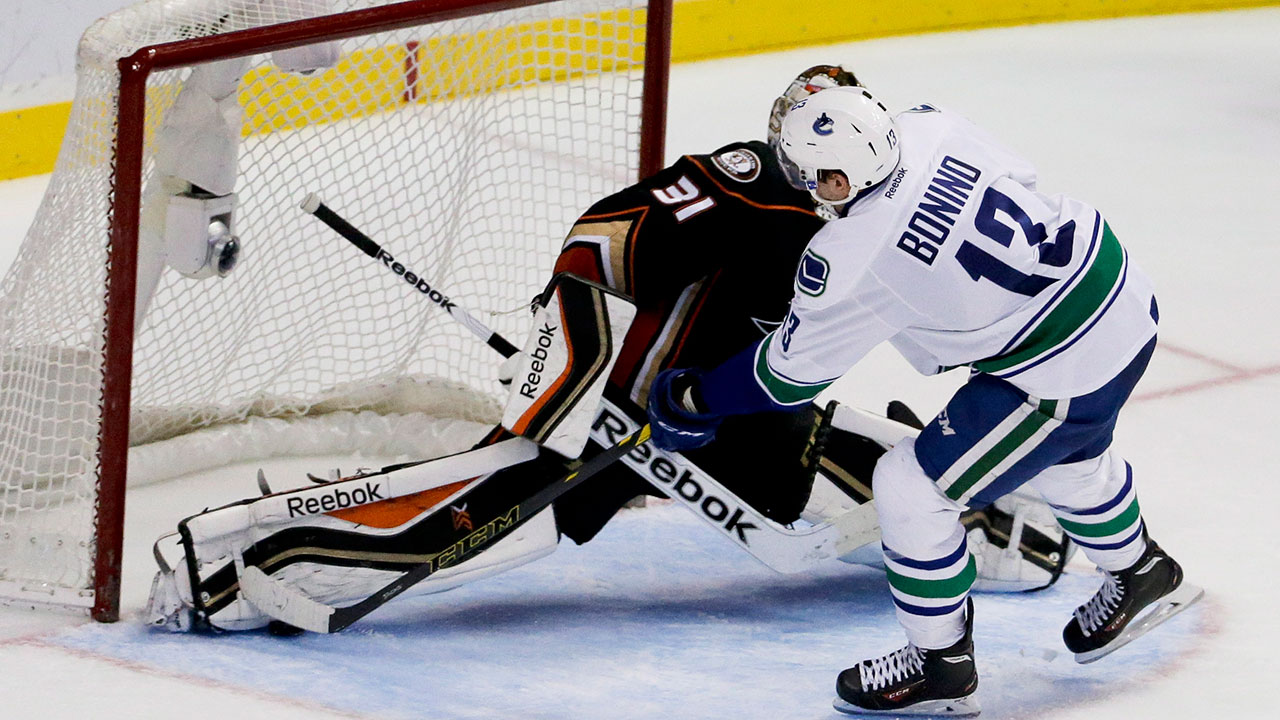

The Vancouver Canucks have been a success story through the first third of the 2014-15 NHL season. It is at least a little surprising, coming as it does on the heels of a disastrous 2013-14 campaign, and it suggests that this summer’s massive overhaul of the organization affected needed change.
That summer shakeup touched every facet of the Canucks, from the players on the ice to the coach behind the bench to the office of the executive boardroom. In terms of the on-ice product, the shifts involved a number of different transactions, but the biggest changes came at the 2014 NHL Draft, where new GM Jim Benning authored a quartet of trades involving NHL roster players:
- Ryan Kesler and a 2015 third-round pick to the Anaheim Ducks in exchange for Nick Bonino, Luca Sbisa, and 2014 first- and third-round draft picks
- Jason Garrison, Jeff Costello and a 2015 seventh-round pick to the Tampa Bay Lightning in exchange for a 2014 second-round pick
- A 2014 third-round pick to the New York Rangers in exchange for Derek Dorsett.
- A 2014 second-round pick to the Los Angeles Kings in exchange for Linden Vey.
Obviously, the most critical pieces in those three moves were the NHL players who switched teams, but it’s also worth looking at the draft picks. Those sent to New York and Los Angeles were the same ones acquired in deals with Anaheim and Tampa Bay, so Benning was able to make a significant gain in futures, adding a first-rounder in 2014 while only sending away third- and seventh-rounders in 2015. That’s a big jump, albeit one which won’t really be seen at the NHL level for several years.
In terms of players, Costello was not signed to an NHL deal by the Lightning and is currently toiling in the ECHL, so he can be safely disregarded. That leaves one forward (Kesler) and one defenceman (Garrison) heading out of town, with three forwards (Bonino, Vey and Dorsett) and a defenceman (Sbisa) coming back the other way.
Defence is the easiest position to examine, because the sum total of the trades resulted in what was essentially a one-for-one swap, with Garrison heading out and Sbisa taking his spot on the roster. Garrison adds a power play dynamic that Sbisa lacks, but the two play remarkably similar roles otherwise. Both feature on the penalty kill and Sbisa plays all of eight fewer seconds per game at evens so far this season than Garrison did for the Canucks last year.
So far, it’s hard to argue the Canucks lost much in the trade. Garrison ranked fourth on Vancouver’s blueline in Quality of Competition last year while starting more shifts in the defensive end of the rink than in the offensive. As well, the Canucks’ shot numbers were slightly worse with him on the ice than off it. Sbisa ranks fifth among Canucks defenders in Quality of Competition this season, takes on a slightly higher ratio of defensive zone zone starts and has a slightly nicer Relative Corsi number. In other words, so far there has been no noticeable decline in terms of team performance with Sbisa on the ice in place of Garrison, and the power play has been just fine with other defencemen taking Garrison’s minutes.
That sounds like a wash, but in reality it’s a big win for Vancouver, for several reasons. First, moving from Garrison to Sbisa allowed the Canucks to clear significant salary. Garrison earns $4.6 million per season while Sbisa’s cap hit is a modest $2.175 million. Second, the players are moving in different directions. Garrison is 30, meaning he is likely all that he ever will be as a player; Sbisa is 24 and still improving. Finally, the trade of Garrison allowed the Canucks to add the draft pick which was then used to acquire Vey from L.A.
Younger and cheaper wasn’t just the theme on defence; it was also the order of the day up front. Nobody would argue the fact that Kesler is an exceptional player, but at age 30 he’s moving out of his peak years and with a $5-million cap hit he is reasonably well-compensated for his efforts. The three forwards Vancouver added have a combined cap hit just south of $4.3 million and range in age from 23 to 27.
That’s well and good, but naturally there was a cost associated with shedding age and salary, and in this case the cost was moving from Kesler to Bonino at the second-line centre position. That hit was inevitable, of course; rumours had previously circulated that Kesler had requested a trade out of Vancouver and Benning confirmed that at the draft.
In any case, Bonino has been a revelation. As of the start of action Monday night, Bonino was tied (with Sidney Crosby) for 12th in the NHL in even-strength points. Like Kesler did, he is playing reasonably tough minutes (he ranks fourth among forwards in quality of competition and is starting a significant umber of shifts in the defensive zone) and on a per-shift basis he’s delivering more than double the offence that Kesler did last season (3.12 points per hour vs. just 1.26 from Kesler).
Bonino’s numbers aren’t likely to stay this high, while Kesler has both rebounded in Anaheim and plays more minutes in all situations than Bonino, but Bonino has been a better centre for the Canucks than Kesler was in 2013-14. That’s remarkable, particularly given the way that Kesler’s no-trade clause shackled Benning.
Vey has been a nice find, too. The 23-year-old rookie has 13 points in 27 games, adding some needed offensive punch at both even-strength and on the power play; he’s riding a high shooting percentage at the moment, but posted exceptional numbers in the minors the past two seasons and still has room to grow as an NHL player. Dorsett is less impressive, but does add a physical dimension to the lineup.
It’s awfully hard not to be impressed with Benning’s work at the draft. He was in a tough situation, both in terms of handling Kesler and with a team that was dangerously close to the NHL’s salary cap. He managed to shed major dollars, add significant futures, get younger on the NHL roster and find players who could approximately fill the holes left by Kesler and Garrison. Just for good measure he added a couple of low-end forwards to the lineup. There are a lot of reasons Vancouver has had success this year, but a big one is the general manager’s adroit work at last summer’s draft.