
While the Toronto Maple Leafs seem to be back on track for a second consecutive trip to the Stanley Cup Playoffs and working a rebuilding program that’s once again moving in the right direction, they are seemingly doing it against normal convention.
The tried-and-true format for building a team is through the NHL Entry Draft and by supplementing a few players via free agency and trades. The Leaf draft cupboard is pretty bare these days, with the likes of Nazem Kadri, James Reimer and Morgan Rielly currently on the NHL roster. Making things tougher, Toronto’s front office has to watch players originally drafted by the Leafs (Tuukka Rask, Alexander Steen and Jiri Tlusty) excel with other teams, having been discarded by the Leafs.
The free-agent signings, meanwhile, have been basically a bust. Hopefully David Clarkson can find a comfort zone with the Leafs this season and not join the likes of Mike Komisarek, Jeff Finger, Jason Allison, Hal Gill and Jason Blake (to name a few) that didn’t live up to the hopes and expectations of the organization and their fans.
But then, not a single one of the current “elite” Leaf players was cultivated via the draft or free agency.
Here is where former Leaf general manager Brian Burke’s imprint has grown in his absence. This is a team built on trades—good, solid hockey trades. Trades that are harder and harder to make happen in the modern NHL.
Because the first of his big trades lingered as controversial sore points for Leafs fans, Burke’s overall trade record is largely forgotten. Possibly the lingering bitterness of giving up too much via trade to acquire unsuccessful goalies like Andrew Raycroft and Vesa Toskala was a factor as well. But, let’s take a look objectively at Burke’s overall body of work when it comes to recent Leaf trades.
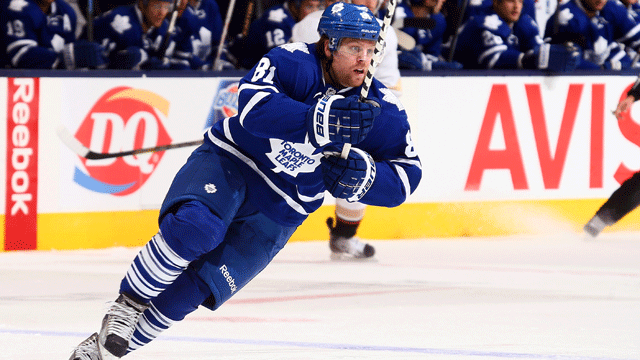
He made a splash in September 2009 by trading two first-round picks to Boston for Phil Kessel. For almost four years Leaf fans have bemoaned those picks becoming Tyler Seguin and Dougie Hamilton, and it wasn’t until last year’s first-round playoff series against the Bruins that the trade began to be seen in a positive light. Phil Kessel is not quite simply the best player on the Toronto Maple Leafs, he’s one of the best half-dozen offensive forwards in the NHL. Finally, the trade with Boston is now “at least” a saw off.
Now let’s look at the rest of the Leaf roster. Top defenceman? Dion Phaneuf. Burke basically fleeced the Calgary Flames (his current team) for Phaneuf in a January 2010, trade that sees the Flames with just Matt Stajan left from the Toronto package.
Top goaltender? While I remain a big James Reimer fan as a player and character person, there is no question Dave Nonis acquired Jonathan Bernier via trade from Los Angeles last July to be their #1 goaltender.
Top supporting cast members? How about a top forward like Joffrey Lupul and top young defenceman like Jake Gardiner? Burke acquired both in the same deal with the Anaheim Ducks in February 2011 in exchange for Francois Beauchemin.
James van Riemsdyk set career highs for most goals in a season (21) and points (41) in the Leafs win on Tampa last Tuesday. He was acquired? Via trade, of course, from Philadelphia in exchange for Luke Schenn in June 2012.
While Clarkson was the big name free agent signing around the free agent frenzy period, what was the other acquisition via trade? Dave Bolland from the Chicago Blackhawks in exchange for draft picks. He was a top three forward for the Leafs before his injury last November.
One last piece? How about the New Year’s Day acquisition of Tim Gleason (in exchange for Jean Michael Liles and a prospect) from the Carolina Hurricanes by David Nonis? To date, he has been a solid core defenceman on a much-improved Leafs blue line.
Kessel, Phaneuf, Bernier, Lupul, Gardiner, Van Riemsdyk, Bolland and Gleason—all acquired via trade. Something that should give Leaf fans cause for excitement as we count down the remaining weeks of the NHL trade deadline.