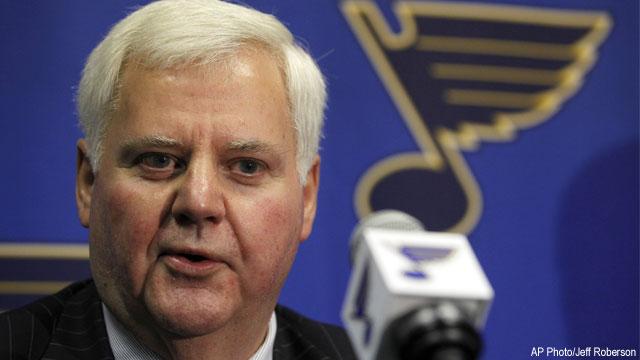

The move to hire Ken Hitchcock in St. Louis can be summed up in one word: Desperate.
Clearly the patience of Blues general manager Doug Armstrong and his management team was running paper thin after a mediocre start to the season, so they went back to the old drawing board.
Hitch will get the rest of the season to show everyone what a genius coach he still is, and if he does get them to the playoff dance, he’ll likely parlay it into a new, lucrative long-term deal with the new ownership group. And if he doesn’t, he’ll simply fade off into the sunset like so many have done in the past.
For Armstrong, he can sell this with minimal downside because Hitchcock won’t get a new long-term deal until he proves he can motivate this group into playoff contenders.
Armstrong can also pin this hiring on how no one else was remotely available with Hitchcock’s coaching experience to save this season. Above the surface, we all know Armstrong put his job on the line with a very gutsy call.
In the meantime, Hitch will go into the Blues’ dressing room and remind the players who the new boss is and how the country club atmosphere has officially come to an end. He’ll start by grinding them to the bone with rants, raves, threats, lies & tantrums — heck, whatever it takes to get the team winning.
And knowing a thing or two about brow-beating coaches, he’ll probably get a jolt out of them within a week or two but count on one thing: it never lasts long. These “old school” coaches don’t get the four or five-year shelf life expectancy they once knew.
Players now quit on hard-line coaches much earlier because they stop believing what they’re selling far more quickly than ever before. In my era, coaches fed off our fear of having our careers buried by them and worrying we’d never recover — even highly-paid players felt that way.
Today, highly-paid players who are locked in long-term don’t suffer the same insecurities we did back then. Players now look at coaches and think to themselves: “You’re embarrassing yourself”. Then they shut down because they’re not buying what’s being sold to them so they often outlast the coaches.
The truly successful coaches today are the ones that look at their players as partners, not puppets. You won’t find a better example of that than Dan Bylsma of the Pittsburgh Penguins. He’s a man who can still pass as one of the guys, while maintaining the utmost respect of his players.
And how does he manage to do that?
By simply offering knowledge and wisdom in a manner that isn’t so intimidating; by having better communication skills than the norm. This is how Bylsma and his colleague Joel Quenneville stay ahead of the curve when it comes to dealing with the new generation.
Interacting with a fair, honest approach — without attitude — can go a long way with these kids. Take a good listen when cameras roll on certain coaches when they speak — it’s like they invented the game. Now imagine what some of the players get from coaches behind closed doors in a private one-on-one meeting. I may miss the paycheques but certainly not those meetings.
Coaches who continue to bully just don’t last anymore. Hitchcock was very fortunate with his group in Dallas back in 1999 — they had Mike Modano, Joe Nieuwendyk, Brett Hull, Ed Belfour, Sergei Zubov and Derian Hatcher. Those were guys who could stomach the everyday dosage of his condescending attitude and still maintain professionalism despite it.
The only question that really matters today is whether or not David Backes, Patrik Berglund, Alex Steen, Alex Pietrangelo, Kevin Shattenkirk and Jaroslav Halak have the same type of stomach.
Good luck boys … the Pepto-Bismol is on the back shelf in the trainer’s room.