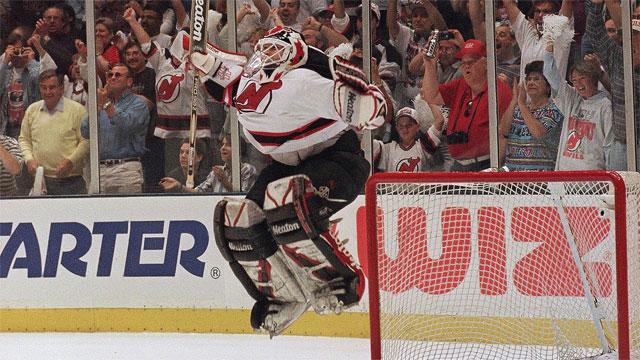
The best way to have the ultimate success in a shortened NHL season starting in mid-January is to begin by not winning in the first four games and posting just three wins in the first 10 games.
That was the formula used by the New Jersey Devils, coached by Jacques Lemaire, in 1995 to capture the Stanley Cup.
Any team starting this shortened campaigned in similar fashion would be in for great ridicule from the home fans after making them wait four months for the first game.
However, based on what the Devils did 18 years ago, it wouldn’t be time for panic.
Martin Brodeur is the only player from that Cup champion Devils squad still playing in the NHL. It’s certain the then second-year goaltender, will now be asked frequently how it was achieved.
Clearly there was no hint at the outset. The Devils had three losses and a tie in their first four contests. At the 10-game mark their record 3-5-2 was better than only four of the League’s then 26 clubs. New Jersey didn’t reach the .500 mark until Game 33. Over the final 15 tilts, the Devils were 8-5-2. That was enough to get them in the playoffs as the No. 5 seed in the Eastern Conference.
Somewhat similar to the way the Los Angeles Kings did it in the most recent 2012 Stanley Cup playoffs, the ’95 Devils marched through the playoffs with relative ease. Like the Kings, the Devils didn’t have home ice advantage in any post-season series. Undaunted, they won all four with none going the seven-game limit.
Led by Brodeur, Stephane Richer, Neal Broten, Claude Lemieux, John MacLean, Scott Niedermayer and others, the Devils took out Boston and Pittsburgh in five games in rounds one and two.
Then they eliminated Philadelphia in six games for the East Conference crown. The Devils swept favored Detroit, the team with No. 1 overall record during the regular season, in four straight.
Current coaches will lead up to the beginning of this short campaign underscoring the importance of strong starts. Clearly, that will be the key to making the playoffs. Although, as the Devils demonstrated all those years ago, you can start slow and still nab the big prize.
In 1995, ten teams didn’t qualify for the playoffs. Of that group, only one team, Tampa Bay, was over .500 after playing their first 10 games. The Lightning were 5-4-1, but would finish third last in the East. The other nine non-playoff squads that season were all under .500 after 10 games (Ottawa, NY Islanders, Florida, Montreal, Hartford, Edmonton, Winnipeg, Los Angeles and Anaheim).
The very best teams out of the gate in ’95 were Quebec and Pittsburgh. Both won 12 of their first 13 games. In the end, they had the best regular-season records in the East, but neither could parlay that into a good playoff run. The Nordiques lost out in the opening round to the defending Cup champion New York Rangers and moved to Colorado the next season. The Penguins with the season’s top scorer Jaromir Jagr, won out over Washington in seven games in the first round before succumbing to the Devils.
The Red Wings (14 points), Chicago (14) and St. Louis (13) were the West’s top teams through the first 10 games back then. The Wings (70) and Blues (61) would finish the 48-game slate with the best records followed by Calgary (55), which was pennant winner in the Pacific Division.
In the playoffs, Detroit would knock off the Blackhawks in the West final before being stunned by the Devils. The Blues (by Vancouver) and Flames (by San Jose) would both be beaten out in seven games during the first round.
Some interesting notes for that ’95 campaign.
No skater (defenceman or forward) was older than Joey Mullen, who was 37 while notching 37 points in the 45 games he played for the Penguins. This season, Jagr and Ray Whitney, both with Dallas, Anahaim’s Teemu Selanne and Ottawa’s Daniel Alfredsson are all age 40-or-more.
The top four scorers during the ’95 regular-season were all age 25-or-less (Jagr (23), Eric Lindros (23), Alexei Zhamnov (24) and Joe Sakic (25).
Led by Washington’s Peter Bondra with 34 goals, five players scored 30-or-more. Jagr (32), Zhamnov, Red Wings’ Ray Sheppard and Nordiques’ Owen Nolan all had 30. Lindros, the Flames’ Theoren Fleury and Blues’ Brett Hull all tallied 29 times.
The rookie-of-the-year and top rookie scorer was Quebec’s Peter Forsberg with 50 points at age 21. Anaheim’s Paul Kariya had most rookie goals with 18. Paul Coffey, age 33 and with the Red Wings, won his third, and last, Norris Trophy and led defencemen in scoring with 14 goals and 58 points. The Penguins’ Ron Francis was top plus player at +30 and also Lady Byng Trophy winner.
The goalie with the most regular-season wins in ’95 was Pittsburgh’s Ken Wreggett with 25. Buffalo’s Dominik Hasek won the Vezina Trophy posting the best GAA (2.11) and save percentage (.930). Chicago’s Ed Belfour was runner-up.
It was also the first season in which two ice-cleaning machines (many of them Zamboni’s) were used to resurface the ice between periods.
Referees had the names taken off the back of their jerseys and were identified by number only.