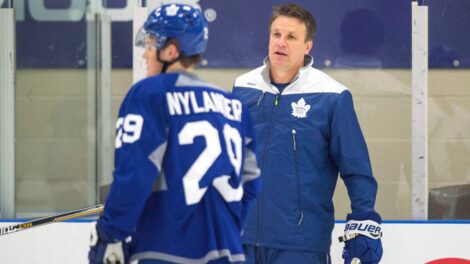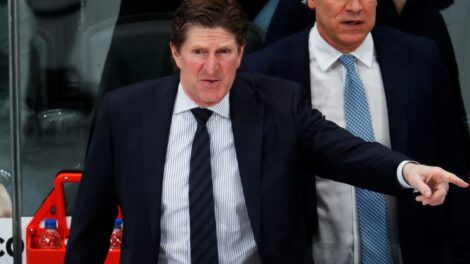

Toronto Maple Leafs head coach Randy Carlyle seemed wistful. Longing. Like he was talking about something he’d love to call his own, but can’t quite yet.
The subject was the Calgary Flames — the grittiest, hardest-working, most determined team in the NHL so far this season, if measured by how far they’ve surpassed outside expectations.
“When you look at the Calgary Flames their energy is one thing that is front and centre. They have young guys that are playing at a really high level, their work ethic, their forecheck is very noticeable, their backside pressure,” said Carlyle.
“They have three defencemen in the top-15 of scoring for defencemen, there’s a lot to handle. You have to respect the Calgary Flames and what they’ve accomplished so far and what they’ve accomplished so far is they’ve taken the attitude that it’s us against the world. No one expected them to be where they are at. But they’ve earned it. You can’t take it away from them.”
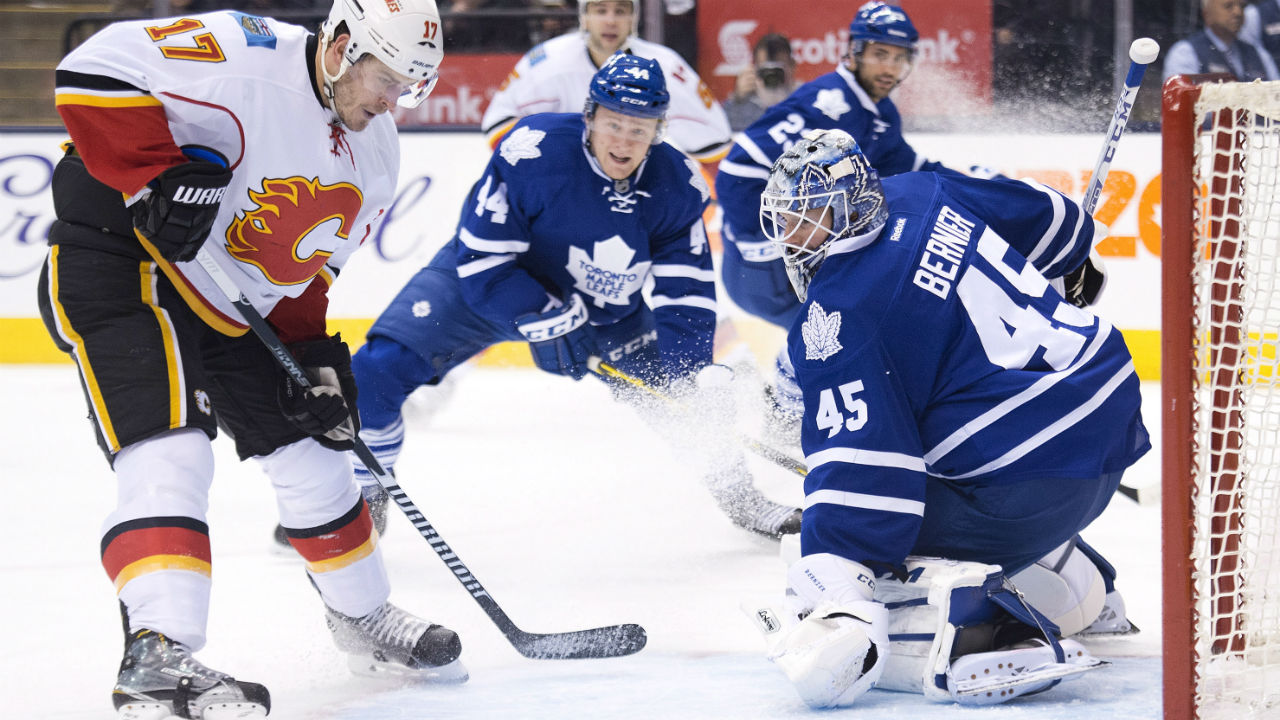
The Leafs did it Tuesday night. They outlasted the Flames 4-1. They took away the momentum the Flames — winners of four of their past five — carried into the ACC to start their road trip. They held Norris Trophy candidate Mark Giordano and the rest of Calgary’s high-scoring defence corps off the scoresheet, save a couple of assists. They outworked a team whose identity is hard work.
And they did it by surviving their own near-paralysis in the third period, when the Flames outshot them 16-8 and Leafs goalie Jonathan Bernier had to make one key save after another; clearly a man in a groove after having started nine straight games, with Carlyle hinting he might get another turn Wednesday night when the Leafs are in Detroit.
“We got away from our game plan a little bit, but Bernie was there for us,” said Leafs centre Peter Holland. “He’s been there for us a couple of games now and he was there for us in the last 20 [minutes].
“He’s making a couple of cross-crease games every game and we’re on the bench going holy jumping, how’s he doing this?”
With Bernier’s help, the Leafs seem poised to become a team a little closer to the one Carlyle has in his mind’s eye; one that relies less on a seemingly-injured Phil Kessel and more on a group of hard-working forwards who can occasionally turn to one of their premier talents for a little something extra when needed.
Holland opened the scoring midway through the first period Tuesday as he drove to the net and banged home a rebound on a rush keyed by pure theft at the other end by Bernier. The Leafs goaltender stopped a dangerous walk-in attempt from Flames rookie Johnny Goudreau.
Those kinds of chances were few and far between for Calgary through the first two periods, as the Leafs largely kept them bottled, with few mistakes they could take advantage of.
And Holland? He was out to kill a penalty the next shift. Priorities.
“I think there’s a way to win hockey games in this league and that’s part of it,” said Leafs veteran winger Daniel Winnik who has helped add some substance to the Leafs’ support staff. “What you’re seeing now is a commitment to defence. I don’t know if that was there in previous years. We get a lot of hard back-pressure and more discipline in the neutral zone. We’ve sacrificed a little offence for defence, but we can score. We know we’re going to get our three goals — it’s ‘can we keep them to two?’”
The Leafs were a team in full flight in the second period, when they outshot Calgary 13-4 and had shift after shift where they simply played keep-away in the Flames’ end.
Toronto extended their lead to 2-0 early in the second period as they converted a gorgeous three-way passing play from Dion Phaneuf (who earned his first point against his old club), to Nazem Kadri to James Van Riemsdyk who was undefended at the far post.
“That second period was one of the best periods we’ve played this year from the perspective of it being more the style of hockey we require for 60 minutes,” said Carlyle. “Those are the things you try to capture and try to watch and say to your team: ‘This is what we’re going to need to do on a regular basis.’”
But Calgary’s reputation for feistiness has been earned, in part, by their play deep in games. They are second in the NHL with 33 third-period goals.
The Flames cut the lead to 2-1 with a power play goal early in the third on a power play goal from Markus Granlund.
From then on the Leafs were like a shadow of the team that played the first two periods as they retreated deeper and deeper into their defensive shell that threatened to collapse on them.
They were outshot 16-8 in the third period until Phil Kessel outmuscled a Flames defender to accept a pass from van Riemsdyk and score an impressive empty-netter to give the Leafs a 3-1 lead with 40 seconds left. Mike Santorelli finished the scoring with four seconds left, firing into a still-empty net from centre ice.
There is no sweeter spot in the NHL than being an over-achiever. The Flames came into the Air Canada Centre to face Carlyle’s Leafs as a story not so much because they had 36 points in 17 games, good for a tie for fifth in the Western Conference, but because they are already 17 points ahead of Edmonton, their provincial cousins and an emerging favourite to win the Connor McDavid sweepstakes. The Flames were supposed to be a bottom feeder. That they’re not is a triumph.
They left Toronto disappointed, no doubt — but they are playing with house money.
The Leafs don’t have the luxury of being unexpectedly successful. They have a veteran core under long-term contracts. They have the most expensive seats in hockey. They have spent to the cap. People will be fired -– Carlyle among the first -– if they don’t hold on to the playoff spot they pulled themselves back into with this run of 13 points in their past eight games, dating back to their disastrous 9-2 loss at home to Nashville.
“I know it couldn’t get much worse,” Carlyle said of where his team was just three weeks ago. “It was bad.”
As they have almost every night since, the Leafs stayed on the right side of the grass Tuesday. And if Carlyle isn’t completely satisfied with what he sees, he can take comfort in what he’s not seeing anymore.