The 2016-17 Chicago Blackhawks present a dilemma to anyone in hockey trying to straddle the fence between old-school virtues and new-school analytics.
From one vantage point, Chicago appears to be an obvious contender. It is the lone Western Conference club with more than 100 points on the season. The core group powering that performance has gone to the third round or further five times in the past eight seasons, with three of those runs ending in championships. Since the start of February, Chicago has gone 18-4-2.
When the West’s regular season club is coming off a decade of dominance and only getting better down the stretch, making a case against them may well be an exercise in foolhardiness. Yet it’s hard to deny that there is a fundamental difference between the current Blackhawks and the successful teams in their recent past.
Consider two statistics: 5v5 shot attempts share (better known as Corsi) and 5v5 goals share.
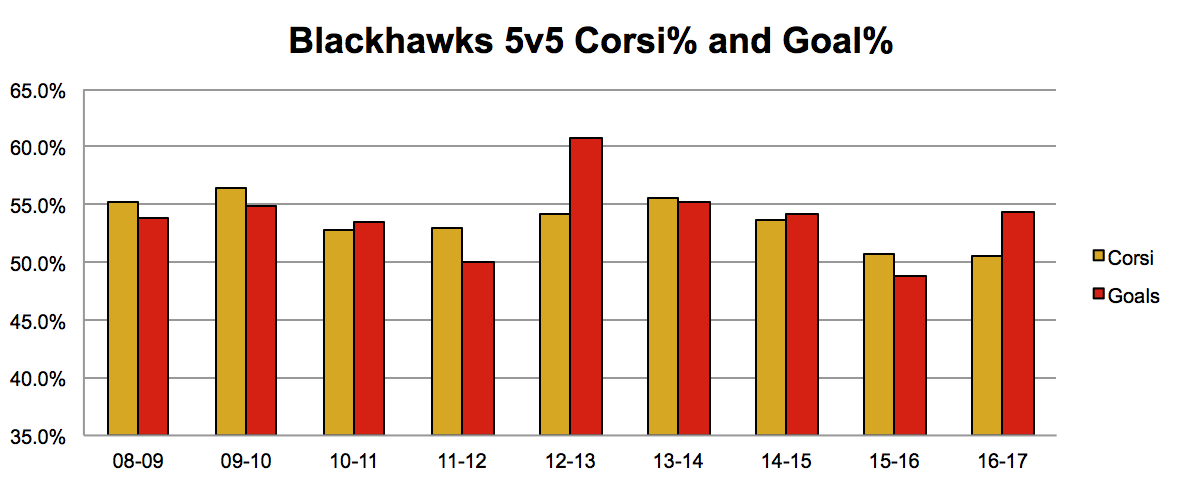
Over the past eight seasons, 5v5 Corsi has neatly separated the successful Blackhawks teams from the (relatively speaking) failures. The five teams that went on long playoff runs all had a Corsi percentage north of 53.5. The three teams that got knocked out in the first round were all below 53.0 per cent.
During this same span, goal differential has moved in lockstep with Corsi. The five teams that went on long playoff runs all had a regular season goal share better than 53.5 per cent. The three teams knocked out in the first round were all below that number, with last season’s team the first over this run to surrender more goals than it scored.
An analyst looking solely at 5v5 shots and another looking solely at 5v5 goals would have come to the same conclusion about Chicago’s strength as a team, and both would have been correct.
That isn’t true this season, which is the dilemma. By goal share, Chicago this year is better than it was when it won the Cup in 2015, and looks like the teams of old. By shot share, Chicago this year represents the low point of its contending run, falling even a little from where it was last season.
The easy answer to that kind of question is to default to the consensus viewpoint. The Blackhawks have been great in the past, are near the top of the standings, and few will seriously question an assertion that they are a contender. Since goals are the metric that aligns with that viewpoint, goals are correct and shot share is wrong.
Though it masquerades as analysis, this is confirmation bias. Rather than trying to understand the discrepancy, such an approach picks the data that supports an existing viewpoint and discards that which does not. We can do better.
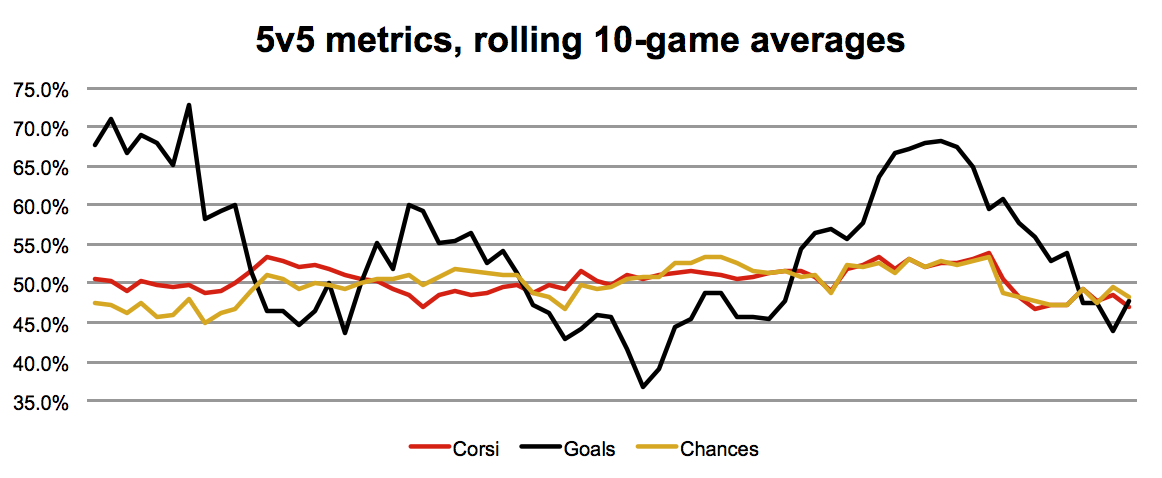
The chart above shows three metrics. We’ve discussed Corsi and goals already. The new number is scoring chances, as recorded by Natural Stat Trick.
Chances and Corsi are reasonably steady and obviously tell much the same story. This doesn’t eliminate shot quality as a potential driver of Chicago’s success this season, since it is possible there are variables not being captured by this scoring chance definition. It does reduce the likelihood, though, particularly since we know that the Blackhawks won in the past more by outshooting the opposition than by outperforming their shot metrics.
Goals vary widely, with the highs driving Chicago’s winning runs and the lows resulting in losses. The first big peak was mostly driven by a team save percentage of .963 for a month. The one valley in the middle of the chart was a collapse in both shooting and save percentage. Finally the most recent peak was driven by shooters firing at a much better rate than the NHL average, along with very strong goaltending.
Over the season as a whole, Chicago’s shooters have been good but not amazing, coming in just above the NHL average. The fluctuations here suggest that’s likely to be the case in the post-season, too. It’s also in keeping with the team’s history; when it won the Cup in 2015 it did so after finishing 28th in 5v5 shooting percentage during the regular season.
Goaltending has had a bigger impact; outside of that one blip it has been uniformly excellent thanks to the expected strong play from Corey Crawford and from starter-in-waiting backup Scott Darling. Having two goalies is a major advantage in the regular season, but except in case of injury that gap narrows in the playoffs, when every team plays its starter.
By 5v5 save percentage, Darling has been a top-five backup in 2016-17, and that’s helped drive regular season wins. Crawford, in contrast, has had a good year (.930 5v5 SV%) but has not separated himself from a pack of good Western Conference goalies, which includes Devan Dubnyk (.932), John Gibson (.932), Cam Talbot (.930) and Brian Elliott (.928). Any could prove his equal over a seven-game series.
We’ve mostly ignored special teams here, but they don’t help the Blackhawks’ case given that the team’s power play is mediocre on the year and its penalty kill is running neck-and-neck with Arizona and Colorado in the NHL’s bottom-five.
With Chicago’s goaltending advantage closing in the post-season, with their shooters unlikely to far exceed the NHL average, and with special teams no help, the club’s shot share deficiencies look more critical. This Blackhawks team doesn’t control puck possession the way its successful predecessors did, and that means it has weaknesses those iterations of the club did not.
The team wins, but not the same way it consistently did in its best years. There are some elements in common with 2015, which resulted in a Cup, but there are others more reminiscent of last year’s first-round exit.
Prudence dictates caution. It would be silly to disregard regular season success, or the accomplishments of this core group. It would also be foolish to ignore the signs that this team may not be capable of matching its previous playoff highs.
[relatedlinks]