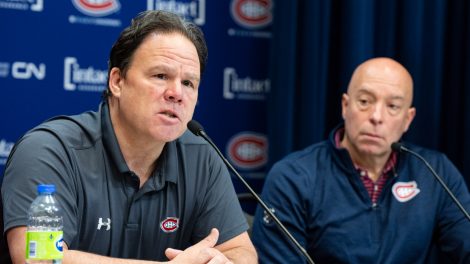
The head coach is currently serving as chairman of an English Premiership team. The general manager played more than 100 games for Slovakia and another 1,000 in the NHL, but has no management experience.
Among the scouts, there is a two-time Canadian Olympian, a Cornell-trained lawyer from Chicago, a former Czech international, a former Slovak international and a 63-year-old hockey lifer from Melfort, Sask., who has experienced just about everything the sport has to offer.
Franz Reindl, the man tasked with overseeing the entire operation, is director of the German Ice Hockey Federation.
We don’t even have to wait to see Team Europe’s roster for the 2016 World Cup before pronouncing this the most wacky experiment in the history of international hockey.
There has never been anything quite like it before. There might never be again.
“We are having disadvantages, we are starting from scratch,” Reindl told Sportsnet in an interview on Thursday. “(But when) you are starting from scratch you have a chance to build something. For me, it’s a dream comes true.”
The team’s very existence is an affront to some purists, but that doesn’t matter much to the men who will spend the next 10 months devising ways to get their eclectic group to defy the odds.
That work ostensibly begins now, with Sean Burke, Peter Bondra, Lorne Henning, Vaclav Nedomansky and Ricky Olczyk being named to the scouting staff before sitting down for their first meeting with Reindl, GM Miroslav Satan and head coach Ralph Krueger in New York City on Thursday.
The task before them is daunting.
They are scouting a pool of approximately 50 players and could wind up with a 23-man roster that spans 10 countries. They have no flag, no anthem and no obvious choice for uniform. They will be an engine built of disparate parts trying to outgun the Canadians, Americans, Swedes and Russians.
While the Europeans are clearly a step behind their counterparts in terms of preparation — Team Canada’s management group has already met three times and settled on a good chunk of its expected roster — they do enjoy the advantage of having an executive group uniquely committed to the cause.
Only Olyczyk, the Carolina Hurricanes assistant GM, is currently employed elsewhere. That leaves Satan and the other scouts a fair bit of time to focus on evaluations before a March 1 deadline to name their first 16 players and a June 1 cut-off to settle on the final roster.
The locks include Anze Kopitar (Slovenia), Zdeno Chara and Marian Hossa (Slovakia), Thomas Vanek (Austria) and Roman Josi (Switzerland), with the likes of Frederik Andersen (Denmark), Zemgus Girgensons (Latvia), Christian Ehrhoff (Germany) and Mats Zuccarello (Norway) pretty safe bets as well.
A number of younger players are making a strong push early this season, with Dane Nikolaj Ehlers and Germans Tobias Rieder and Leon Draisatl standing out in particular.
The plan, according to Reindl, will be for the scouts to file weekly reports. The management group also expects to have regular conference calls to help build consensus among the differing viewpoints.
Krueger laid out a vision for the kind of team he wants to have during Thursday’s meeting and Reindl was thrilled with the level of discourse that followed.
“It was like sitting in the Hall of Fame for me,” he said. “I was really excited at how this selecting process will be done: Professionally. I was so excited to be there and to listen to the people, and listen to the guys, and soak up the experience.”
“We are all on the same page and now we go about doing our work,” he added.
Team Europe is bound to be a huge underdog heading into the World Cup despite carrying a fair bit of talent. Don’t be surprised if that’s something the players try to rally around.
Having the upbeat Krueger behind the bench should certainly help — even if he’s currently immersed in the soccer world as chairman of Southampton F.C.
Born and raised in Winnipeg, Krueger took the Swiss hockey program to new heights as its longtime national team coach. During the 2014 Sochi Olympics, he was responsible for all of the advanced scouting and systems work that helped Mike Babcock’s coaching staff ice the best-prepared Team Canada in history.
At the World Cup Krueger will also be able to draw on the vast experience of Winnipeg Jets coach Paul Maurice, whom he personally recruited to be an assistant.
“I’ve spent a big bulk of my coaching career with kind of underdog teams,” Maurice told reporters on Thursday.
The creation of a team comprised of players from European countries other than Sweden, Finland, Russia and the Czech Republic was a unique solution to two fundamental problems facing the reborn World Cup: How do you involve as many NHL stars as possible? How do you ensure that there are eight strong entries in the event?
In future, the NHL expects to hold a qualifying tournament among second-tier European nations to fill out the final World Cup slots. As a result, there’s a good chance Team Europe and Team North America (the under-24 squad) will end up being one-off propositions.
That makes the current opportunity even more unique.
Reindl competed for Germany at the 1984 Canada Cup and never expected to find himself part of project like this one. Now surrounded by men who hail from both sides of the Atlantic Ocean, he’s invigorated by the challenge of morphing into one cohesive unit and building the best team possible.
“We have a great spirit in this group and if we can transfer our spirit to the team, to the players, then it will be a great event for us,” said Reindl. “This is our challenge.”
A challenge unlike any the hockey world has ever before seen.