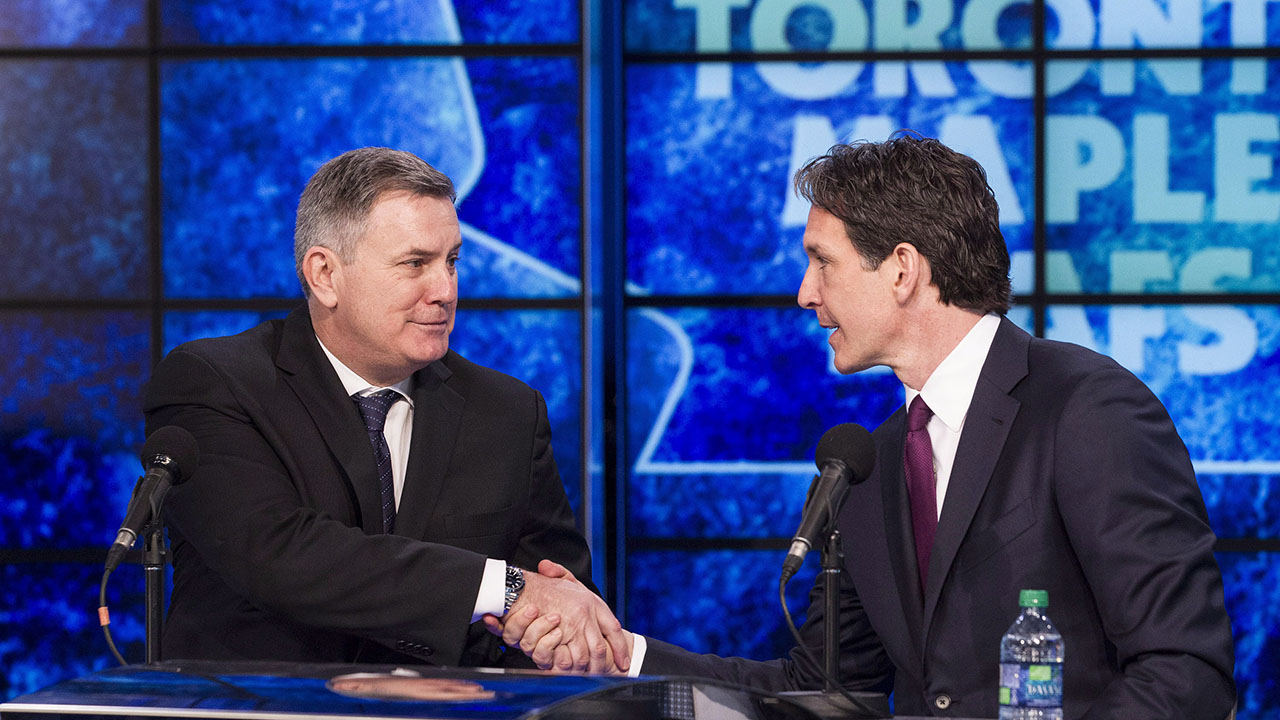

Two years ago this week Tim Leiweke officially started work in Toronto. The plan was simple: Drop boulders into a stagnant pool and ride the waves.
"I wouldn’t have come here if the teams were good," he said, explaining why he would leave Los Angeles, where he’d made himself a brand-name sports executive before parting ways with AEG, his previous employer.
He said he considered going the entrepreneur route – which sounds familiar, in retrospect – but was lured by the opportunity to turn water into championship champagne.
I guess the best thing that can be said at this point is that things are still fermenting, and should it ever turn into bubbly, it won’t be the cheap stuff: A rough estimate of the expenses Leiweke has laid at the feet of MLSE – from the expansion of BMO Field to the largesse afforded newly hired Maple Leafs coach Mike Babcock to miss the playoffs – likely tops $400 million and could push half-a-billion. Never again will anyone be able to say MLSE puts profits ahead of winning, although it’s worth remembering where those profits come from.
But the results? We’re still waiting.
Still, I’d argue he’s done more to revitalize the Toronto sports scene than almost anyone who has ever worked here.
He’s a study in how big a gap exists in sports between talking about winning and actually making it happen.
Almost nothing he initially predicted, pledged or promised worked out. In his first round of interviews after his official start he said he’d already planned the parade route – as in literally planned where it should start and finish – for the Leafs, not realizing he was reciting a local punchline. He hinted at landing an NFL team. He predicted a long, uncertain rebuild for the Toronto Raptors – "We may ultimately have to, excuse my English, suck to be good." He promised a rapid – if costly – turnaround for Toronto FC. And as for the Leafs’ epic Game 7 meltdown to the Boston Bruins? It’s the kind of disappointment a franchise can build from and he was really impressed with general manager Dave Nonis.
Twenty-four months later the Raptors failed at tanking – not the worst sin, granted, as long as you don’t stare too longingly at Andrew Wiggins shimmering in the distance – and are for the moment stuck in the mushy middle of the Eastern Conference. The Leafs simply failed and have now undertaken the most expensive draft-based rebuild in the history of the NHL. And TFC kept being TFC, except they became the highest payroll team in the MLS along the route.
Which is perhaps why MLSE announced Leiweke would be staying on as CEO not with trumpets but with the corporate equivalent of a whisper behind a hand: A press release distributed late Friday afternoon, forever the way the powerful have chosen to pass along their bad news.
Regardless, enthusiasm is Leiweke’s specialty and in the meantime, he can still drum up some for the cause: "I’m excited to see through TFC’s season and the new Leafs and where Masai is going to have the Raptors headed," he told me.
And I believe him. For all the twists and turns, Leiweke has never wavered from the team-focused, results-based measure of success he espoused the minute he showed up and must remain the organization’s blueprint long after he leaves.
That alone is a legacy to be proud of.
Off the field Leiweke has presided over a number of impressive moves that should bear fruit in the long-term. Wrestling the Raptors’ new $30-million practice facility through various government hoops is an example; closing in on a NBA Development League franchise is another. Even as Jermain Defoe, last year’s celebrity soccer signing proved a complete bust, credit Leiweke for having the stones to double down and bring in Jozy Altidore and Sebastien Giovinco with the early returns indicating that he may have got the mix just right this time around. And while he and everyone else at MLSE vastly over-estimated the Leafs’ potential after their lockout-season mirage, his hiring of Brendan Shanahan as president looks for the moment more inspired than desperate.
That he will now be hanging around beyond his forecasted departure date says more about his bosses than him. As Leiweke put it in an unguarded moment while speaking to a Ryerson University class – "I go to work every day for two companies [Bell and Rogers] that hate each other." Factor in that Leiweke and MLSE’s other owner, Larry Tanenbaum, don’t see eye-to-eye and you can imagine how much fun the board meetings are.
The struggle to find a replacement for Leiweke reflects the tension at the top. Board decisions are required to be passed unanimously, which means each of the owners has a veto. According to one source, Bell may have blocked Rogers’ preferred candidate, NHL chief executive officer John Collins and Larry Tanenbaum blocked former Madison Square Garden executive Scott O’Neil. It was reported that retired Corus Entertainment executive John Cassaday was poised to be announced for the job last week, but didn’t end up taking it.
Sportsnet’s John Shannon suggested it could have come down to money: when the Leafs made Babcock the highest-paid coach in the NHL – more than doubling what a coach has ever been paid before and making him the highest paid non-athlete in the organization – it’s thought Cassaday may have balked at drawing significantly less than the estimated $6 million Leiweke earns and what nearly everyone working for him draws.
"If you’re the new guy coming in the question is: What am I going to do? Everything is done," said one source. "None of the new hires are his people, they all make significantly more than him and are going to be incredibly empowered and making more than the new CEO. It’s not healthy."
Whatever the issues in the ownership suite, they haven’t otherwise impacted the organization’s willingness to spill money to try and shed its well-deserved reputation as a company that is a success everywhere except on the field of play.
That should always be the final accounting for the owners and Leiweke has always done a great job of making sure that’s the only scoreboard that matters.
"We have a shot to be great here," he told me early on in his tenure. "Don’t be afraid."
Two years on, MLSE is a long way from the former, but no one can ever accuse of Leiweke of the latter.