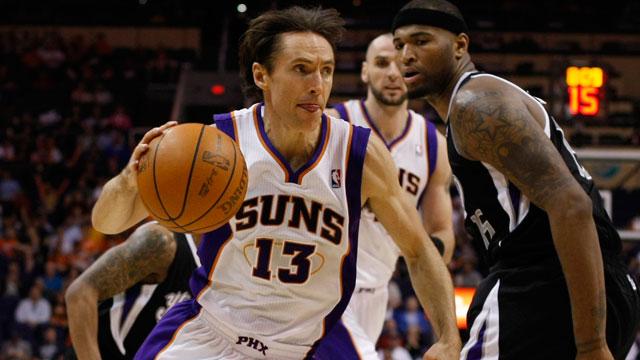

IN PHOENIX, FOR SPORTSNET MAGAZINE — Sixteen seasons in the league, 38 years on the calendar and Steve Nash remains the kid who can’t sit still. As his Phoenix Suns teammates gather outside their dressing room in the hall of US Airways Arena, Nash sprints furiously in place, pumping his size 13 low-cut (old-school) Nikes like pistons, his hands slicing the air, looking about as impressive as you can without going anywhere. He beckons his teammates around and they come, a motley crew of journeymen and roster filler, all younger, save for fellow NBA senior citizen Grant Hill. None of them are as accomplished. Not even close. If and when the time comes for Nash to bolt from the desert, chances are he’ll look back at who he played with and go: “Really? I spent two years trying to get them into the playoffs?”
This is what Nash calls a “professional night”—an occasion when the opponent and the stakes and the crowd don’t quite stir the blood, but duty calls. “Fifteen on the clickity,” he shouts, referring to the countdown to game time. The mismatched Suns raise their hands: “1-2-3,” he says. “Suns” comes the answer. And on cue Nash is all forward motion, racing down the hall and up the tunnel to the court just as he has hundreds of nights before as the franchise favourite.
For a certain type of basketball fan, that left turn up the tunnel has always been a very good thing. It’s where basketball changed. It’s where Nash made a team do special things, and fans could believe in a pro sports fairy tale where virtuosity and virtue would light the way to the mountaintop. The Suns were the most compelling team in basketball, with Nash as their frenetic maestro. But that’s so five years ago. Tonight that left turn leads to a crappy loss to the middling Golden State Warriors in the Suns’ last start before the All-Star Game. “I’m disgusted with the way we played,” was Suns coach Alvin Gentry’s assessment a few hours after another weak home-floor performance in a season full of them. It was just one game, but the reality is the Suns are done, a grand idea stripped down and sold for parts.
The only question is where Nash is going to run to next.
The NBA trade deadline passed on March 15 without incident, at least for the Suns and Nash. For some, this was a minor tragedy. Watching Nash spend the shoulder season of his prime playing for a team that will be touch-and-go to make the post-season (and an easy out should they qualify) seems like a waste of Nash’s gifts. The prospect inspired the fledgling “Free Steve Nash” movement on Facebook, which was taken up by TNT commentator Chris Webber (who started chanting it while calling a Suns-Nuggets game) and seconded by ESPN’s Bill Simmons, who even speculated in his annual pre-trade deadline opus that Nash had lost his nerve—“I think he likes toiling away on mediocre teams, playing that martyr role and having everyone feel sorry for him. Poor Steve Nash! Look what the Suns did to him! We have to get Nash out of there!”—before adding, via stage whisper, that: “I just wanted to use a little reverse psychology to get Nash to ask for a trade because Phoenix is obviously too cowardly to accommodate him. I’m at wit’s end. Don’t you want him in the playoffs?”
That ain’t happening (chances are) and the Suns’ decision not to trade Nash seems unfathomable from a distance. Not trading a veteran star from a bad team is like not rolling up the rim or failing to scratch your lottery ticket. The NBA trade deadline is a blunt instrument that swings two ways. Some teams judge themselves in need of a talent infusion to help them compete in the playoffs, others look at what they have, where they are, and figure: screw it, time to liquidate. Throwing your season and your veterans overboard and swimming for the distant shore of the NBA draft is a perfectly rational choice in a league where a franchise’s entire trajectory can be changed by selecting the right skinny teenager. It’s not really the “if” so much as the “when” that drives the debate. Are there a few more playoff dates to harvest? Or is it best to slash and burn the present for an undefined future?

Steve Nash will leave the game as one of its best passers.
There’s little doubt where the Suns are on the continuum. After a shocking last-gasp run to the Western Conference finals in 2010, standout forward Amar’e Stoudemire was allowed to leave—he signed with the New York Knicks as a free agent—and the Suns missed the playoffs in 2011. In Nash and Hill they were returning the oldest pair of starters in the league by far, and with precious little around them. Their 12-19 record through mid-February confirmed the obvious: It was time to start anew and leverage Nash’s all-star-calibre point guard value to kick-start the process. It was time to #freestevenash.
But Nash didn’t follow the script calling for the veteran star to ask for parole—to be released from the shackles of ordinariness. Standing in front of his locker, as media of various stripes and allegiances tested him, waiting for him to throw his hands up and shout, “This team sucks, get me out,” he never once stepped off Loyalty Island, making him a man alone, the NBA equivalent of Tom Hanks’ character in Cast Away: “One, it’s not my style to ask for a trade. And two, I feel like I’d be giving up on my teammates,” he says to me after the game, before heading into the dry desert night in scruffy skinny jeans, a short-sleeved plaid shirt buttoned to the top, nerd-style, and a pair of boat shoes. “We’ve had a lot of success here, and for me, when the ship starts to sink a little bit, to be the first one off? I don’t feel that comfortable with that.”
But, but, but… what about a ring? Your legacy? goes the refrain. Nash finding his way to a contender as his competitive clock ticks down matters not just for him and a sizable population of fans who simply want the best for him. It’s also imperative to a strain of hoops true believers who would like nothing better than to shove it in the face of the defence-first high priests who take the Suns’ failure to win a title as proof that fun-and-run can’t win, period. Um, Steve? There’s a lot at stake here.
Thanks for the concern, but chill, says Nash, who can get zen-y with it with the best of them. Want proof?
“I don’t feel like I need the justification,” he says. “I know what I can do. I know that I’m a great competitor and basketball player. Don’t get me wrong, I’d love to have a shot at it and I believe that I still could, but now isn’t the time to start demanding trades.”
It’s a Nash-ian masterstroke, really—as clever as the no-look bounce passes he’s thrown across his body and through a tangle of arms and legs to cutting big men for a waterfall of easy baskets during his career. Not to suggest he was anything but sincere, but merely being kind of normal (“Look, he reads books!”) and sticking by his long-time employer, Nash solidified his reputation as the anti-LeBronMeloDwightChrisPauletc. By standing firm in his commitment, he simultaneously remained true to the spirit of his image as the NBA player who has built a Hall of Fame career based on thinking team first (it should be pointed out that, as a point guard whose primary gift was court vision, being a team guy has always been Nash’s best route to maximizing his talent) while enhancing his good-guy brand.
It comes naturally, which helps: “If you know Steve and the fibre of what he is, I don’t think it surprises anyone around here,” a calmer Gentry was saying before the game from behind his desk in his large, square office. An NBA lifer, Gentry was the lead assistant on the “Seven Seconds or Less” Suns led by Mike D’Antoni, who trusted Nash to play the game at warp speed and unleashed his waterbug ways on the NBA in 2004–05. The result was two MVP awards and 232 regular season wins in four star-crossed seasons playing an aesthetically pleasing brand of basketball that never quite earned mainstream acceptance because injuries, bad luck and—the high priests would argue—a lack of defence left them short of a championship. They were the beloved indie flick that got shut out come the Oscars.
Nash was the floppy-haired Canuck who made it go: a filmmaking, book-reading, anti-war-T-shirt-wearing gift to the earnest hipster fan base that has informed the NBA to such a great extent over the past decade. Gentry and Nash are the only holdovers from that brilliant experiment, and they lean on each other as reminders of what used to be. “In most cases, guys would say: ‘I want to move on,’” says Gentry, who is less a coach to his Hall Of Fame–bound point guard than an occasional sounding board. “The guy’s got a loyalty about him. There have been times I’ve been down a little bit and he’s the one saying to me: ‘Don’t get down. Hang in there. We’ll find a way to get this turned around.’ That’s really unusual for today’s guy.”

Which doesn’t mean Nash will stay in the desert forever. In fact, the farther Nash looks into the future, the more open-ended his musings get. Leaving Phoenix would have its complications, including managing the shared custody arrangement he has with his ex-wife Alejandra and their three children, but Nash sounds like he’s willing to consider his options: “I don’t want to not be here because [time with my kids] is very valuable to me, but I’m not going to make that the only factor or the biggest factor in whatever happens in any decision,” he says. “It will be an interesting summer. I would love to be back here. I would also love for us to add some pieces, so we’ll see.”
And with that we introduce you to Lon Babby, the Suns’ president and the person who will either go down in franchise lore as the guy who signed Nash to a contract in the vain hope of returning the Suns to competitive relevance or the guy who let one of the most popular athletes in the history of Arizona (there are only two jerseys hanging in the sports pub at Sky Harbor Airport: one belonging to Pat Tillman, the former NFL star and tragic war hero, and Nash’s No. 13). A bookish-looking lawyer turned player agent, Babby took over the Suns as the franchise began to ebb away from its high water marks in 2010. Now he’s the man charged with steadying its future without hand-grenading its present or tarnishing its past. No biggie. “What I’ve said all along is Steve’s earned the right to stay here as long as he wants, provided that he believes in what we’re doing and believes in the direction that we’re going and is all in,” Babby says when I catch him in the hall on his way to chat with some team sponsors. Does that mean he’ll sign Nash this summer? “I’ll jump off that bridge when we come to it.”
In a way, it was Nash who put the Suns in this position by continuing to play better than his age argues he should. Logically, his game should be falling off a cliff, making for an easy mutual parting called retirement, but Nash is an all-star who has talked about playing another five years. It’s far-fetched maybe, but Suns trainer Aaron Nelson has Nash’s game-day routine memorized—it begins early and involves an array of massages, rubdowns, adjustments, and hot and cold baths, and it finally ends about 14 hours later.
It seems to work. Nash is 15 lb. lighter than in his rookie year. He has the gaunt-yet-muscled look of an underwear model, minus the waxed chest and the spray tan. On Feb. 7, Nash’s 38th birthday, he torched the Milwaukee Bucks’ Brandon Jennings—the type of bottled-lightning point guard whom Nash shouldn’t have a hope of keeping up with—for 18 points, 11 assists and the game-winning basket.
But perhaps the best way to appreciate his still-formidable skill is through the gushy swoon of Marcin Gortat, the 28-year-old centre who averaged 3.6 points per game in his last full season backing up Dwight Howard in Orlando. Working the pick-and-roll with Nash has turned the former Polish soccer goalie into a near all-star, with averages of 16 points and nearly 11 rebounds a game. When I asked him about how Nash had helped his career, he got comfortable against a wall outside the Suns’ weight room and composed a 20-minute love note to his point guard. “One day I’m going to write a book and a huge chapter in that book is going to be playing with Steve,” he said in his Eurodrawl. “Being honest with you, right now this guy is a legend.”
The question for the Suns is whether they can afford to begin rebuilding around the skills of a 38-year-old point guard, legend or not. After all, Nash, for all his loyalty, won’t come cheap. He’s making $11.7 million this year and said if the Suns try to coax a discount from him, it will be at their peril. “If you’re sacrificing something,” he says, “what’s it for?”

Moreover, the drumbeat has already begun in Toronto for the Raptors to pay Nash whatever it would take to have him finish his career at home. Contenders like the Heat and the Lakers could stand to upgrade their point guard play, and the Knicks’ win-now roster is badly in need of his leadership, even if Nash’s pal D’Antoni was pushed out.
When it’s all taken into consideration, Nash’s willingness to stand pat at the NBA trade deadline sits solidly in crazy-like-a-fox territory—one more example of Nash seeing the game two steps ahead. He avoided opening Pandora’s Box by not stumping to get out of town, risking being traded to a team or situation not of his choosing. Meanwhile, his reputation as the superstar with team-first values remains intact, his bond with Suns fans unbroken. At this point, were Nash to leave as a free agent, the people of Phoenix would be more likely to have a parade for him than run him out of town. “If Steve does leave, I don’t know if there’s anyone who can say anything bad about him,” says soccer star and friend-of-Steve Thierry Henry from a courtside seat as Nash warmed up a few feet away. Henry knows something of leaving and being welcomed back, as his cameo this past winter with his old club Arsenal proved. “Steve is not the kind of guy who [if he leaves] when he goes back, everyone is going to say he didn’t try. He busts up his nose, his lips, his eyes and he wants to stay on the court. And people recognize that, and that’s why fans love Steve Nash.”
Come July 1, Nash’s long and mutually beneficial relationship with the Phoenix Suns will be contractually over. Barring some sleight of hand by the Suns’ front office, he will have turned left and run up the tunnel for the last time, the Suns’ moment in the NBA spotlight officially done. Even if the magic faded from the relationship years ago, no one will ever say he didn’t fulfill his obligations. He would be leaving the franchise better than he found it, and if he ever had eyes for another team, he never embarrassed Suns fans by making a big show about it as so many of his fellow superstars have. Fairy tales may not come true, but chivalry is not completely dead. He will be on the market as an all-star point guard of impeccable character, and demand should drive his price up considerably. He will be able to choose where to finish his career and on what terms.
Steve Nash might be sprinting in place for now, but he’s just getting warmed up. Well played.