
Four shows, four main event changes, and two injury-ravaged line-ups — that is the reality of what the UFC has brought to fight fans west of Ontario over the last three years.
Starting with UFC 115 in June 2010 and running through UFC 161 this weekend, fans west of the “Centre of the Universe” (read: Toronto) have consistently ponied up big bucks to make events in Vancouver, Calgary, and now Winnipeg rapid sellouts, only to see the projected headlining act undergo changes each and every time.
Vancouver’s debut event was supposed to feature a third meeting between longtime rivals – and TUF 11 coaches – Chuck Liddell and Tito Ortiz. UFC president Dana White even guaranteed our own Showdown Joe Ferraro that the historic grudge match would take place.
It didn’t.
Ortiz pulled out with an injury and was pulled off the reality television competition, replaced in both by veteran Rich Franklin, who went on to knockout Liddell late in the first round of what would prove to be the final appearance of “The Iceman” in the Octagon as a fighter.
One year later, another TUF coaching battle was supposed to unfold in the cage at Rogers Arena. This time, heavyweights Junior dos Santos and Brock Lesnar were scheduled to lock horns and trade leather, but once again, it wasn’t meant to be.
Lesnar suffered a recurrence of the diverticulitis that sidelined him during his title reign and was ultimately replaced by Shane Carwin, who was dismantled by dos Santos in what would turn out to be his final appearance in the UFC cage as well.
And then came Calgary.
Initially, this card was loaded with big name talents and exciting pairings, including a featherweight championship main event between Jose Aldo and Erik Koch, and bouts involving proven stars Michael Bisping, Mauricio (Shogun) Rua, Antonio Rodrigo Nogueira and Thiago Alves. The lineup that ended up airing on pay-per-view from the Scotiabank Saddledome bore little resemblance to the originally scheduled collection of contests.
The UFC endured an unprecedented run of bad luck in the injury department, leading to bouts being shifted in multiple directions, and the summer consisting of a series of weak events, with UFC 149 being the most underwhelming of the bunch.
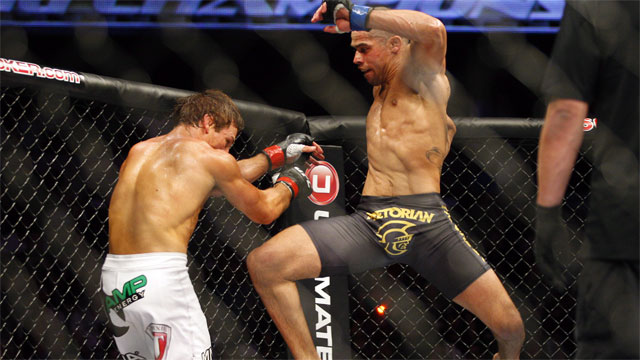
To make matters worse, the main card fights simply fell flat, with a trio of tepid decisions killing the mood before Renan Barao defeated Urijah Faber to win the interim bantamweight title in a solid fight that had no chance of being well-received after what preceded it.
White was frustrated and disappointed at the post-fight press conference, and promised to make it up to the people of Calgary. They’re still waiting for their “do-over.”
Now comes UFC 161, the organization’s debut event in Winnipeg, and things aren’t looking much better.
After being a consolation main event last year in Calgary – and last having fought as the headlining act on a FUEL TV event from London, England in February – Barao was slotted opposite Eddie Wineland in the main event, with a pair of solid match-ups between veteran light-heavyweights serving as the lead in to the bantamweight championship bout.
Rounding out the main card was were Canadian Alexis Davis taking on Rosi Sexton and fan favourite heavyweights Pat Barry and Shawn Jordan on the pay-per-view opener.
If everything held up, it was going to be a strong event, but true to form, things have fallen apart.
Barao was forced out of his bout with Wineland due to an injury, pushing Rashad Evans and Dan Henderson – who are a combined 1-3 in their last four fights – into the main event. Two weeks before the event, Antonio Rogerio Nogueira pulled out of his rematch with Rua, citing an old, lingering back injury. Chael Sonnen was momentarily attached to fill-in, but the bout couldn’t come together, leading to Rua being pulled from the card entirely.
Swapping in Roy Nelson against Stipe Miocic (in the place of Soa Palelei) was a wise move, but the addition of “Big Country” isn’t enough to redeem this event.
One year after Calgary watched every fight on the main card change from announcement to actually hitting the cage, 60 per cent of the line-up for Winnipeg’s first UFC event has shifted, leaving UFC 161 with a main card that looks more like what you’d find on FX or FUEL TV – or FOX before the UFC figured out the formula that works best on network television.
By these standards, the two Vancouver events – both of which were long on Canadians and short on bouts with immediate divisional impact – look like all-star affairs.
Will UFC 161 still produce some entertaining fights? Probably, but it’s preposterous for the organization to use that as a counter to fans and media questioning the weaker fight card being put forward.
The two are incongruous and the UFC needs to stop trying to push the “it’s still going to be a great show” line every time a card is ravaged by injuries.
No matter how exciting and entertaining UFC 161 turns out to be, it doesn’t make up for the fact that fans paid pay-per-view prices for what has morphed into a “free on television” calibre fight card.
Even if Ryan Jimmo and Igor Pokrajac combined for the Fight of the Year, it doesn’t change that fans didn’t get to see Barao and Wineland or Rua and Nogueira. No amount of Pat Barry and Shawn Jordan heavyweight brutality makes up for the fact that, once again, a sellout crowd west of Ontario is getting nothing close to what they initially shelled out to see, and suggesting “you’re still going to have a great time” is insulting to your loyal, paying customers in my opinion.
When situations like this happen with fight cards in major markets, the UFC throws ever big name they can coax into fighting into the cage to prop the event up. When it happens in Winnipeg or Calgary, they make do by primarily promoting from within the original fight card and suggest the event is just as good as when it was initially constructed.
UFC 153 in Brazil was infused with an impromptu Anderson Silva appearance, and Brazilian icon Antonio Rodrigo Nogueira when injuries forced changes to that show’s main and co-main events; Winnipeg gets the co-main elevated to main event standing, and Jimmo and Pokrajac promoted to the pay-per-view.
With all due respect to the parties involved, those two replacement scenarios are nowhere close to comparable.
It’s not the UFC’s fault that all of these injuries and general bad luck have ravaged these main events and fight cards over the last couple years, but they can’t keep trying to sell used cars at new car prices, and expect fans to buy the “trust us – it’s still going to be exciting and we’re going to make it up to you” rhetoric they consistently use in these situations.
Admit the card has taken a hit and is not as good as originally planned and then actually try to make it up to the fans in some way.
Even something as small as giving everyone who walks through the doors at the MTS Centre on Saturday a free souvenir program will go a long way to showing the fans in attendance that you appreciate their support, and want to do right by them in whatever way possible.
While the timing and logistics of adding top-flight replacements to the card didn’t work out, the UFC can still salvage some good will and continued support by just acknowledging that things went south (again), and holding true to their promise to try and make it up to the fans next time around, provided the “next time around” comes quicker than it has for the fans in Calgary.
[polldaddy poll=7170188]