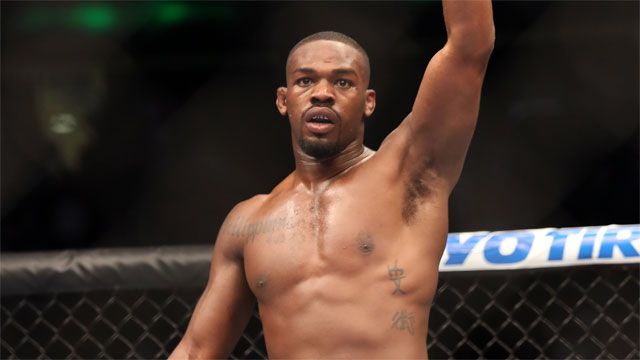

It was easy selling Jon Jones’ first appearance in Toronto as the bright young star with the freakish moves. And to a certain extent, his second appearance represented the dramatic turn in his life when he became a fallen idol. But how do you sell his third appearance?
This will be up to the UFC marketing department now that the word is out that Jones will be returning to Toronto in September to headline UFC 165. The UFC will present its fourth show in Toronto since the Ontario government relaxed the rules in 2010 to allow professional mixed martial arts in the province and, if nothing goes awry with his health, Jones will be part of three of them.
This is Jones’ Toronto trilogy.
His first appearance at UFC 140 on December 10, 2011 drew a reported attendance of 18,303 and a gate of $3.9 million. The pay-per-views totaled 485,000. The card also featured former champion heavyweights Frank Mir and Antonio Rodrigo Nogueira in the co-main event and legendary Tito Ortiz facing Nogueiro’s brother Antonio Rogerio.
Jones’ second appearance last September at UFC 152 recorded an attendance of 16,800 and a gate of $1.9 million. The PPV dipped to 450,000. The event did not have the same star power, although it featured two title fights, the other being the first-ever UFC flyweight championship fight, which was originally supposed to be the main event. The addition of Jones following the cancellation of UFC 151 earlier in the month in which he was supposed to be the main event pumped up the Toronto card. The flyweight title fight lacked marquee value, if only because the division was still in its infancy stage.
So this will be three appearances in less than two years for Jones. Put it this way: you could put legendary Canadian welterweight champion Georges St-Pierre on every Toronto card and it would be an instant sellout and automatic appeal. Such is the difference between GSP, the top attraction in the UFC, and Jones. Jones may turn out to be a better all-around competitor than GSP if he continues along the same trajectory, but not everyone is buying his talent.
Literally.
GSP has the capacity to draw 1 million or more PPVs. Jones has a ways to go before he reaches that level – if he ever does.
From the first-ever UFC card in Toronto, that took place at the Rogers Centre and drew a record crowd 55,724, to the third card, the thirst for seeing the biggest MMA promotion in the world has dipped. It has become more for hardcore fans that are willing to pay top dollar than those who came for the first time and aren’t coming back.
In a perfect scenario, Jones could have fought in the UFC 164 card three weeks before the Toronto card in Milwaukee, but he is recovering from a nasty broken toe suffered in his last fight and clearly needs more healing time. UFC 164 will be headlined by lightweight champion Benson Henderson facing rising Canadian star TJ Grant, whose appearance in Toronto would have been far more appealing to a Canadian audience. But Grant will have his day, even if it’s not on home soil.
Had the Henderson/Grant tilt happened in Toronto, it would have marked the champion’s second appearance there. Henderson fought on the inaugural Toronto card in April 2011 when he was only beginning to emerge as a possible champion in the making. He beat a Canadian fighter, Mark Bocek, and was roundly and soundly booed after the fight by the partisan crowd.
So instead of a double shot of Henderson, it’s a triple of Jones.
Jones is already a polarizing figure – despite all his talents he simply has not been embraced by fans with the same popularity of St-Pierre or others of that ilk. In his last appearance in Toronto, Jones drew a loud chorus of boos entering the Air Canada Centre. His opponent, Vitor Belfort, received hearty applause, embraced as if he was the champion and not the challenger.
Jones chose Bob Marley’s song Could You Be Loved as his entrance music in his walk toward the cage, making his own statement. It followed a trying period in Jones’ personal and professional life: a charge and subsequent guilty plea of driving while intoxicated in April, and then the cancellation of the UFC card in which he was supposed to be involved in the main event, but refused to accept the challenge of a replacement on short notice.
The UFC had never cancelled an event before and it did not sit well with the company, but all was resolved when Jones came to Toronto three weeks later and defended his belt with the heart and courage of a champion. He overcame an armbar in the first round – essentially fighting with the use of an injured limb, which would later be diagnosed as a ligament strain – to force Belfort to submit in the fourth round with an Americana. In Jones’ first appearance in Toronto, he beat another former Brazilian UFC light heavyweight champion, Lyoto Machida, with a standing guillotine choke that was absolutely sublime.
His next opponent is Sweden’s Alexander Gustafsson, who has only lost once in 16 fights and is undefeated in his last six bouts. The 26-year-old Gustafsson is older by less than two months and is an inch taller at 6-foot-5. He has a reach of 76.5 inches, giving up eight inches to Jones, who’s wingspan is superhuman.
It’s an interesting bout, but you wonder if it’s too much of one fighter, even if he happens to be the future face of the company. Winnipeg has its first-ever UFC card this Saturday and it does not have a title fight, although one was originally scheduled and had to be withdrawn due to interim bantamweight champion Renan Barao suffering an injury. The Winnipeg card is not too bad overall, but MMA fans must think Torontonians are spoiled getting to see Jones fight there so often.
It has often been said by those in other parts of Canada that Toronto likes to think of itself as the centre of the universe. Turns out that it is the centre of Jon Jones’ universe.
No Bones about it.