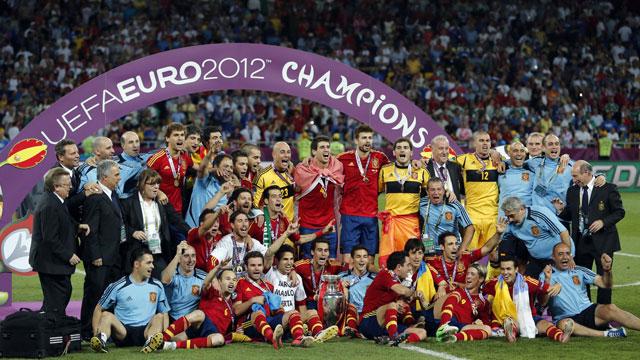

In case you missed it, here are the highlights from Sunday’s Euro 2012 final between Italy and Spain in Kiev.
The score
David Silva and Jordi Alba scored first-half goals, and Fernando Torres and Juan Mata both found the back of the net late in the game to guide Spain to a convincing 4-0 win over its arch-nemesis.
What this result means
Spain made history on Sunday by becoming the first nation to repeat as European champions. The Spanish are also the first side to win three consecutive major tournaments: Euro 2008, 2010 World Cup, and Euro 2012. Italy’s quest for a second European title (the Azzurri won on home soil in 1968) continues for at least for another four years.
The major storyline
What can you say, really? What is there that hasn’t already been said about Spain?
La Roja cruised into Sunday’s final without really breaking a sweat at this tournament, riding its luck and easing past opponents without really being tested. Along the way, Spain was labelled “boring,” fans and critics unimpressed and having grown tired of their magnificent tiki taka and lack of direct play.
This would be different, though. Italy challenged Spain during a 1-1 draw in the group stage, and won plaudits and praise for its attacking style of play and newfound positivity under manager Cesare Prandelli. And after Italy dispatched Germany, touted as the tournament favourite, many thought they could derail the Spanish juggernaut.
Turns out the Italians were on a fool’s errand. The only team that can stop Spain is Spain.
The Spanish made the Italians look decidedly average, humbling a wonderful Azzurri side by dominating possession and dictating the pace of the game as though they were facing a Sunday pub team.
Italy was guided by thoughts of grandeur, but Spain was chasing history, and faced with the task of beating its sternest opponent at this tournament, it switched into high gear and turned on the style — and then some.
It took the Spanish all of 14 minutes to breach the Italian defence, David Silva’s goal the product of a breathtaking and sweeping move that embodied the very best qualities of tiki taka: speed, flare, precision passing and a great flourish to end a fabulously-crafted scoring sequence.
Italy valiantly fought back and called the tune for a bit but it didn’t last.
Xavi threaded a perfect pass for Jordi Alba who sprint past a cluster of Italian players and sped in on goal, cooly slotting the ball home past Gianluigi Buffon just before halftime.
The result was never in doubt after that. The second half was a mere formality. When Thiago Motta went down injured and Italy was reduced to 10 men, it became painful to watch Spain mercilessly pick apart their wounded and lame opponent.
Substitutes Tores and Mata scored in the 84th and 88th minutes, to complete the rout.
The final result was harsh on Italy, but in some sense a 4-0 win was the very least Spain deserved as the European champions took their rightful place in soccer history.
Really, you can’t overstate how colossal of an achievement this is. It’s just not possible. They deserve every single accolade heaped upon them.
Not only is Spain the first nation to repeat as European champions, but it is also the first to win three major tournaments in a row: Euro 2008, 2010 World Cup, and Euro 2012.
Their remarkable run over the last four years assures them of a spot in the soccer pantheon alongside the game’s truly legendary teams, including Pele’s Brazil, Franz Beckenbauer’s West German machine, and Hungary’s Magical Magyars.
The sheer magnitude of Spain’s dominance is even more incredible when you consider the nation’s long and notorious history as a chronic underachiever.
Finally, a question for those who think the Spanish play a boring style of soccer and slam them for not being more direct: Would you also have asked Picasso why he didn’t use brighter colours to paint Guernica?
Would you have preferred it if Santiago went fishing for a shark instead of a marlin in Hemingway’s The Old Man and the Sea? If Beethoven’s Ninth Symphony was only three movements in length? If Shakespeare’s sonnets were in the form of a haiku?
Plain and simple, what Spain produces on the pitch transcends soccer — it is art of the highest form and greatest quality. That more people don’t realize it and appreciate it isn’t all that surprising in this modern age of instant gratification and pith where everything is succinctly broken down in 140 characters on Twitter.
More’s the pity.
Interesting tidbits
Spain’s Vicente del Bosque is the first coach to win the UEFA Champions League (with Real Madrid) and the World Cup and European Championship. He is only the second coach to win the World Cup and European Championship, joining Germany’s Helmut Schon in 1972 and 1974.
Spain only trailed once in this tournament, when Italy’s Antonio Di Natale scored in the 61st minute of a 1-1 draw in the group stage. After that, Spain went the rest of way without conceding a goal, a stretch of 509 consecutive minutes.
This was the fourth time that teams who met in the group stage of Euro faced off in the final: Netherlands vs. Soviet Union in 1988, Germany vs. Czech Republic in 1996, and Greece vs. Portugal in 2004.
Spain’s Fernando Torres is the first player to score in two Euro finals.
Six starters for Spain on Sunday also started in the Euro 2008 final triumph against Germany: Iker Casillas, Sergio Ramos, Andres Iniesta, Xavi Hernandez, Cesc Fabregas, and David Silva.
Chelsea stars Fernando Torres and Juan Mata have won the UEF Champions League and European Championship in the same season. Others to achieve that feat: Luis Suarez (1964, Inter Milan and Spain) and Hans van Breukelen, Ronald Koeman, Barry van Aerle and Gerald Vanenburg (1988, PSV Eindhoven and the Netherlands).
Spain is undefeated in its last 20 competitive matches, its last loss coming against Switzerland in the first round of the 2010 World Cup.
Spain is unbeaten in its last 10 games overall (eight wins), and has not lost since dropping a 1-0 decision to England last November.
Spain has earned nine wins (with 12 draws and 10 losses) in 31 games against Italy. Seven of those victories came in friendlies.
In 12 competitive games against Italy, Spain’s record is three wins, four draws and five losses, including a Euro 2008 quarter-final victory via shootout. Spain’s other win came in the sides’ first meeting at the 1920 Olympics in Belgium.
Goal of the game
The first three were very nice, but the award goes to Spain’s opener in the 14th minute. Andres Iniesta delivered a sublime pass that unleashed Cesc Fabregas into the box. The Barcelona man reached the end line and then expertly chipped the ball back for David Silva, who slipped between two Italian players and scored on a powerful header.
Save of the game
Down a goal but surging, Italy furiously pressed forward. Ignazio Abate unleashed a fierce, low and driving shot from distance in the 33rd minute. Iker Casillas did very well to get down and parry the ball away, keeping the Italians off the score sheet.
Burning questions
Is this Spanish side the greatest national team of all time?
Where does Spain go from here? Will Vicente del Bosque stay on as coach? If so, will he completely overhaul the squad? Will he continue to use the famous “false nine” formation? Can Spain make it four major tournaments in a row by winning the 2014 World Cup in Brazil?
Is this the last we’ve seen of Andrea Pirlo (33 years old) and Xavi (32) playing for their national teams?
Has Mario Balotelli matured to the point where all of his bad boy antics are completely out of his system?
Did Italy do enough with its new attacking philosophy and style of play under Cesare Prandelli to win the respect of critics and neutral supporters?
3 stars
1) Andres Iniesta: The best player in the tournament was Spain’s chief midfield organizer, and he delivered the killer pass that led to the first goal.
2) Xavi: Like his Barcelona conspirator Iniesta, he was sublime in the Spanish midfield, delivering the pass that freed Jordi Alba to score and make it 2-0.
3) Cesc Fabregas: Third member of Spain’s magnificent midfield trio laid off the pass for Silva’s goal and was a constant creative force for his country.
POLL:
Is this Spain side the greatest national team of all time?
$(“#poll_10082”).v2Poll({poll_id: 10082});