
On May 15, 1991, Manchester United and Barcelona met at Rotterdam’s De Kuip stadium to contest the final of the European Cup Winners’ Cup.
And Alex Ferguson, completing his fifth season with United, found himself overwhelmed by the occasion.
Although the 49-year-old Scot had taken Aberdeen to a European final against Real Madrid in 1983, this one with United was another experience entirely.
“As our (team bus) made its way to the stadium through streets brightened by the colours of rival fans,” he writes in his autobiography, Managing My Life, “the sight that warmed me most was the smiling face of Sir Matt Busby. He was glowing with pride.”
Ferguson continues: “When the (bus) drew up outside the main entrance, our supporters were in a frenzy, battering the windows and sides of the bus, urging us with clenched fists and screaming out affection for the team. But as the door swung open and Sir Matt led us out, the clamour ceased instantly and in its place there was polite clapping, which he acknowledged with a dignified wave. There could hardly have been more reverence for the Pope in St. Peter’s Square.
“It was a moment I knew I would remember forever. I just followed on behind Sir Matt. ‘I’m with him,’ my body language was saying.”
Comfortable retirement
When Sir Matt Busby resigned as Manchester United manager in 1969, he was named a club director — and eventually made president — and was given an office at Old Trafford.
The 60-year-old had very much earned the trappings of a comfortable retirement.
Approached by United several months before the end of the Second World War, Busby took over a team with just three major trophies to its name and a bombed-out stadium to repair. But repair it he would, and as Old Trafford rose from the ashes so too did Busby’s United, winning five First Division titles, two FA Cups and the European Cup over a memorable, 24-year period.
From the Busby Babes to the Munich Air Disaster to the side of Charlton, Law and Best, so tied to Busby were United that it was difficult to separate the man from the club.
And so they didn’t.
Busby, after hand-picking Mancunian and former United player Wilf McGuinness as his successor, stayed very much in the picture at Old Trafford, and after the woefully inexperienced McGuinness was sacked less than two years later he re-took control of the team on an interim basis.
While a succession plan isn’t something most clubs have to worry about, when a manager’s longevity and success have combined to make him a larger-than-life figure, it is absolutely vital that pre-meditated, intentional preparations are made to ensure the organization doesn’t walk out the door with the man who put it all in place.
United botched their first attempt at the succession roadmap, but that they did bodes well for David Moyes as they look to avoid the mistakes of times past.
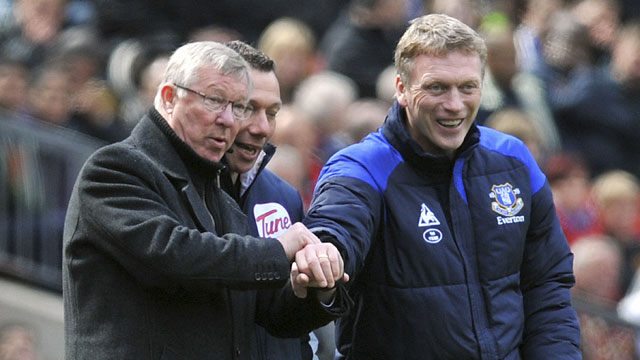
Ferguson and Moyes
In a recent interview with the Telegraph former Preston North End player and current Fleetwood Town manager Graham Alexander revealed why he moved to Deepdale, where Moyes had been in charge for six years, in 1999.
“(Moyes) was the reason I signed for them,” he said. “I’d lost my way a bit and he told me he would make me a better player… He’d pick up tiny things in your performance that he wasn’t happy with and criticise you for it, but then the penny dropped. He did it to make me a better player. He had an amazing work ethic and he knew exactly what he wanted from his team.”
A steadying hand, a teacher, a disciplinarian. Sound familiar?
Ferguson and Moyes have more in common than simply a working class Glasgow upbringing. And while Moyes, as Sir Bobby Charlton said in a statement, will have a chance to “express himself” at Old Trafford, he’ll likely take a student’s approach for a few years as well.
After all, even Ferguson’s education didn’t end with his first sniff of success at Aberdeen.
About his appointment as interim manager of the Scottish national team in the mid 1980s, Ferguson writes, “The Scotland get-togethers were an absolute revelation for me —priceless access to the mind and personality of Jock Stein. I am sure there were times when he got fed up with my incessant barrage of questions.”
Whether it was Stein or Busby, Ferguson not only respected the giants on whose shoulders he stood, he gleaned as much information from them as humanly possible.
Moyes, with Ferguson’s office just down the hall, will have a similar opportunity.
Hired because his qualities already jive with his predecessor’s, the outgoing Everton manager already has a leg up on Wilf McGuinness. And if he can take advantage of Ferguson’s ongoing presence at United he, too, just might follow a club legend into a European final.
Jerrad Peters is a Winnipeg-based Writer. Follow him on Twitter