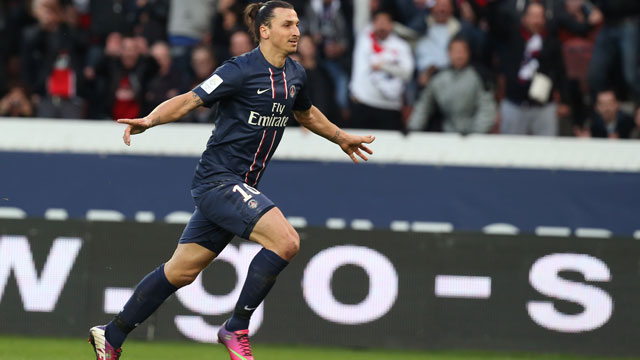

The champagne is on ice, for now.
On Saturday, Andre-Pierre Gignac’s brace at Stade Velodrome helped Marseille to a narrow win over Bastia, meaning Paris-Saint Germain would have to wait at least another week before celebrating a Ligue 1 title that has seemed destined for the capital for months.
Even a win at home on Sunday against Valenciennes will not be enough for PSG to secure only their third championship and first in 19 years.
With three straight wins and a nine-match unbeaten run, Marseille have at least kept things close at the end. Although with a goal-difference advantage of 34 and a potential nine-point lead with three rounds to play, PSG’s trophy will have been guaranteed by everything except mathematics if they beat the 12th-place Atheniens at Parc des Princes.
And so the top-flight of French soccer will go into a 36th matchday without a champion. Even with all their talent and all the money spent, PSG will have to wait. And that’s a good thing.
Investment
Last summer Paris-Saint Germain, backed by the Qatar Investment Authority, spent nearly €150 million on squad upgrades.
Former AC Milan duo Thiago Silva and Zlatan Ibrahimovic headlined an incoming group of superstars that also included Napoli forward Ezeqiel Lavezzi, Pescara midfielder Marco Verratti, Ajax right-back Gregory van der Wiel and Sao Paulo winger Lucas Moura, and then in January came the news that they had picked up David Beckham as well — the 37-year-old no doubt acquired as much for his marketing potential as right-footed free kicks.
The outlay brought the QIA’s spending to more than €250 over less than two years — a game-changer in any division, but especially so in the usually modest Ligue 1.
Nevertheless, PSG were forced to wait another year for that inevitable title when they were pipped to it by Montpellier last season. And they are waiting still. They may have altered the landscape of French soccer, but they have yet to master it. That they have a financial advantage is obvious, although perhaps not as pronounced as it seems.
The fact is a rich and splurging PSG is good for Ligue 1 as a whole. The National Directorate of Management Control (DNCG) that monitors the accounts of French clubs has typically ensured losses are kept to a minimum (Lyon’s €28 million operating deficit for 2011-12 was seen as catastrophic, but is small when compared with the most indebted clubs of rival leagues), although the restraints have also helped deter meaningful investment, which in turn has meant Ligue 1 has struggled to attract top talent.
That PSG have blown the lid off the cap should ensure a stream of high-profile players trickles into France, and with those acquisitions will come the subsequent sponsorship and television revenues that have already been growing in recent years. There is considerable potential for a more financially robust Ligue 1, and with the DNCG oversights still in place it’s unlikely that losses would ever spin out of control.
Profitable
This winter the Deloitte accounting firm released its latest Money League table — a top-20 listing of the most profitable soccer clubs in the world. PSG weren’t on it (they will be going forward), but Marseille was ranked 16th and Lyon 17th.
Both clubs, as well as PSG and 2010-11 champions Lille, are part of what the Ligue de Football Professionnel (LFP) considers “Group 1” of a five-group economic structure in the French top flight.
In concert, Ligue 1’s four biggest clubs produced 49 per cent of the division’s total revenue last season, while Group 2 — consisting of Bordeaux, Montpellier, Rennes and Saint-Etienne — contributed 19 per cent. It’s a disparity both the LFP and DNCG are keeping an eye on, but in no way is it a threat to the league’s sustainability.
In fact, the LFP and DNCG controls were referenced by UEFA as European soccer’s governing body crafted its own Financial Fair Play measures, and that not a single club in France is presently in violation of the incoming rules speaks volumes as to their effectiveness.
But beyond profits, each of the LFP’s five groups offers something unique, which is part of what makes French soccer so special.
For example, Group 2 Rennes and Group 4 Lorient boast two of the best youth academies in Europe, while many of the other, lower-grouped clubs serve as the European entry point for some of Africa’s top prospects.
As PSG continues to grow as a global brand, and as overall revenues grow along with it, those clubs will stand to benefit as well. Prize money will be higher; rights contracts will be more lucrative; attention will be riveted on Ligue 1 like never before.
A high tide, as they say, lifts all ships.
Jerrad Peters in a Winnipeg-based writer. Follow him on Twitter