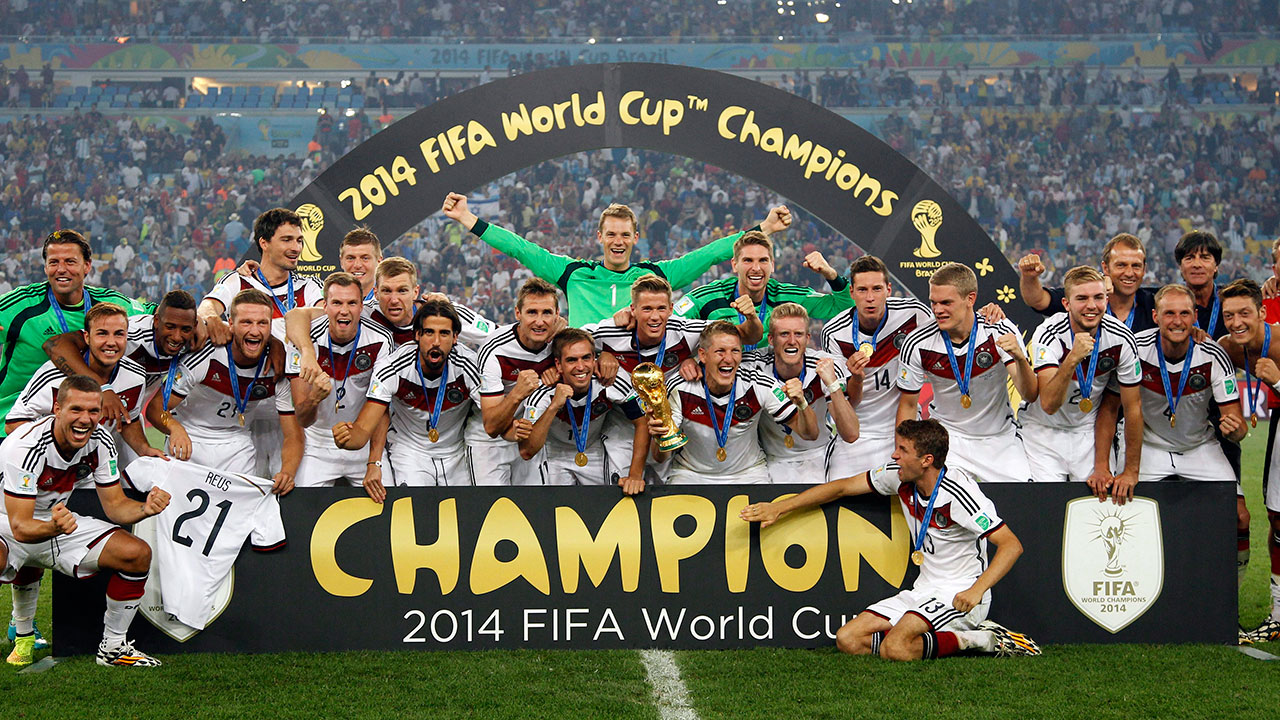
There is only one game left that matters. Sunday’s World Cup final between Argentina and Germany at Rio’s Estadio Maracana, which will be watched by more than 10 percent of the world, is as notable for who won’t be there as who will be. The failures of Brazil and defending champions Spain—each eliminated in shocking fashion—was one of the big storylines of an event that has had plenty of them.
The first goal of the World Cup was scored, as expected, by a Brazilian. Unexpectedly, it went into the wrong net. That set the tone. The group stage was a reminder that in sports, it’s often the mistakes that make things exciting. Defensive malpractice led to a number of high-scoring games. When teams began playing to avoid mistakes, in the knockout round, the soccer became less entertaining.
Before that, however, Brazil 2014 was crazy fun for fans of open soccer. The group stage saw 136 goals, 35 more than in South Africa in 2010. Holland’s 5-1 demolition of Spain on day two of the tournament was only the first in the series of jaw-dropping score lines. Germany thrashed Portugal 4-0, aided by Pepe’s foolish headbutt, which forced the Portuguese to play a man down for 53 minutes. Colombia, minus Radamel Falcao, one of the world’s best strikers, rang up nine goals in its three group games anyway. France, minus Franck Ribery, one of the world’s best midfielders, scored eight.
2014 FIFA World Cup: Sportsnet.ca is your home for in-depth coverage of the FIFA World Cup in Brazil. TV viewers can watch all 64 games on CBC and Sportsnet from June 12 to July 13. Be sure to watch Connected every night on Sportsnet for all of the latest news and analysis. And check out Sportsnet magazine’s team profiles of all 32 nations.
Blunders near the goal made for some dramatic endings. In the thick humidity of Amazonia, the United States appeared to have clinched a spot in the next round and eliminated Portugal until the American back line allowed Silvestre Varela to waltz through, unchallenged, and head Cristiano Ronaldo’s cross into the net. That was in the 95th minute.
Two days later, Greece was moments away from the next plane home when Giorgios Samaras caught his foot on the leg of Ivory Coast’s Giovanni Sio. One converted penalty and two minutes later, it was the Africans who were on the outside. The Greeks booked tickets for the city of Recife and the round of 16, which they deservedly lost to Costa Rica in one of the worst games of the World Cup.
When the stakes got higher, the games got tighter and the better teams began to assert their defensive muscle. In 14 games since the knockout stage began, only once did a team score more than two goals. The Netherlands, boasting the dangerous Arjen Robben, managed to play four hours of soccer without scoring or allowing a goal. The Dutch barely got a sniff of the net against Argentina, which has not conceded a single goal since the group stage, shutting out half of Western Europe along the way. Their opponent in the final, Germany, has given up two, but both were meaningless late strikes when the game was already won.
One of my most vivid memories of this World Cup is watching the Germans take control of their final group game against the United States in Recife, a city about 2,300 km northeast of Rio de Janeiro. It poured rain that morning, and as our buses rolled into the city, we could see that some of the streets were flooded. Traffic was unimaginably bad; a friend staying in a nearby town left at 8:30 in the morning and missed the 1 pm kickoff. Ian Darke, ESPN’s play-by-play man, needed a police escort in order to get to the stadium on time.
The Germans, though, were punctual as ever and calmly took command from the first whistle. The math of Group G was such that while Die Mannschaft were likely going through, nothing was guaranteed. All four countries—Portugal and Ghana were the others—still technically had a shot. But there was never a shred of panic or impatience in the German squad, no sign that they ever felt threatened by the U.S. attack. (The Americans made this easier by inexplicably leaving Landon Donovan, their all-time leading goal scorer at the World Cup, at home in California.)
When Thomas Muller hammered the ball into the net in the 55th minute to give Germany the lead, I had the sense the game was over. So did the German supporters who sang the name of their country over and over: Deutsch-land! DEUTSCH-land! Deutsch-land! Deutsch-land!
Late in the game, the scoreboard flashed the shots on goal: Germany 7 United States 0.
Even then, it wasn’t obvious that the Germans were a great team. Organized, yes, but hardly invincible. They had stumbled against Ghana in the group stage. In the round of 16 they looked ordinary in the first half against Algeria, and eventually needed extra time to win 2-1. There was nothing in that performance to foreshadow what they would do to Brazil eight days later.
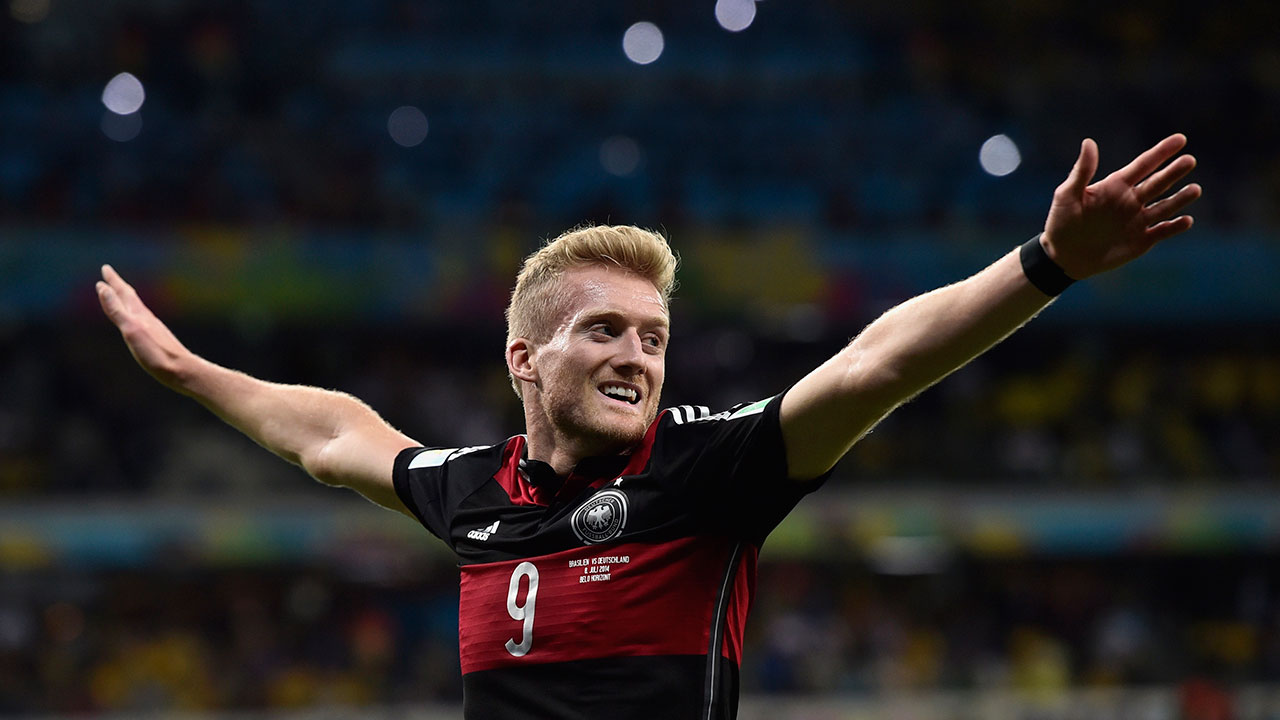
The “Horror in Belo Horizonte” was by far the most significant and memorable game of the World Cup. I think it will stay that way no matter what happens in Sunday’s final. It’s hard to think of a more complete capitulation under pressure, in any sport. (Imagine if, in the Summit Series of 1972, the Soviets had scored five goals in the first period, and the stunned Canadians played like zombies for the rest of the series. Maybe that would compare. Maybe.)
It is tempting to say the football gods were exacting revenge for Brazil’s sins. And there are many: the egregious diving, the constant braying at the referees, the corruption and waste that defines governance of the sport in Brazil. This World Cup tested the patience of even the soccer-loving Brazilian public, both for its outrageous cost (somewhere between $11- and $14-billion U.S.) and the negligence.
Above all, the Brazilian side paid a heavy price for its softness in midfield, for captain Thiago Silva’s dumb yellow card in the quarterfinal and for its psychological reliance on Neymar. Everywhere I went in Brazil, people were wearing the yellow jersey of the Selecao, and the vast majority of them bore the number 10 and “Neymar Jr”. A 22-year-old man carried the weight of a nation’s expectations on his back—until it broke.
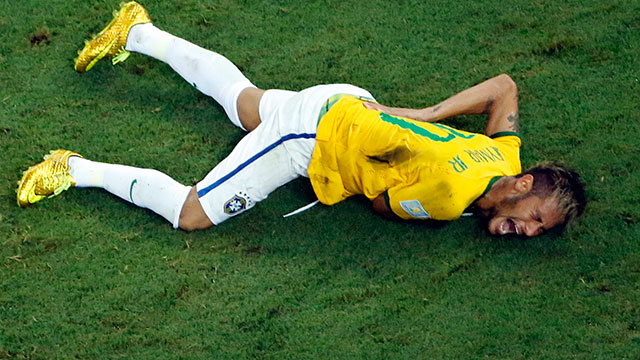
The fractured vertebrae Neymar suffered in the quarterfinal against Colombia ended his World Cup, but his iconic no. 10 made one more appearance on the pitch. Brazilian goalkeeper Julio Cesar and defender David Luiz held up Neymar’s jersey during the anthem before the semifinal.
An empty shirt turned out to be the perfect metaphor for Brazil’s starting 11. Luiz paid tribute to his fallen teammate by having one of the most awful games you will ever see from a top defender. The entire back line and midfield were at sea. When German midfielder Mesut Ozil missed an easy shot that would have made it 8-0—deliberately, it appeared—Brazil’s humiliation was complete.
For me, the indelible image of World Cup 2014 was the television shot of a little boy with glasses, crying his eyes out inside the Mineirao stadium after Germany’s fourth goal. ”Aqui jaz o sonho do hexa em 2014″ said one Brazilian newspaper headline, on an all-black front page: Here lies the dream of a sixth title.
A nation crushed and angered, a team shamed, its star player badly injured: it’s hard to imagine how it could get worse for Brazil—until you picture Lionel Messi lifting the World Cup on Sunday evening for their arch-rivals from Argentina. That would be quite an ending to a raucous tournament that the rest of the world probably enjoyed more than the host country did.