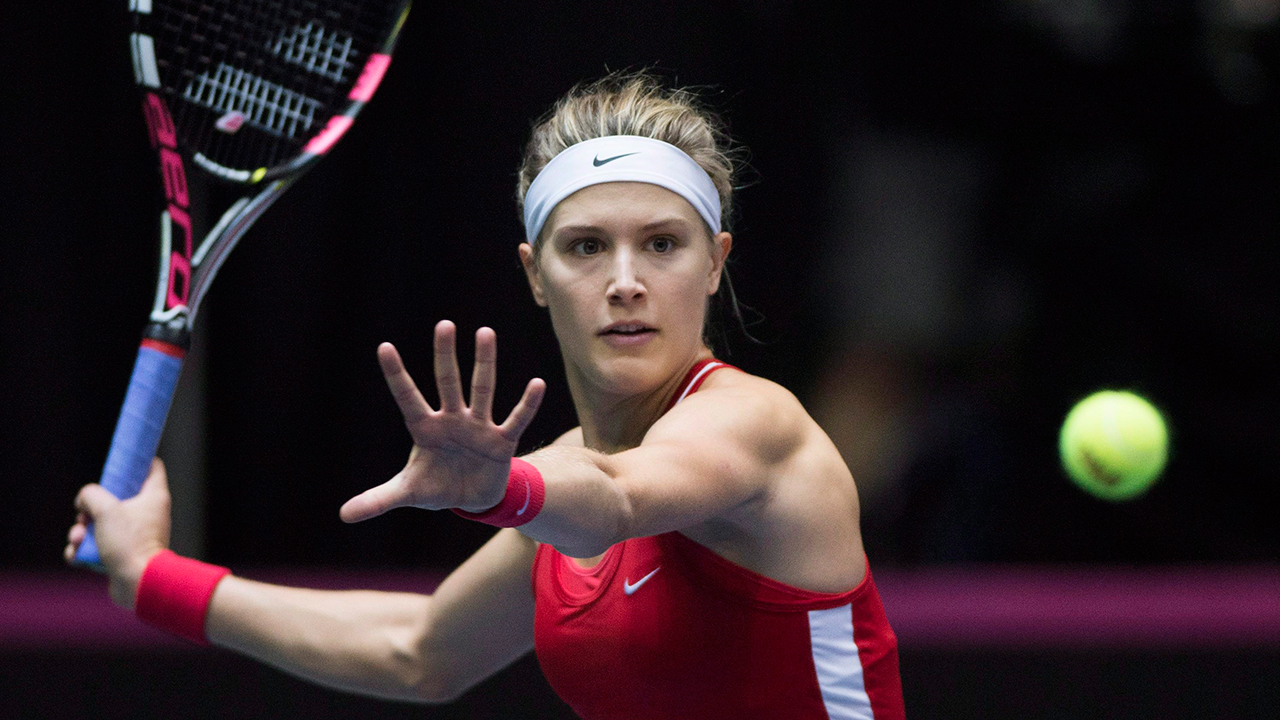

Eugenie Bouchard will be in the spotlight all week long as she returns home to Montreal for the Rogers Cup. Bouchard recently sat down with Sportsnet’s Dave Zarum to discuss the challenges in playing in front of a hometown crowd, her disappointing first-round exit at the Citi Open on Tuesday, the #WorkoutWithUSANA event she’s hosting on Sunday, and what Canada’s young crop of upcoming stars stand to learn at the Rogers Cup next week.
I’ve spoken to a lot of athletes who say there are often too many distractions playing in their hometown. Is that a notion you subscribe to?
I do love being able to play in front of my Canadian fans because they don’t get to see me live often, just once a year pretty much, so there’s some motivation wanting to make them proud. That said I do find it very tough to stay focused. There’s also a lot of pressure and expectations, so it’s important for me to try to stay in my bubble.
So you’ll have to turn your phone off and whatnot?
Exactly. I’ll actually be staying in a hotel the whole week instead of going home so that I don’t have all these things going on—you know, my brother bringing his friends over while I have to play a match the next morning [laughs], that sort of thing. I’m trying to simulate every other tournament during the year, where I’m always in a hotel. I want to keep as normal a routine as I can while in Montreal, which will be one of the hardest things to do next week.
You had a disappointing loss in the first round in Washington on Tuesday. Does the tourney schedule make it harder to bounce back from those early exits? It’s not like hockey or baseball, where you’re forced to put it in the rearview because there’s a game the next night. Now you have time to dwell on the loss, while I’m sure you’d rather just move onto the next match.
Yeah, I’ve never been asked about that before but it’s true: It sucks. When you lose in the first round it means you have a minimum of, like, a week, or as many as two, before you play again and that can be tough. But unlike those sports you mentioned, we have a very long season—10 and a half months—and, while sometimes you wish the wait was shorter, I like the fact that there’s always another tournament around the corner.
After the match in Washington you mentioned how difficult it was for you because your opponent, Camila Giorgi, wouldn’t let you get into a rhythm. I thought that was interesting—can you elaborate on it? Is rhythm something you’re always trying to dictate during your matches?
What’s both tricky and amazing about our sport is that every player is different from another in terms of how they play. With my opponent on Tuesday, she really goes for it, hitting the ball as hard as she can on every shot, and it’s either a winner or an error every time. I’m exaggerating a bit, but that’s her style. When the ball is coming at you quick and you’re only really hitting one or two shots in each rally I found it really hard to get into the match. When I did finally get a shot—like, ‘yay, I finally got a backhand to hit. I haven’t hit a backhand in five minutes!’— I’d be forcing it a bit because I felt ‘I finally have my chance.’ It took me out of my game, but that’s what’s good about her game and it’s what we, as opponents, have to figure out how to deal with.
Do you prefer longer rallies?
I play an aggressive game style as well, which also made it tricky [on Tuesday] because we were going after each other, which cut the rallies even shorter. In general, I try to control the point, but most opponents aren’t quite as extreme as she is.
You had a tough warm-up before that loss, where you couldn’t find a hitting partner that morning— and then you couldn’t find one who could consistently get the ball back to you, and your coach, Nick Saviano, had to come in. Do you think that contributed to the loss at all? Mess up your routine?
[Laughs.] It was a little disappointing but I just tried to be relaxed about it. That warm-up is important, but I have to realize it doesn’t make or break a match. I know how to play tennis, and I won’t forget how to hit a forehand just because I didn’t get a hit in that morning. But it’s not ideal. I didn’t feel prepared. With that hitter there wasn’t a lot of consistency, or even pace on the ball. It’s pretty bad when your 60 year-old coach steps in and that actually becomes a better warm-up, so… it was definitely a struggle.
Speaking of your 60 year-old coach, Nick Saviano— you two parted ways before the 2015 season after working together for so long, and then you brought him back as your coach earlier this year. Was it a matter of finding a comfort zone?
That’s definitely part of it, being around someone who knows you so well. I’ve known Nick since I was 12 years old and so he knows me and my game. It is comforting, he’s someone I have this trust with, compared to someone you just met and started working with a month ago. I’ve tried a couple of coaches who I’ve since split with, and they’re great coaches, but there has to be a good fit between a player and a coach. [Saviano] is the right coach for me.
What can you tell me about this Workout With Genie event you’re hosting on Sunday in Montreal before the Rogers Cup?
I want to give fans some insight into my life, what I do in my workout routine, and what I feel helps me as an athlete. Hopefully I can help to educate people so they can add some of what I do to their own workout routines.
So what do you do before a match?
I want to walk onto the court for a match already sweating. If I walk out cold I feel like I’m spending the first two games warming up, so I want to take that out of the equation. About three hours before the match I’ll hit for a half an hour. Then closer to the match I’ll do a 20-minute warm-up. It could be yoga poses and stretches, definitely cardio—a little time on the bike or running—and then after that a couple of quick stretches, active stretches to move the muscles, and I’ll use a band to do some shoulder exercises which is obviously so important for tennis. And then finally I’ll do quick-feet movements—ladder drills, sprints—and that’s where I really get my heart rate up and awaken my body to realize “OK, time to go to work.”
And then there’s the nutrition—it seems to me that’s the kind of thing a lot of athletes become more cognizant of as they get older and their careers progress.
Yeah, it’s definitely something I’ve thought about more as I get older. I take vitamins and supplements in the morning, but for my job I’m travelling around the world and sometimes it can be hard to get exactly what you need— if I’m at a restaurant in China, or if, like right now, I’m in an airport— it’s hard to get the perfect meal. Something I’m really conscious of is my calorie intake, because I burn so much. After a match it can be hard to get a good meal in, but that’s when it’s so important to get those calories— nutritionists always talk about that 30-40 minute window after exercise— so I’ll have this chocolate protein shake, it’s about 200-300 calories, and I can get that right away so at least my stomach isn’t trying to eat my muscles [laughs].
Last thing, there are going to be a ton of Canadian juniors getting wild-card spots at the Rogers Cup, on both the men’s and women’s side. You’ve been in that position before—what would your advice be to the young crop in advance of the tournament?
In my experience getting a wild card to a big event like this helped me to see what the game is like at a higher level and slowly get used to the idea of ‘OK, I can belong here. I might not be there yet, but this is the goal.’ It helps you become less intimidated, less in awe.
As for advice, I would say: Have confidence. Wild cards win matches. It happens. And even if you don’t win, you’ll walk away from it all having learned so much more than just the average tournament you’d be playing right now because it’s such a unique experience. Soak it all in.