The new NHL collective bargaining agreement is set to go into effect this fall and will include a pretty significant change in how clubs can strategize the best development path for their first-round draft picks from the Canadian Hockey League.
In the past, players with major-junior eligibility could go directly to the NHL out of their draft year, if they made the team at training camp. The same held true for their second NHL training camp. But if the prospect wasn’t quite ready for full-time NHL duty, they had to be returned to their respective junior clubs to develop and couldn't land in between in the AHL.
Starting with the 2026-27 season, CHL prospects who were selected in the first round and are entering their second major-junior season after being drafted, will qualify for placement in the AHL. The news is being met with a degree of understandable concern from CHL clubs and fan bases. But the reality is, some prospects reach a point where they have outgrown major-junior hockey and are ripe for a new challenge in the AHL before eventually earning promotion to the NHL.
Here’s a look at some major junior prospects who will qualify for the AHL starting next fall, as well as an example of one of my past experiences in the same scenario under the old CBA:
(Note: Players drafted out of NCAA, USHL or Europe were already eligible to play in the AHL under the old agreement and the new CBA has no effect on those players.)
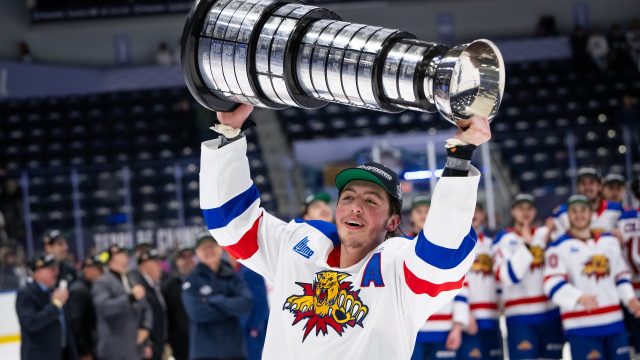
Caleb Desnoyers, 6-foot-2, 185 pounds, left-shot centre, Moncton Wildcats, QMJHL
Desnoyers was selected fourth overall by the Utah Mammoth in 2025. Over the course of his major junior career, the captain of the Wildcats has produced 77 goals and 141 assists in 161 regular-season games. He was named the most valuable player in last year's QMJHL playoffs after contributing nine goals and 21 assists en route to a league championship.
Desnoyers recently signed his entry-level contract with the Mammoth and projects as a top-six NHL centre.
Brady Martin, 6-foot, 186 pounds, right-shot winger, Soo Greyhounds, OHL
Martin is one of the hardest-hitting forwards in the OHL, and the Nashville Predators selected him fifth overall last year. He projects as a top-six winger who should provide better than secondary offence while constantly driving opponents crazy with his relentless competitiveness.
Martin hasn’t been as offensively dominant as other prospects on this list but he’s ready to compete in the AHL and leads by example as the captain of the Greyhounds. He’s deployed in all situations and empties the tank every time his number is called.
A couple of examples of what I’m describing about Martin:


Jake O’Brien, 6-foot-2, 177 pounds, right-shot centre, Brantford Bulldogs, OHL
The Seattle Kraken selected O’Brien eighth overall in 2025. He averages over 20 minutes per game while being deployed in all situations for the Bulldogs. Although O’Brien needs to add strength before graduating to the pros, the fact he’s produced 60 goals and 131 assists over the last two seasons stands out. O’Brien has obvious skill, skating ability and vision with the puck on his stick. He could be a player the Kraken would look to challenge by sending him to the AHL to battle against more seasoned players compared to the OHL.
Carter Bear, 6-foot, 179 pounds, left-shot forward, Everett Silvertips, WHL
Detroit selected Bear 13th overall in 2025. He’s a late birthday and one of the older prospects identified here. Bear’s combination of skill and will are undeniable. He can be deployed in all situations, and when he’s not producing offence, pushes back physically and contributes defensively.
In 176 regular-season games for Everett, Bear has contributed 101 goals and 115 assists, and he’s an impressive plus-101.

Braeden Cootes, 6-foot, 185 pounds, right-shot forward, Prince Albert Raiders, WHL
Cootes broke training camp with the Vancouver Canucks last fall after being selected 15th overall in 2025. He was used sparingly in his three-game audition and sent back to the Seattle Thunderbirds before being traded to Prince Albert.
The Raiders are one of the top teams in the CHL, and Cootes is part of the reason they are contending for a WHL title this spring. He contributed 14 goals and 26 assists in 28 regular-season games after the trade to Prince Albert, and has produced two goals and four assists in four playoff games. The Canucks are in the midst of a full rebuild and might feel the best development path for Cootes is a stop at the AHL level next fall.
Kashawn Aitcheson, 6-foot-2, 196 pounds, left-shot defenceman, Barrie Colts, OHL
Aitcheson is another late birthday prospect who’s already 19 years old. He was selected by the New York Islanders in the first round (17th overall) in 2025.
Aitcheson is a perfect example of a prospect who will be better off developing in the AHL compared to returning to major junior for an additional season. He’s produced offence, logged an incredible amount of ice time in all situations, and dominated the OHL with his physical style of play.

Why this could make a difference
During my time scouting for the Nashville Predators and Florida Panthers, I experienced many scenarios where we had a prospect who had to return to junior hockey as a byproduct of the CBA rules and regulations.
At the 2017 NHL Draft in Chicago, I was the scouting director for the Panthers when we selected Owen Tippett 10th overall. Tippett was a coming off a season that saw him contribute 44 goals and 31 assists in his draft year. We were confident in his upside offensively but also recognized Tippett was going to need to work on his consistency and off-the-puck work ethic as he matured.
Tippett made our team out of his first training camp and dressed for seven games before it became obvious he wasn’t yet ready for the NHL. We sent him back to Mississauga in the OHL and he went on to produce 36 goals and 39 assists in 51 games.
The following season, the organization determined Tippett wasn’t ready for the NHL again, and we had no choice but to send him back to the OHL. He ended up being traded to Saginaw that year and produced 33 goals and 41 assists in 54 games split between the Steelheads and the Spirit. Those numbers weren’t as elite as we expected them to be. Our player development department, led by former Toronto Maple Leafs defenceman Bryan McCabe, had its hands full attempting to motivate Tippett and push him toward better results and a more detailed/competitive game overall.
At the end of the day, it’s the player's responsibility to maximize his ability at every stop of their development path. In Tippett's case, he had the look of a prospect who wasn’t playing to his potential at the OHL level. He was producing offence but it was coming to him far too easily in relation to his consistent, high-end compete. In short, he looked like a prospect who needed to be challenged.
Tippett landed in the AHL the following season and had a wonderful rookie year. He went on to produce 19 goals and 21 assists in 46 games. He was trending in a positive direction at the pro level, plying his trade under the watchful eye of our coaches and development team.
Tippett was learning what it takes to be a good pro on a daily basis. If we would have had the luxury of sending him to the AHL the previous season when he was 19, there’s no doubt in my mind he would have developed sooner than he did and become a more impactful NHL sniper earlier than he has. That's no knock on the OHL organizations, who do a great job developing players, but there are cases where someone, like Tippett, is just ready for the next step in their development.