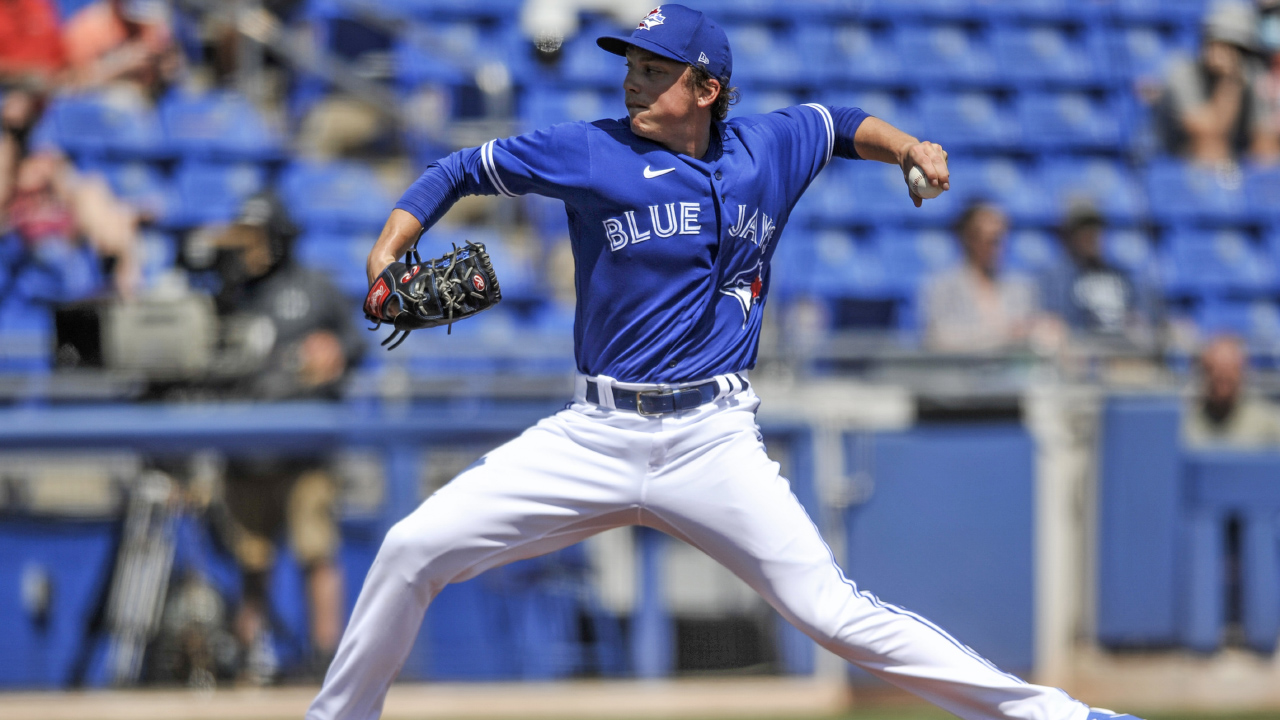

DUNEDIN, Fla. — Ryan Borucki can’t tell you if it feels like it’s gone fast, slow, or somewhere in between, but this will be his 11th season under contract with the Toronto Blue Jays, making him the longest-tenured player in the organization. Few from his 2012 Blue Jays draft class are even still in affiliated ball. Only one — Marcus Stroman — has signed a major-league free agent deal.
That says one thing about how poorly the Blue Jays drafted that year; another about how difficult it is to reach and hang around at baseball’s highest level; and an entirely different thing about the perseverance and dedication it’s taken for Borucki to still be here, competing for a big-league bullpen job at Blue Jays spring training over a decade later.
“Yeah, I’m the only one left — the dying breed from the 2012 draft,” Borucki says. “I’m 28, so that’s still kind of young, I would think. But it’s been a long time. I’ve seen so much happen in this organization. It’s done a complete 180 since I got drafted.”
Now, 2,499 batters, 603.2 innings, and three surgeries later, Borucki’s Blue Jays career has reached a pivotal juncture. He’s out of minor-league options; in a battle for limited Blue Jays bullpen openings. There’s a decision coming in less than two weeks that will see Toronto either opt to include Borucki on its opening day roster or designate him for assignment and expose him to waivers.
Throwing a mid-90’s fastball from the left side, a slider that’s produced a nearly 50-per-cent whiff rate over the last two seasons, and a changeup to keep right-handed hitters honest, it stands to reason that some club somewhere would see Borucki’s name hit the waiver wire and think that guy can help us. And it stands to reason that the Blue Jays should think that, too. With expanded April rosters, the club is discussing the possibility of carrying 10 relievers on opening day — and it’ll need all the arms it can get to weather a hellacious season-opening stretch of 30 games in 31 days.
But stuff is one thing and results are another. And while there’s no denying Borucki’s former, the latter has been harder to come by of late. The converted starter has a 4.02 ERA over his last 45 outings dating back to the beginning of 2020, with an encouraging 24.6-per-cent strikeout rate and concerning 13.5-per-cent walk rate over that span. He’s been injured and inconsistent and fighting himself on the mound. He’s continued to receive opportunities because it’s obvious what a weapon he’d be if he could stay healthy and put it all together.
But the Blue Jays are becoming less lenient in how they award opportunity. This season is about winning — full stop. Certainly a playoff spot, ideally a division, maybe a World Series. It’s easy to envision a world in which Borucki’s a part of that, chewing up sixth and seventh innings and validating the club’s decision to award him a job at the end of spring. But it’s also possible to imagine one in which his struggles continue, and the club is forced into a much more difficult decision altogether.
“I understand what’s at stake. That’s the nature of the game. And I’m going to try to do as much as I can. I want to make the team and prove that I’m here to stay,” Borucki says. “I try not to think about it too much. I’m just going to keep on trying to execute pitch-by-pitch — and make the decision as hard as I can for them.”
There’s no questioning the work Borucki’s put in after an off-season first spent properly healing a flexor injury that dogged him throughout 2021, then spent continuing a search for answers as to why his command’s been so inconsistent since he transitioned to the bullpen after spending the first eight years of his career filling up the strike zone as a starter.
“I’d never really walked guys — that was never me,” Borucki says. “But the last couple years I haven’t felt synced up. My delivery’s been inconsistent. I knew that there was something. Because I had this feeling — like I was stuck. Like my arm was stuck behind me. It never felt like my arm was getting to the point I needed it to.”
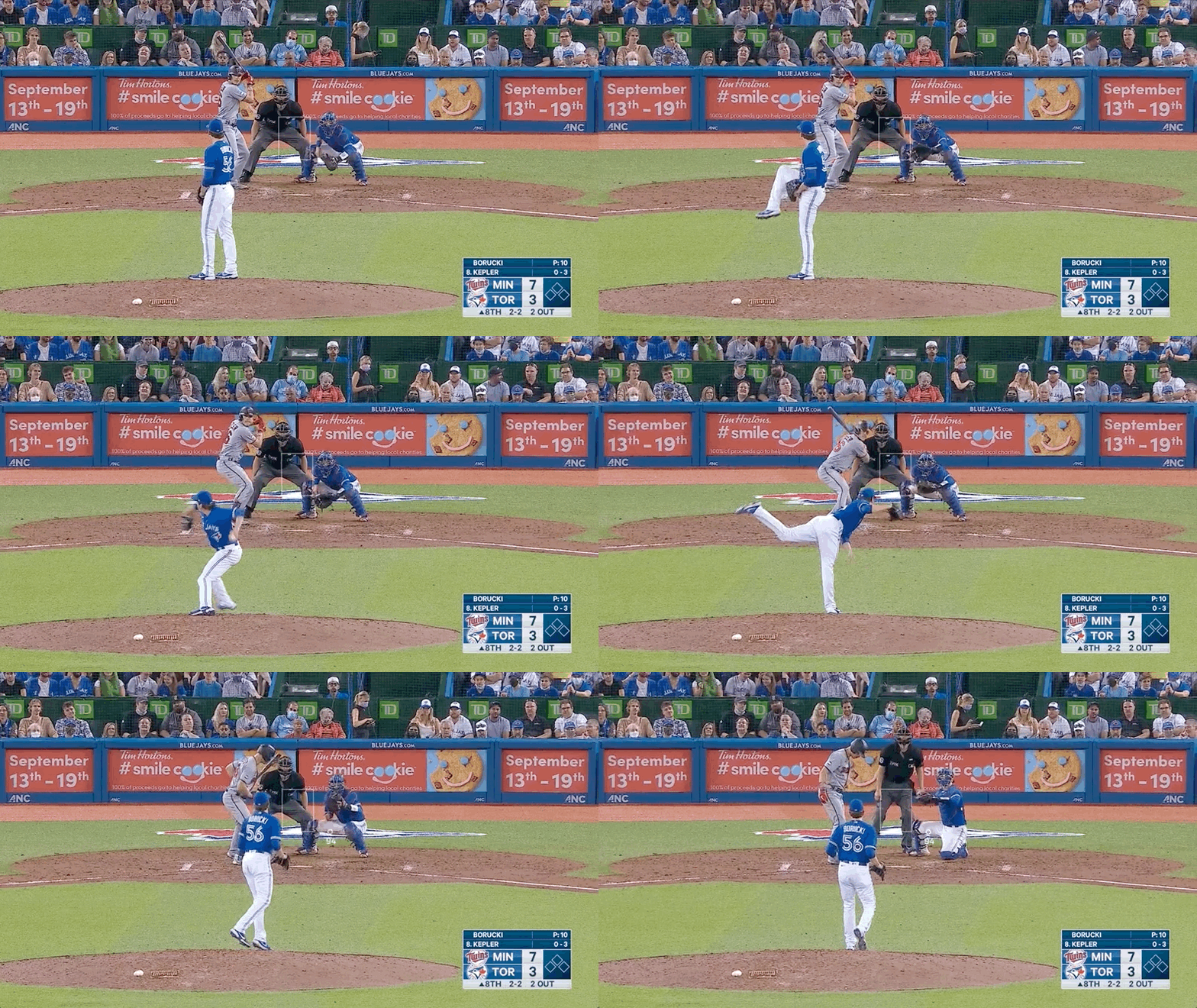
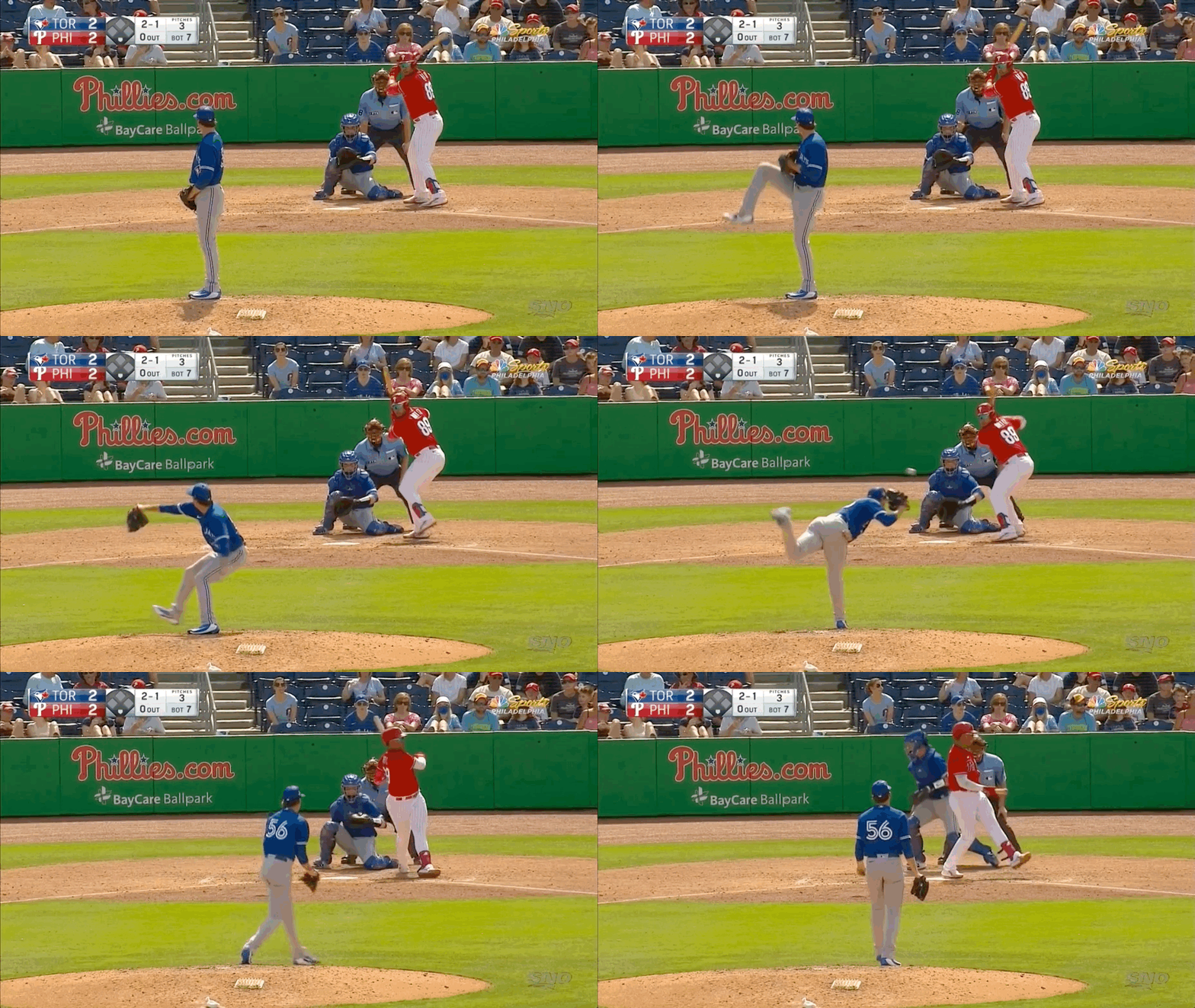
Turned out, the problem wasn’t his arm — it was his hands. He’d begun burying them behind his hip at the height of his delivery in an effort to hide the ball. But that was giving his arm more distance to travel as he drove towards the plate, forcing him to rush it forward to catch up to his body. And the more distance his arm had to travel, the more challenging it was for Borucki to maintain his delivery as he fatigued late in a long season.
Coming up through the minors, Borucki never held his hands that low. They just crept down over time. So now he’s moved them back up. Here’s Borucki’s delivery from an outing last September:
Here it is from an appearance last week:
And here’s a side-by-side, 2021 on the left and 2022 on the right:
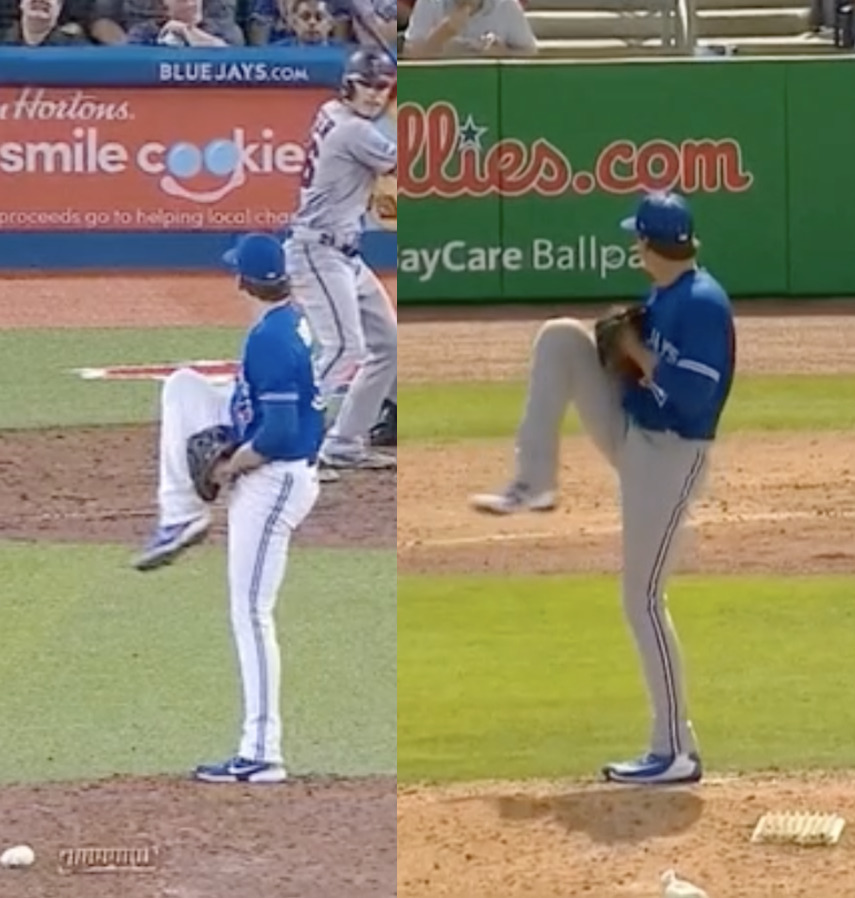
It’s a subtle tweak to his process. But one Borucki believes will be impactful to his results.
“That little adjustment has really freed me up. It’s a timing thing. Now, I feel so much more free and easy,” he says. “It’s a lot easier to move the ball around the zone. And hopefully health-wise it helps me out a lot too.”
That last bit would be huge for a pitcher whose career has been repeatedly beset by injuries, the most recent that flexor strain in his left forearm which sidelined Borucki for two months last year. It came out of nowhere. Borucki felt great through the first month of the season, carrying a 2.00 ERA through his first nine outings, leaning on a sinker that was averaging just shy of 96 mph, the hardest he’s thrown in his career.
But two days after an outing in Houston on May 7, Borucki’s arm started to hurt. A little soreness — nothing crazy. But it got worse each time he played catch. And one night in Atlanta, after he had to get hot in Toronto’s bullpen twice without entering the game, it started screaming.
An MRI revealed the flexor strain and the club shut Borucki down to let him get over it. Initially, he thought it would be a two-week thing. But before he knew it, the injury became a two-month thing, that strong start getting further and further away in the rear view.
“It stopped me in my tracks,” Borucki says. “And it just wouldn’t go away. It was a very weird thing. Usually, there’s some creeping soreness when something’s wrong. But I felt great; I wasn’t sore at all. That was the frustrating thing — I couldn’t look back and identify something I did to cause it.”
When Borucki finally got back into games in July, he wasn’t himself. He was well enough to pitch, but the lingering effects of the injury were still there. The ball wasn’t coming out the same; his arm was constantly sore after outings. He wasn’t able to find the velocity that sustained his results earlier in the season, losing a tick off the fastball he was throwing in April. The spin rates and break on his slider dropped off, too.
“I never felt 100 per cent. It was always there,” Borucki says. “It was super sore. When you get adrenaline going in games, you’re not feeling it too much. But any other time of day, you’re battling the soreness and trying to make sure you can pitch that night.”
That’s not a formula for success at the game’s highest level and the results you’d expect followed. Working primarily in lower leverage situations, Borucki gave up five runs — all via homers — over seven appearances in July and August. That’s when the club chose to use its remaining minor-league option and demote Borucki to triple-A Buffalo to get right.
He’d been to the minors over prior seasons to rehab injuries, sure. But four years after Borucki made his MLB debut, this was his first demotion for poor performance.
“It was eye-opening. Like, ‘Hey, man, you can’t be too comfortable where you’re at. You have to perform. It’s the big leagues,’” he says. “But I knew that I wasn’t at the caliber that I needed to be to help that team make the playoffs. I wasn’t good enough. I didn’t feel good enough. My stuff wasn’t playing the way it usually does. I deserved that demotion.”
Joining Buffalo allowed Borucki to reunite with Bisons pitching coach Jeff Ware, who he’d first worked with seven years prior as a 20-year-old in low-A. Borucki had already begun diving into what was behind his command struggles while rehabbing at Toronto’s player development complex in Dunedin, working in the Blue Jays pitching lab with one of the club’s pitching development co-ordinators, Matt Tracy, to get to the bottom of why his arm wasn’t getting to the positions he wanted it to.
Tracy helped Borucki advance the adjustments he’d started to make in Florida, focusing on being more in sync during his delivery and re-establishing his timing to the plate. Borucki didn’t get close to being the guy he needed to, if he’s being honest. But a major-league opportunity opened up in mid-September, and suddenly he was back on a mound at the highest level trying to help the Blue Jays in a post-season push.
Which is when he found himself amidst the moment you probably remember most from Borucki’s season, when he reached back and delivered a 93 mph fastball into the number 9 on Kevin Kiermaier’s back two days after the Rays centre fielder nicked a Blue Jays information card that fell out of Alejandro Kirk’s wristband after a play at the plate.
That got Borucki ejected, and eventually suspended, putting a strange cap on his strange season. They laugh about it in the Blue Jays bullpen now, of course. But don’t think that wasn’t a meaningful moment for that team at a critical time. Everyone knew Borucki was pitching through pain, working without his best stuff, doing all he could. And sometimes a pitcher’s best opportunity to contribute to his club presents itself in an unexpected way.
“It happens, you know?” Borucki says with a smile. “Stuff happens in the game.”
From there, Borucki served his suspension, pitched two more outings with Buffalo, and shut it down the season. He took an entire month off from throwing to finally give his forearm the time it needed it heal. And come winter, it was time to ramp back up and try to sort out his delivery.
One problem — a work stoppage. Typically, Borucki trains at Toronto’s player development complex during off-seasons. But as MLB’s lockout took effect on Dec. 1, that was no longer an option. So, Borucki and his old pal Danny Jansen joined a collection of big-leaguers working out at Eckerd College in St. Petersburg, Fla. including Yoan Moncada, Brett Phillips, and Matt Vierline. That helped keep Borucki motivated and consistent with his strength and conditioning, and gave him the added benefit of big-leaguers to throw to and learn from.
The lockout also forced him to seek a pitching coach outside the organization, which is how he ended up throwing with Anthony Telford, the one-time Montreal Expos reliever who’s been working with Nate Pearson since he was a high-schooler and also coaches Toronto closer Jordan Romano. Twice a week, those three and Blue Jays prospect Bowden Francis would throw bullpens to Jansen with Telford looking on, providing feedback on mechanics and approach.
Which brings us to where we are now, with Borucki at Blue Jays camp, out of options, battling for a big-league bullpen job, a roster decision looming. The organization’s longest tenured player at a pivotal juncture. Watching his name called by the Blue Jays in that 2012 draft, Borucki had no idea what he was in for. A mere 11 seasons later, he still can’t be sure.
“We’ll see what happens. My entire career, I feel like I’ve always been competing for a spot. I’ve never really felt comfortable,” he says. “And I don’t want to feel comfortable. I don’t want that mindset. Because then you take stuff off and you don’t work as hard. So, I’ve just always been trying to compete. Which is what I love doing anyway.”