
By David Matchett
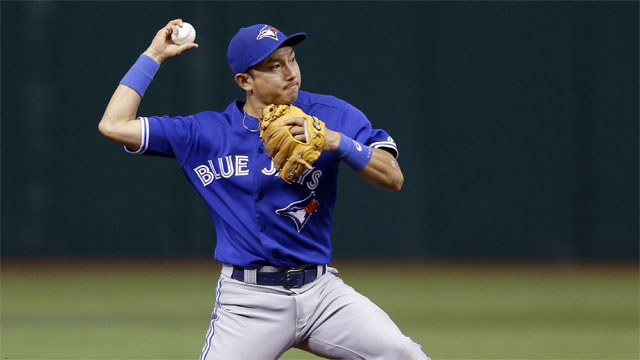
The Toronto Blue Jays’ victory over the Boston Red Sox Wednesday night saw the return of fan favourite Munenori Kawasaki to Toronto.
So far this year he’s hitting .209 and slugging below .300. A total of 268 big leaguers who have batted at least 200 times have a higher on-base plus slugging.
So why are we excited? It’s because he makes the game fun and, after the latest run of performance-enhancing drug scandals, we need more fun in baseball. Kawasaki is 32 but he plays the game with the enthusiasm of a five-year old in a t-ball league, and that joy rubs off on the fans.
But he also seems to have a positive impact on his teammates and raw data can’t explain how. Since the beginning of the Moneyball era we’ve been inundated with more and more advanced statistical analyses to evaluate and rank players but there is still something to be said for the intangibles.
The Jays’ overall record through their first 120 games is 55 wins and 65 losses for a .458 winning percentage. Kawasaki has appeared in 71 of those games and the team has won 38 of them, a .535 clip. When he hasn’t played the team’s winning percentage is only .347.
Projected over a full schedule that is the difference between a team winning 87 versus 56 games. Except for Anthony Gose (8-5) and Kevin Pillar (1-0) no other position player has appeared in more wins than losses for the Jays.
Kawasaki has been recalled from Buffalo because of injuries to Jose Reyes and Brett Lawrie and now a trade of Emilio Bonifacio.
Is Reyes a better player than Kawasaki? Yes.
Is Lawrie a better player than Kawasaki? Yes.
But Kawasaki is an upgrade over the 2013 version of Bonifacio. Bonifacio split his time between second base and the outfield while Kawasaki has played primarily at shortstop so Bonifacio gave manager John Gibbons more flexibility in putting together the lineup card.
Their batting numbers are similar but Bonifacio is a below-average fielder at both positions (based on Total Zone Fielding Runs) whereas Kawasaki doesn’t hurt the team with his glove.
Wins Above Replacement takes into account all aspects of a player’s contributions, and even though Kawasaki has appeared in 23 fewer games than Bonifacio, Kawasaki’s WAR of 1.1 is far better than Bonifacio’s 0.0.
In fact, an argument can be made that Kawasaki has been more valuable to the Jays than Adam Lind (WAR of 0.9), J.P. Arencibia (0.7), Melky Cabrera (-0.1) and Maicer Izturis (-0.8).
This isn’t the first time that a backup middle infielder has provided more to the Jays than his statistics would indicate. John McDonald was the heart and soul of the team for years. He has been missed by the fans ever since but they have now found a replacement.
With only two and a half weeks until the rosters expand, it looks like Kawasaki will be with the Jays for the rest of the season. He won’t play every day, and he won’t run up gaudy statistics when he does, but when he’s in the dugout the team finds a way to win and the game becomes fun again for the fans.
Welcome back Munenori!
This piece originally appeared at the Canadian Baseball Network.