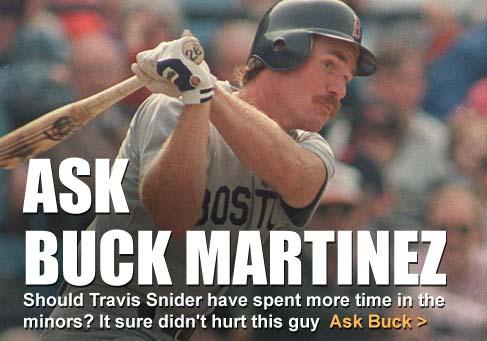
With over 40 years as a major league player, manager and broadcaster, Buck Martinez has experienced baseball from all angles. Now in his role as the Toronto Blue Jays play-by-play announcer, Buck is taking your questions in his weekly blog for sportsnet.ca, Ask Buck Martinez.
Rahul asks…
Hi Buck: A question – I have noticed when the Jays play on the road, some ballparks
fly the Canadian flag, while others do not.
Specifically, it was surprising that when the Jays played the Diamondbacks in Phoenix, the Canadian flag was displayed, but when the Jays play at Fenway or in Yankee Stadium, I never see the Canadian flag flying.
Why is this?
Buck: Rahul I have not noticed the Canadian flag missing at the road ball parks. Certainly we hear O Canada everywhere we play and for sure, when there is a colour guard, we see the Canadain Flag.
I will make a point of checking every park from here on out to make sure they honour our team and our country.
Mayur asks…
Hey Buck, just wanted to ask you: where does Eric Thames fit in the Blue Jays organization? Do you see him being called up this year over Lawrie?
Thanks Buck, love the column!
 Watch the Jays vs. Rays live Wednesday on Sportsnet ONE at 6:30 p.m. ET.
Buck: Mayur as you know the Jays have just called up David Cooper from Las Vegas and sent Travis Snider back to the minors, so you can imagine there are more moves to come.
Alex Anthopolis doesn’t want these premium prospects going up and down to the big leagues like a yo-yo, so I think he will be very deliberate when he decides to promote.
I believe the organization may have rushed Snider to the majors and he is paying the price now for not having the solid foundation built with steady development in the minors. The most at-bats Travis has at any stop was 457 at Lansing in the Midwest League. Then it was bounce, bounce, bounce to double-A, triple-A and the big leagues. He needs consistent at-bats to get his swing right.
Now with Thames and Lawrie, Alex is going to make sure they are ready for the next step in every aspect of their game: the bat, the glove, the wheels, the work ethic and the discipline. When the Jays make the call for the next class from the minors, you can bet the organization will have asked itself over and over again, "Are these guys ready?"
If the answer is "yes" then you will see them.
Specifically you asked about Thames. If he fits, from what I have seen, I think he has a good chance to become an everyday left fielder in the very near future, and we will see him before the end of the season.
Ralph asks…
Buck, You (and Toronto Star columnist Richard Griffin) seem to be answering a lot of questions about the readiness of certain minor league players within the Blue Jays system. Everyone has a take on who should be brought up to replace an ailing or failing current Jay.
But do you find that it’s more of an issue here in Canada because of what I’ll call ‘the hockey-fixation’ of
baseball in Canada?
Hockey fans (and I’m NOT one, I’ll admit) tend to look at athletes coming out of the junior ranks at 18 or 19, believing they’re ready for the big leagues.
You and Pat Tabler refer to Wade Boggs or Don Mattingly "coming through each level" with 500 at-bats in at both double-A and triple-A (and Griffin refers to needing at least 1,000 at-bats at the minor
league level to really prepare for life in the majors).
Does a hockey perspective make it difficult getting the realities of baseball through to people?
Buck: Ralph, that is a good take on the two sports and probably very accurate.
I think baseball is a real challenge because of the variables organizations have to deal with when evaluating young talent.
Are they playing in Las Vegas or Colorado Springs where the ball flys and pitchers don’t have good command? Who are they playing against?
There has never been a wider gap in the talent level from triple-A to the majors.
Hitters may see one good pitcher in a week at triple-A, but they face three or four good arms a night in the bigs. There are many forms of evaluation that can give you a good idea if a hockey player is ready or not.
That doesn’t mean they all succeed of course, but you have a universal standard that helps the process.
In baseball there are so many variables in a short sampling of time and you have to let the player develop over the course of the five-month, minor league season. Baseball also has the challenge of 162-game grind that young players aren’t used to after high school, college, and even the shorter minor league season.
It does take seasoning in the minors and patience in the majors.
I think you need three years to find out what you really have in a pitcher and two full seasons and nearly 1,200 at-bats before you really know what kind of position player you have.
Doug asks…
In a close game such as (Morrow vs. Price two Saturday’s ago) where there were only five hits after six, why wouldn’t managers have their third and first basemen play the line to take away the doubles in the seventh inning or the eighth rather than wait until the ninth?
Buck: Doug we have talked about this recently and good of you to bring it up.
The Blue Jays choose not to guard the lines as they believe the percentages are against that defense. We have reports on everything, where players hit the ball in what counts, day or night, hot or cold, fast infield or slow. The percentages of a ball being hit down the line between the bag and the corner infielders doesn’t warrant that defense.
If you play in a normal defense, chances are the hitter is going to hit the ball where he normally does and you try to go with that. It happened in the Blue Jays favour during the Tampa Bay series in Toronto when Joe Maddon elected to guard the lines and a ball went in the 5-6 hole all the way to the wall for a double.
If the third baseman had been playing it straight up it, it would have been a 5-3 ground out.
It’s a good question and many teams play that way, but John Farrell and his coaches like the percentages of covering the holes.
Bill asks…
Buck, I’m old enough to remember when TV cameras would show “tomorrow’s” starting pitcher sitting in the dugout charting pitches. With all the video available now, do teams still chart pitches, or is this a lost art?
Buck: Bill you are right about the starters charting pitches but now with all of the "video coaches" recording every pitch, it isn’t required.
Us old timers think that a pitcher is better prepared when he has to log each pitch and the corresponding result for the entire game to help him put together a game plan for his outing. I have joined the new age: video is much better and seeing the conversations between Ricky Romero and the rest of the starters during the game is more valuable than sitting with a clipboard trying to figure out how to chart.
Richard asks…
Hey Buck, my name is Richard and I’m a 21-year-old just finishing my first year of Sports Management at Durham College in Oshawa, ON. My question is, besides your playing record in professional baseball, what did it take for you to get into broadcasting.
It has always been my dream career to be able to do what you do on a daily basis and was just wondering if there were any suggestions you have for me.
Thanks.
Buck: Richard, I was fortunate to have played a long time which allowed me to meet so many great broadcasters over the years.
My first broadcast team was Buddy Blattner and Denny Matthews in Kansas City with the Royals, then the great Bob Uecker in Milwaukee and maybe the most important team was in Toronto with the late Tom Cheek and Jerry Howarth.
It was Tom that put the idea of entering broadcasting into my head, so after my last game in Toronto during a meeting when Jimy Williams and Pat Gillick told me I wouldn’t be asked back as a player, Paul Beeston asked me if I wanted to "do some TV."
That was a great break.
I actually had done some radio during my playing days and enjoyed the experience. As for my post-playing days, I bought a tape player and sat on the roof of Dunedin Stadium doing play-by-play and analysis during spring training games.
Later, I worked with speech pathologists to improve my voice, an acting coach to be more "natural," and the former director of the MLB Game of the Week, Harry Coyle.
I know if you have to desire and the work ethic to practice and listen to the great voices of the sports broadcasting world, you can get into this great business as well.
Another thing I was so lucky to have was great partners. I had the good fortune to work with Tom and Jerry of course during my radio days, but I also worked with the two best baseball play-by-play announcers in the game in Jim Hughson and Dan Shulman.
Good luck.