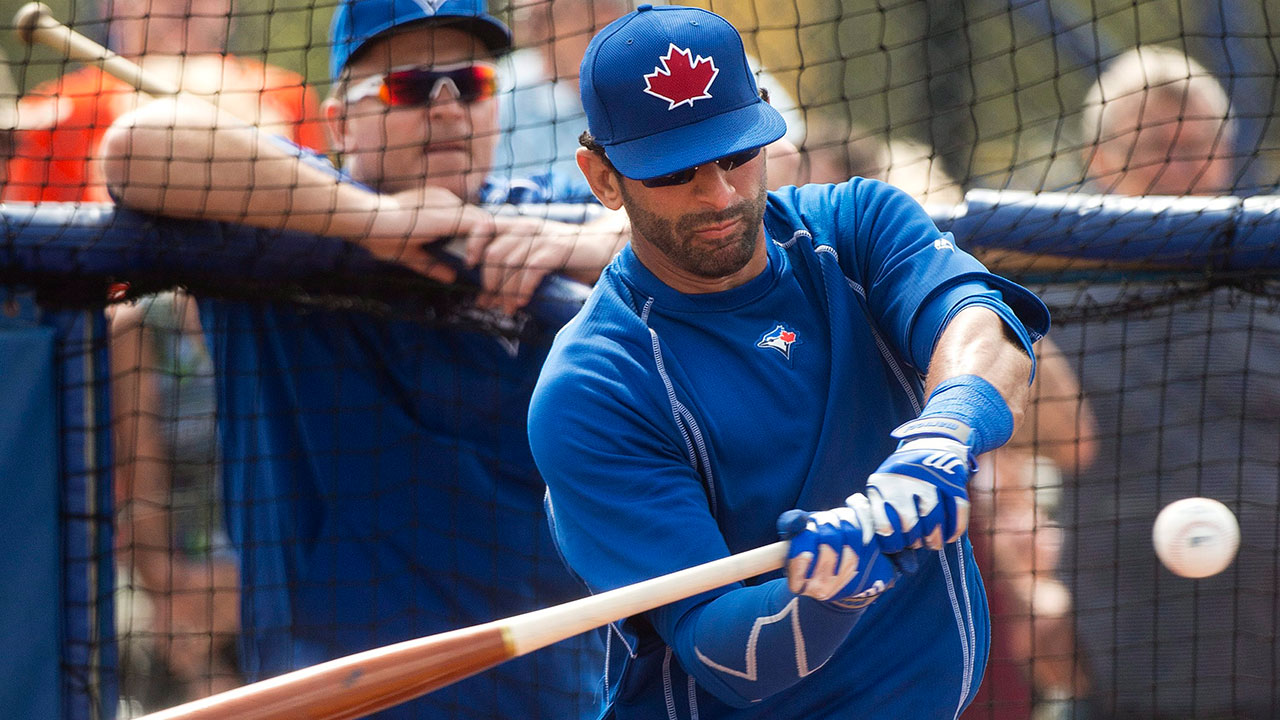

DUNEDIN, Fla. – Jose Bautista sees the logic in Major League Baseball’s new pace of game initiatives, while at the same time he can also understand why David Ortiz and others are concerned about the changes.
The Toronto Blue Jays slugger gets the pros and the cons.
What Bautista doesn’t get, and takes issue with, is something entirely different – the lack of active player representation on the committee that drafted and developed the plan.
“It’s not that I’m in favour [of more player representation], or I’m pushing it, but doesn’t it make sense that player input should be considered a little bit more strongly than just one seat through the players’ association on a seven person board? I think so,” Bautista says during an interview this week. “Ultimately [MLB] is going to do what they want to do. Our league is concerned about the strength of our union, and maybe other leagues aren’t, and that’s why they accept player input more openly, because they don’t see the empowerment of players as a threat where baseball might.
“I can’t say that’s accurate, but it could be.”
 We’ve ranked the 25 Greatest NHL Games Ever Played. Get the free, digital-only edition of Sportsnet magazine on your iOS or Android device right now.
The pace-of-game program – installing clocks to ensure swift changeovers between innings and when relief pitchers enter the game, plus enforcement of a rule stating hitters must keep one foot in the batter’s box – was announced Feb. 20 and put in effect for spring training games.
It’s the product of a committee named in September by former commissioner Bud Selig that was chaired by Braves president John Schuerholz and included then commissioner-elect Rob Manfred, Mets GM Sandy Alderson, Red Sox executives Tom Werner and Michael Gordon, MLB executive Joe Torre, and Tony Clark, executive director of the Major League Baseball Players Association.
While no rule changes can be implemented without approval from the players union (and the umpires union, as well), the lopsided committee construction puts MLB in strong position to drive the agenda.
During meetings Clark wasn’t always on his own and was free to bring whom he saw fit, but there’s a reasonable argument to be made for providing active players with a more formalized role in the process through actual spots on the committee.
That was something negotiated into the National Hockey League’s collective bargaining agreement, as its competition committee features five active players (David Backes, Mike Cammalleri, Ron Hainsey, Alex Pietrangelo and Cory Schneider), five league representatives (Randy Carlyle, Ken Holland, David Poile, Ed Snider and Steve Yzerman) and two non-voting members (Mathieu Schneider from the union and Colin Campbell from the league).
“Taking a similar approach to what [the NHL] does would be smart,” says Bautista. “[MLB] knows how to do things, they’re not novices, they just choose not to involve us right now.”
Manfred has a permanent competition committee that’s mandated to identify issues and problems in the game, but it’s strictly internal. To be fair, the point can be made that Clark was included on the pace of game committee to provide active players with a voice and to welcome their input.
The union, after all, is the players’ bargaining party.
Yet a counterargument is that even with Clark’s involvement, the players are only in position to react to the process, not to help shape it.
“I wonder why one of the rules that was changed wasn’t timing mound visits, both in number and in length,” says Bautista. “That doesn’t involve rushing a pitcher coming out of the bullpen, that doesn’t involve rushing back out onto the field. I think what was done was enforcing existing rules, or that’s the attempt, which is great, because no new rules were implemented.
“But when you’re talking about implementing new rules like time between pitches, when it could directly potentially affect the health of some players, why not do something that doesn’t, like timing and limiting the number of mound visits from coaches, managers and catchers? The NBA does it [with six regular timeouts and one 20-second time out per team per game]. Makes sense to me, but these are the things they don’t ever get to hear when they don’t ask players.”
Important to keep in mind is that with Manfred taking over from Selig in January, the relationship between him as commissioner and the union is still evolving.
Also evolving is the entire pace-of-game initiative, as the program’s implementation will be just like those of instant replay and the catcher collision rule last spring – subject to review and change at season’s end.
If active players really hate the new rules, Clark will certainly have a chance to make their opinions known. And worth remembering, too, is that none of the more radical pace-of-game initiatives experimented with during the Arizona Fall League, such as the pitch clock, saw the light of day because they were total non-starters among many players.
Clark’s quote in the statement announcing the changes Feb. 20 was telling in that regard: “The players believe that enforcing the rules that currently exist regarding between inning breaks and plate appearances is the best way to address the issue of pace of play.”
Bautista acknowledges some players around the league take too much time in the batter’s box or taking the field on changeovers, and everyone in the game needs to be cognizant of how longer games impact the fan base.
Perhaps with the direct involvement of active players, the process could become more collaborative and more substantive changes, if deemed necessary, could be made.
“This is the way I look at it – I don’t really care, but if baseball wants to get it right and do what’s best for the sport, they should [get more active player input],” says Bautista. “That’s the way I think. They don’t want to ask us? Don’t ask us. But if they want to get it right and do what’s best for the sport and for the fans, it makes sense to ask the players.”