
With over 40 years as a major league player, manager and broadcaster, Buck Martinez has experienced baseball from all angles. Now in his new role as the Toronto Blue Jays play-by-play announcer, Buck is taking your questions in a weekly blog for sportsnet.ca, Behind the plate with Buck.
BOB ASKS: The question I always wondered about involves the signs in ballparks on field level that say ‘No Pepper Games’. What exactly is a game of pepper? I’ve seen that for years and never got a straight answer about that.
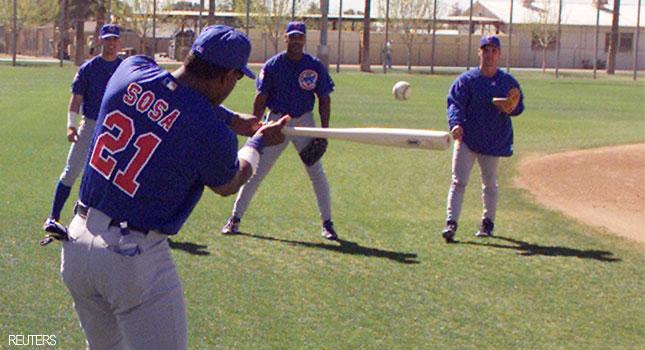
BUCK: The “no pepper” sign is becoming a thing of the past as well. The pepper game was a part of baseball for decades. It is a game played with one batter and several fielders. The batter tries to hit one hoppers to the fielders who field it and throw it back to the batter for another one hopper. These can become very animated and intense. The faster the action the better the players like it. Occasionally the ball would be batted into the seats, hence the ban. There is a variation of the game, called “flip”. The fielders grab the first grounder then keep tapping the ball to the next fielder, on and on until the ball hits the ground. The player that caused to ball to fall is eliminated and stands on the sidelines until the last man is standing at which time he is declared the winner and a new game begins. With the Brewers in the late 70’s we would have 15-20 players playing flip for an hour before BP. Great for the team spirit.
BILL ASKS: Hi Buck! I enjoy your play-by-play. How much of an effect does the tossing of the manager have on the game? Is he still able to manage from the runway or the clubhouse for example?
BUCK: Bill, when the manager gets tossed from the game he generally stays close to the dugout if possible. The bench coach and the pitching coach will make most of the regular decisions during the course of play, but if there is an unusual decision to be made most times they will check with the skipper. Most bench coaches have a pretty good relationship with their manager and would play the game the way he would want.
LOUISE SAULNIER ASKS: Hi Buck, I always understood that arguing balls and strikes meant that a player/manager was automatically ejected. Has the rule changed or are umpires more tolerant?
BUCK: Louise, the rules are the same. If a manager questions the strikes and balls while he is on the field he is subject to ejection. Many of them will voice their displeasure from the dugout being aware there is a fine line they shouldn’t cross. Lou Piniella a couple of weeks ago in a Cubs-Cards game I was doing wasn’t happy with the strike zone of a young umpire and took a slow stroll to the mound to “visit his pitcher” before Lou was done the home plate umpire arrives at which time Lou asked about a couple of close calls. The ump said “you can’t ask about balls and strikes”, to which Lou replied “would you like to have lunch one day”?
BOB OWSNETT ASKS: I’ve always wondered what’s involved in a pitcher’s SIMULATED game? Does it take place under the stands with a strike zone target OR out on the diamond with a catcher? Are certain situations set up? Do they pitch a full game or just a few innings? Do they actually face batters, OR is it like throwing in the bullpen? Please enlighten me on this subject.
BUCK: Good question Bob. We always talk about a pitcher throwing a “simulated” game without much explanation. Generally this involves a pitcher coming back from injury. As he builds up his arm strength and stamina getting closer to major league action, the team will set up one of these sim sessions. The idea is to simulate the action of pitching an inning. He will face some of his own hitters, the catcher will call pitches and the pitching coach will serve as the umpire. The inning will consist of a regular sequence of pitches to a batter that has an at-bat. If he gets a base hit he doesn’t run the bases but the pitcher will work out of the stretch. When three outs are recorded, the inning is over, the pitcher takes his normal break between innings and resumes the process. This simulated game is the last practice a pitcher has before he makes a “rehab assignment” in the minors as a final tune up before activation onto the major league roster. Of course I would always prefer they simulate no-hitters!
IAN ASKS: At the start of the year, Alex Anthopoulos said he would be conducting an intensive search over the season for the next manager of the Blue Jays, asking other GMS, scouts etc. Can you give us any update on how the search is going, or any thoughts on possible candidates for 2011? Thanks so much.
BUCK: Ian that is the toughest thing to get a handle on around the ball club. Alex I am sure is developing a list in his mind of what he wants in a manager. The move to keep Cito in place for this year was brilliant. Cito loves teaching these players and is prepared to move on after the season to a new role as consultant. By allowing himself a year to decide on the direction for the next manager, Alex has had the time to get into the role of GM, watch his team, and formulate ideas for the next skipper. As I said earlier, I don’t think many around Alex at this time have a feel for where he is going.
MICKEY ASKS: Hello Buck, what is meant by “Slugging Percentage” and how is it calculated? Thanks.
BUCK: Slugging percentage is the number of bases a batter earns per at-bat. As a fan, I am sure you realize a slugging percentage of .500 will always be among the leaders. That means that batter earns one half a base per every at bat. Barry Bonds had some ridiculous numbers during his run as the home run leader.
The calculation is a simple one: divide the total bases of all safe hits by the total times at bat. “Safe hits” do not include walks, sacrifices, hit by pitcher or times awarded first by interference or obstruction.
DEB HALL ASKS: I have been an avid baseball fan for as long as I can imagine. Each season I keep hearing about players that have won a Gold Glove but what I don’t hear is how they won it. Could you give me the criteria for winning a Gold Glove?
BUCK: Deb, that may be the most arbitrary award in baseball. The players, coaches and managers vote on it each year and unfortunately most don’t take the time to really investigate the players and their fielding prowess. Once a player wins a couple of Gold Gloves he will gain the reputation of a perennial Gold Glover getting a lot of votes because of that, when in fact he may have had a down year in the field. Most times the players fill out the forms in the locker rooms before games, hollering across the room, “who’s the best first baseman?”. Too bad, some deserving players get over looked.