DUNEDIN, Fla. – Ken Huckaby is all over the place at the Toronto Blue Jays’ minor-league camp. One moment he’s huddling with a group of catchers, another he’s sounding a horn to inform players it’s time to transition stations, and the next he’s chatting up fellow coaches as work proceeds in front of them.
In between stops one sunny spring morning he makes time to sit down with a visitor at the Bobby Mattick Training Center and discuss his plans for the organization’s young backstops in his new role as catching co-ordinator. A jovial man of 46, he inquires as to what the conversation is going to be about and smiles when it starts with a question about pitch framing.
"I don’t believe in that, I’m old school," he replies with a grin. "Framing is what a carpenter does."
He is kidding, of course. Pitch framing is the big thing for catchers these days, the reason why a three-true-outcome hitter with well-regarded receiving skills like Jason Castro gets a $24-million, three-year contract rather than a one-year deal at a relatively nominal sum.
There’s an art to getting calls on borderline pitches and though framing is often regarded as pulling pitches just outside the zone into it, the skill is equally important in ensuring pitches just inside the zone don’t end up outside it.
"The way they receive is a big point of emphasis for what we’re doing here with the catchers," says Huckaby. "We want them to catch the ball in a relaxed, strong position, but we’re not necessarily trying to manipulate the ball around the plate. We’re trying to catch it where it’s pitched and let the ball present itself. That’s the wording we’re using with our young catchers here."
The distinction isn’t simply a matter of semantics.
"Framing is a word you use for how you handle the ball around the edges of the zone and guys that are a little more advanced with their hands and hand-eye co-ordination can manipulate the ball in a way that’s really deceptive to the eye," Huckaby explains. "But when you try to teach that to younger players, they’re not there yet with their hand-eye and their strength in the wrist, so it looks more like a pull into the zone, which you see a lot on TV with some of the younger catchers. Russell Martin is one of the best at taking that low pitch and turning it up with his wrist. But it’s really hard to teach that."
[relatedlinks]
***
The challenge for any catching coach is that each backstop has his own style of receiving. There are certain technical points that can be fairly uniform, but in terms of footwork, body set up, target-setting, each player will work in ways he finds most comfortable.
"It sounds ridiculous when I say this, but it’s just catch the ball," Mike Reeves, who finished last season at single-A Dunedin, says of his approach. "My job is to present it to the umpire, and if I can give him the best clean look, I’ve done my job."
Says Danny Janssen, who also finished last year at Dunedin: "Receiving isn’t just sticking it, it’s kind of manipulating it, as well, but just being really quiet, being relaxed, being strong and showing the umpire where it is."
Adds Reese McGuire, the 2013 first-round pick acquired from the Pirates last summer who finished at double-A New Hampshire: "You definitely want to be soft with it so you’re not force on force, sticking the pitch really hard. That’s when you tend to clank some balls off the glove or you catch the ball and continue moving the glove out of the zone. The more quiet you can be, the better."
To that end, minor-league catchers in the Blue Jays system run through a series of drills nearly every day aimed at addressing all those elements. Rather than forcing each catcher to adapt a similar technique, they are taught ways to make their style most effective.
"We do a lot of bare-hand drills, a lot of flip drills that teach them where that point of contact is in relationship to their hand," says Huckaby. "We do machine work, where they just let the ball hit their glove and fall out of their glove. Stiffness comes from the act of squeezing the glove, so we try to let them understand that if you do this right, the ball will close the glove, you don’t need to forcibly close the glove. If you just allow the momentum of the baseball to close the glove and not let the arm give, then we’re actually giving a nice firm target.
"So we do a lot of stuff where we focus on the impact and not letting the impact adjust where the glove is."
[snippet id=3319157]
***
A more subtle point of emphasis in the Blue Jays system is that effective receiving isn’t simply the function of strong glove work, but something that starts well before a pitch is even thrown.
Huckaby uses hitting terms like "being on time" to describe the process of getting to the spot where a pitch is expected to be, essentially anticipating the exact location to make it look like a spot has been precisely hit.
"As long as our glove is there on time, we can treat the pocket of our gloves like the sweet spot of the bat," says Huckaby. "Let the ball hit that sweet spot, which puts us in a good strong position, with no play in the glove after impact."
That’s one of the many areas in which a catcher’s knowledge of his pitchers becomes an integral. Once a catcher is familiar with the kind of movement a pitcher has, the better prepared he can be to handle the borderline pitches.
"That’s the anticipation part," says McGuire, "and then working back into the zone. It’s a very subtle move, more just beating the pitch to the spot."
The toughest pitchers to handle in that regard are the type of arms the Blue Jays place a value on – those with power sinkers. Since the desired sink action usually drives the pitch nearly out or totally out of the zone, anticipating the spot and finding a way to keep it on the border is essential to ensuring strikes aren’t lost.
Martin’s skill in that regard is among the factors that prompted the Blue Jays to give him an $82-million, five-year deal.
"Anticipating is huge," says Jansen. "If you’re calling an inside sinker to a right-handed hitter, you can’t be late, you want to be early to it so you can be strong. When you’re late, that’s when the glove bounces up and down, and it doesn’t look really clean at all."
[snippet id=3305549]
***
Among the many relationships a catcher must manage is one that often goes unnoticed – the one with the home-plate umpire. While sometimes that entails making the case for a call, it’s usually far more subtle than that, understanding that there’s a partnership behind the plate and finding ways to work together.
"I try to make the umpire feel real comfortable back there," says Reeves. "If he’s comfortable, then I know he’s going to be the best for me and for my pitcher. I usually go off the adjustments he makes. So if he says, ‘I need you to go out and get that a bit more and I’ll give it to you,’ then I do that. If he says, ‘Stop holding that,’ I stop holding it."
Huckaby is one of several former catchers in the organization and they’ve pooled their collective experiences on ways they’ve "massaged" umpires. Most pivotal, he feels, is maintaining an open line of communication to ensure "you’re catering to them as well catering to your pitcher."
When that happens, "you actually start to get more than you don’t," adds Huckaby and while there’s a temptation to always advocate for the borderline call, he preaches honesty above all else with the men in black.
"We always teach our players that if an umpire asks you, ‘Did you have that as a strike,’ when the coaches are chirping from the side, be honest with them," says Huckaby. "If it’s a quarter of an inch off, or a tenth of an inch off and you know it, tell him it was a ball and that he got it right. Don’t talk selfishly to an umpire. That way, when you do have a gripe to go to him with, you have a legitimate gripe and he doesn’t think you’re always asking for every pitch.
"Along the same lines, if the coaching staff is chirping from the side, which coaches do, tell the umpire, ‘I got it, I’ll take care of it for you,’ then go off and tell the coaches, ‘I told him I’d take care of it, those pitches were off,’" he continues. "That way the coaches stop chirping and that’s just building that relationship, you’re out there for them, too."
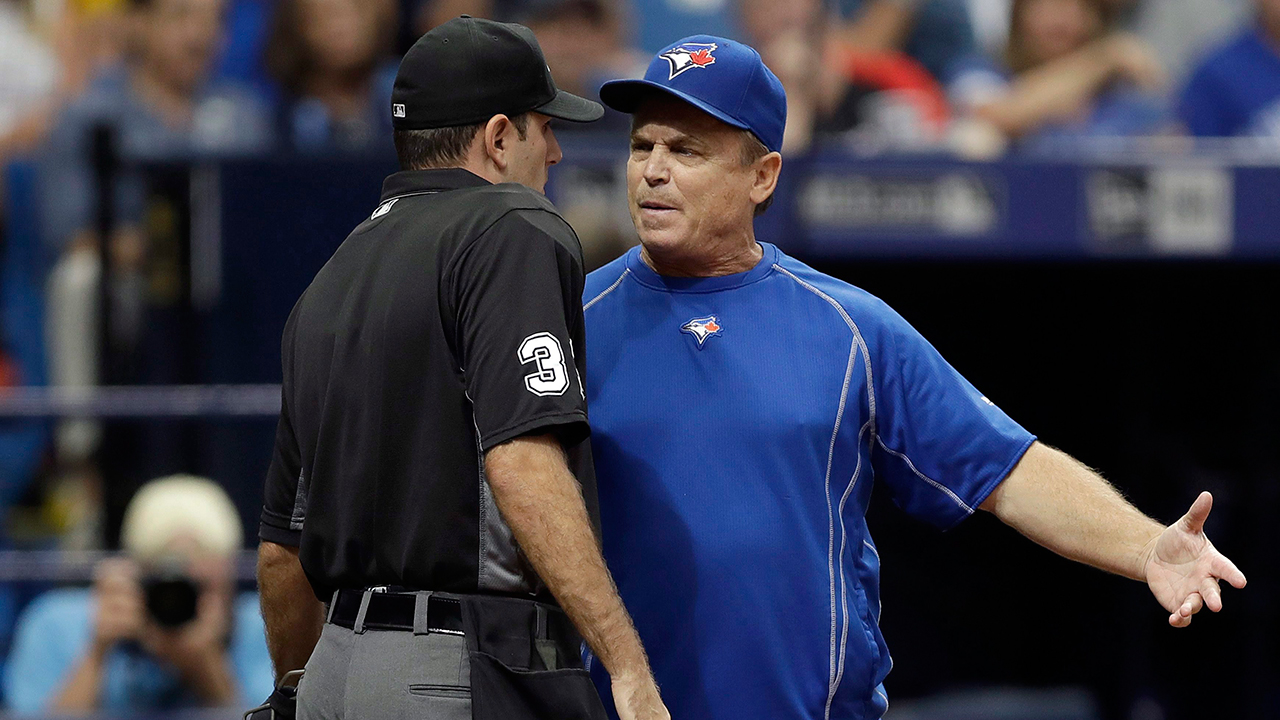
Helping keep the peace between umpires and the coaching staff is something Blue Jays catchers are taught to do. (Chris O’Meara/AP)
***
Few players in the Blue Jays system are as busy as the catchers. Between working on their defensive skills, getting to know their pitchers, reading scouting reports, learning to call games and understanding how to handle various nuances with pitching coaches and umpires, they have plenty on their plate well before they even think about hitting.
Those heavy demands is one reason why Huckaby believes not enough time is spent on the mental part of the game with catchers during the development process. Based on his experience, it’s not necessarily the most talented catchers who reach the big-leagues, but the smartest ones.
"They’ve gone through the system and can read a scouting report, can execute a game plan, they’re best friends with their pitchers, they catch the ball and they can block the ball, they’re not necessarily the best throwers, either," says Huckaby. "So we’re focusing on the mental side of the game, focusing on catching the baseball and we’re focusing on blocking the baseball."