CLEVELAND — Toronto Blue Jays hitters encountered a steady diet of breaking balls during their four-game sweep in Cleveland this weekend. Starting with Trevor Bauer in the series opener, Cleveland starters leaned heavily on their curveballs and sliders in order to generate awkward swings, sabotage Toronto’s plate approach, and force hitters out of their rhythm.
Marcus Stroman, who watched the first three games of the series from the Blue Jays dugout before taking the mound for the finale, took notice. That’s why the Toronto starter threw 47 breaking balls against Cleveland Sunday, accounting for just under half of his 99 pitches.
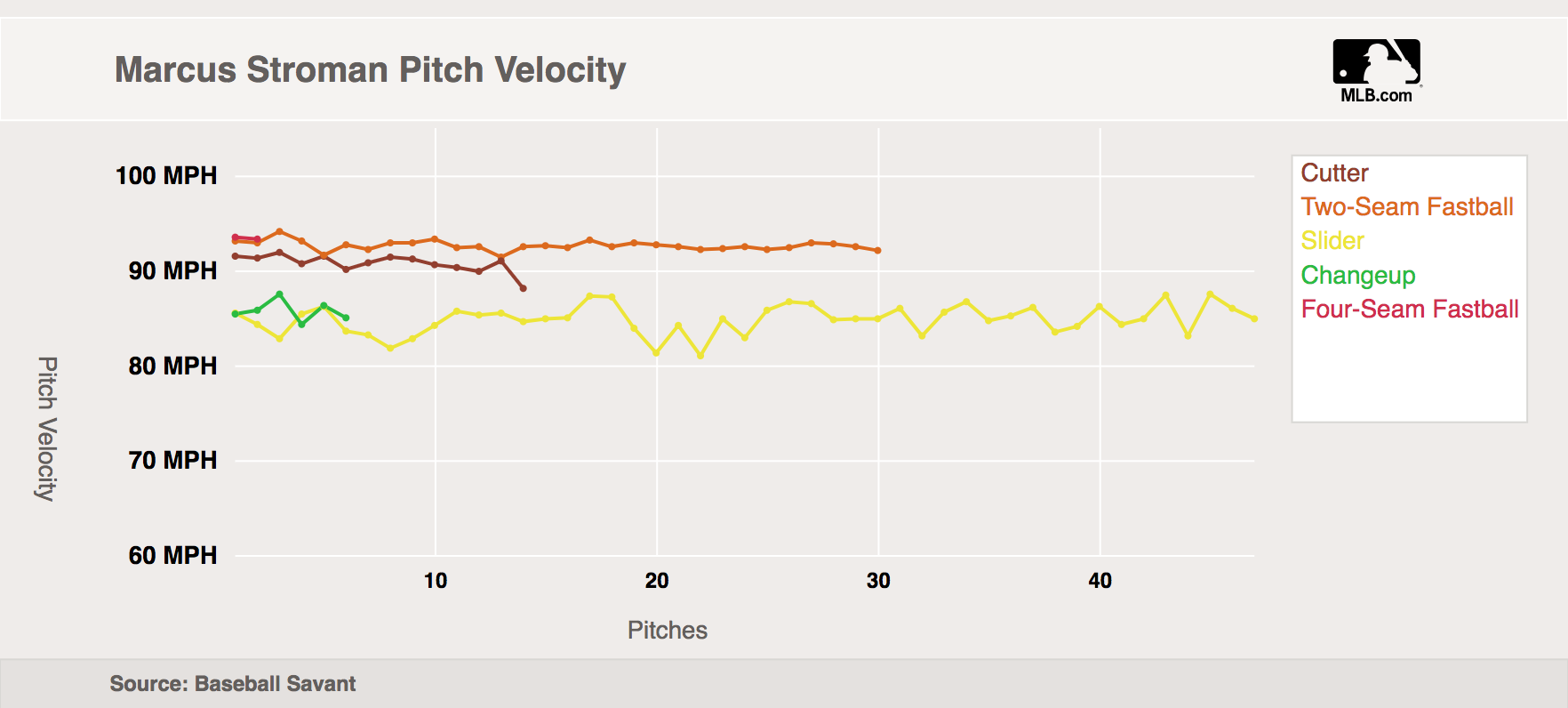
Stroman has used both a slider and a curveball throughout his career, generally relying on them as out-pitches after getting ahead in counts with his two-seamer. But Sunday tied his career-high for most breaking pitches thrown in a single outing. On two occasions, he threw a breaking pitch four times in a row. And over a 27-pitch sequence spanning his second and third innings, Stroman threw 19 breaking balls.
“Just been inspired by their pitching staff, man,” Stroman said. “Just been doing a little bit more research, just looking at how much they spin the ball. I think I can spin the ball with the best of them. So, that might be something I feature a little bit more, maybe become a little less fastball dominant. I don’t see many good swings when I’m spinning the ball pretty well.”
Stroman wishes he’d gone to the pitch one more time in the first inning after earning two quick outs and getting ahead of his third hitter, Jake Bauers, 0-2. Instead, Stroman threw his two-seamer on the plate, which Bauers crushed the other way at 109 m.p.h. — the hardest-hit ball of the game — for a double.
“Just didn’t execute. Just bad pitch selection there on my behalf,” Stroman said. “Probably should’ve spun the ball in those circumstances.”
Things unraveled from there as Carlos Santana poked a 2-2 sinker down the third base line for a double, before Tyler Naquin blooped another sinker — at 68 m.p.h. off the bat, it was the softest-hit ball of the game — into shallow left.
That’s the thin margin for error major-league pitchers operate with. If Stroman gets Bauers with his slider, Santana and Naquin never come to the plate. And if Naquin’s flare doesn’t drop into no-man’s land, Stroman could’ve kept the damage limited to only a run.
So it goes. Stroman still navigated his way to a quality start, and has now allowed only five runs over his first three outings of the season, striking out a batter an inning. And a .340 batting average on balls in play suggests his results could even improve from here. He certainly thinks so.
“I think I can be better, to be honest,” Stroman said. “I think I’m going to be better as the year progresses. I think I’ll be able to put up some zeros deep in games.”
Galvis keeps rolling
Another day, another extra-base hit for Freddy Galvis, who’s off to a torrential start to the season and has been Toronto’s most reliable hitter. It’s a minor surprise, considering Galvis entered the season with a career 78 wRC+, 22 per cent below a league average offensive contributor. But after he hit another big double Sunday, on the heels of homering in back-to-back games, it’s hard to imagine where a slumping Blue Jays offence would be without him.
“He’s a gamer, you know?” Blue Jays manager Charlie Montoyo said about leading Galvis off in Saturday’s game. ”My only concern about leading him off is just that he plays every day. So that’s a pretty good grind. But I talked to him and said, ‘Are you OK with it?’ And he said ‘No problem, if I’m tired, I’ll tell you. I’ll be okay.’ He wants to play every day and I respect that so much. You have no idea how much I respect that. Because they don’t make them like that anymore.”
Galvis has four more hits (11) than any other Blue Jay, and trails only Richard Urena (who has made 17 plate appearances to Galvis’s 34) in batting average (.324), on-base percentage (.378), and OPS (1.025). Galvis and Randal Grichuk have combined for two times as many home runs (6) as the rest of the Blue Jays (3). And Galvis is second on the team in average exit velocity, at 90.8 m.p.h.
But perhaps more importantly, Galvis’s plate appearances throughout the team’s early-season slump have been a stellar example of what Blue Jays hitting coach Guillermo Martinez has been preaching. Galvis has laid off bad pitches early in counts, fouled off tough breaking balls with two strikes, and put good swings on his fastballs when he’s gotten them.
“Every game plan that we have every day, he’s one of the guys that’s really, really, sticking to it,” Martinez said. “And it goes with maturity. It goes with experience. He’s a guy who’s been really good with the rest of the players — just talking about hitting, talking about approach, talking about the game plan, talking in the dugout about how to face the next guy.”
[relatedlinks]
And other players have followed his lead. After Galvis broke up Cleveland’s no-hitter with a ninth-inning single Thursday, Alen Hanson immediately followed with a single, before Teoscar Hernandez doubled. After Galvis hit his second homer in as many days Saturday, Grichuk came up with a hard-hit double, snapping an 0-for-10 skid, two batters later.
“Everybody knows that Freddy’s one of the best players on the team. He’s got a lot of years in here. He knows what he’s doing,” Hernandez said. “I think he knows how to control everything that’s happening right now.”
Drury gets a day
Few Blue Jays had a better spring training than Brandon Drury, who tore up the Grapefruit League and continued to hit balls hard throughout Toronto’s first games of the regular season. But, like most Blue Jays hitters, he’s slumped since, striking out in eight of his 13 plate appearances over Toronto’s first three games in Cleveland.
That’s why Montoyo gave Drury a break from the starting lineup Sunday, saying he wanted to give the 26-year-old an opportunity to relax and clear his head. But that didn’t stop Drury from being one of the first Blue Jays out for batting practice and carrying on an extended conversation with Martinez around the cage about how to improve.
“He’s a hard worker and a good teammate,” Martinez said. “To me, it’s a good sign that guys are so eager to work. I know they’re not where they want to be as a team and as individuals. But it is a good sign that they’re going out there every single day to work and grinding out at-bats, trying to look for a way to get better every single day. That’s what we have to do. We’ve just got to continue to work. It’s simple.”
Simplicity is a hallmark of the feedback and game plans Martinez and other Blue Jays coaches give their players. Hitting major-league pitching is extraordinarily hard. The simpler the game plan, the easier it is to stick with it.
Plus, the last thing you want to do is overload athletes with information, particularly at a time like this. And particularly with a hitter like Drury, who’s been taking good swings when he gets his pitch. With an average exit velocity on balls in play of 90 m.p.h. this season, Drury’s been one of the best Blue Jays at consistently hitting the ball hard.
Blue Jays exit velocity leaderboard through 10 games (minimum 10 batted balls)
| Player | Batted balls | Average exit velocity (m.p.h.) |
|---|---|---|
| Rowdy Tellez | 16 | 95.3 |
| Freddy Galvis | 24 | 90.8 |
| Justin Smoak | 21 | 90.3 |
| Brandon Drury | 21 | 90.0 |
| Randal Grichuk | 21 | 89.9 |
| Danny Jansen | 20 | 88.6 |
| Teoscar Hernandez | 25 | 88.1 |
| Billy McKinney | 20 | 85.4 |
| Richard Urena | 12 | 82.3 |
| Lourdes Gurriel Jr. | 17 | 76.6 |
The issue of late has been putting the ball in play. Drury did that only five times against some tough Cleveland pitching, including a first-pitch flyout as a pinch-hitter in the seventh inning Sunday. It was a good pitch to swing at, a fastball right over the plate. Drury just missed it. He came back up in the bottom of the ninth against Indians closer Brad Hand. That time, he didn’t get anything good to hit, striking out on three pitches.
“I just think that it’s about laying off the breaking balls, competing with two strikes. I know we’ve had some tough strikeouts. But we are competing,” Martinez said. “And the pitches that we’ve rocketed, the lasers that we do hit, are caught. They’re hit right at defenders. It’s one of those things. It’s just bad timing for it to happen at the start of the season. But we’re going to get through this. We’ve got to learn how to deal with it.
“We’ve just got to continue to work. It’s simple. Just continue to work. There’s really nothing to be said about these last 10 games because we’re going to get out of it. We just have to stay positive.”