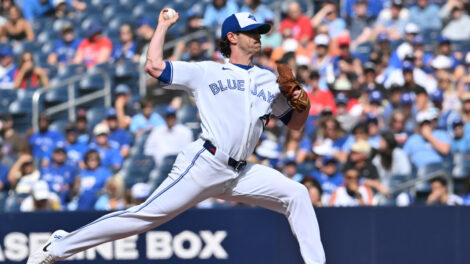
DUNEDIN, Fla. — On a wall near Kevin Pillar’s locker at Dunedin Stadium, there’s a colourful mural of the 2015 Toronto Blue Jays celebrating their Game 5 ALDS victory over the Texas Rangers. Not many players from that team are still around to see it. And of the few that remain, none have played as many games for the Blue Jays as Pillar.
He’s been a member of the organization since 2011, when the Blue Jays selected him in the 32nd round (979th overall) of the amateur draft. A college senior out of an NCAA Div. II school, he was given a $1,000 signing bonus and began his professional career as a 22-year-old in rookie ball, where the average player was nearly two years younger than him.
A longshot among longshots, Pillar steadily climbed his way up the organizational ranks, hitting .324/.367/.479 over more than 400 minor-league games, and persevering through a pair of false starts in the majors, before supplanting Dalton Pompey as Toronto’s everyday centre fielder three weeks into the 2015 season.
Of the 631 regular season games the Blue Jays have played since, Pillar has appeared in 584, starting 561 in centre field. And of the 262 outfielders selected in that 2011 draft, Pillar’s played the most MLB games, posting the third-highest career fWAR (10.3) following George Springer (18.2) and Jackie Bradley Jr. (12).
This spring, the 30-year-old finds himself the longest-tenured Blue Jay in a rebuilding clubhouse full of young, homegrown prospects like he once was. At 8:30 a.m. on a recent March morning, he sat at his locker with that mural behind him and talked about how his approach to spring training has evolved over the years, what he’s learned from chasing hits, and his hope to play out the remainder of his career in Toronto.
[relatedlinks]
Sportsnet: You’ve been playing a lot this spring — you’re second on the team in at-bats. That’s a little unusual for a player who isn’t fighting for a spot on the team. Is there a reason for that?
Kevin Pillar: From day one stepping into camp, Charlie [Montoyo] and Shelley [Duncan] and [Dave Hudgens] have been really good at communicating what their expectations are for every individual in here as far as playing time, and how they’ve mapped out spring training. I have some input with what I want to do and what I want to accomplish. But they’ve spent a lot of time amongst each other, our training staff, our high-performance staff, trying to figure out what the best way is to get us ready for the regular season.
I could go out there and play every single day. That’s what I train for. That’s what I expect to do. I have no issue when they want me to play three days in a row, four days in a row. Ideally, sometimes, as a little bit more of a veteran guy and a guy that has a spot on the team, you try to avoid those long road trips. That would be my only request. But I just enjoy going out there and playing.
SN: Given all these reps, are there certain things you’re trying to work on at the plate prior to the regular season?
KP: There’s nothing better than three at-bats in spring training. You can go up there and literally work on whatever you want to work on. Whether it’s your timing, whether it’s getting to two strikes, whether it’s hunting certain pitches. For people viewing these games, people watching these games, people coming to these games, that’s something that players don’t really share too often. People don’t really get a chance to understand what every individual player might be working on that specific day, that specific at-bat. There are a lot of times guys in here will intentionally try to get to two strikes, to try to get that anxiety and that nervousness of hitting with two strikes in a non-meaningful environment.
So, as long as my body feels good and I feel fresh, as many at-bats as I can get in spring training, I’ll take. Because there are so many different levels of things that I’m trying to accomplish as far as hitting with two strikes or being aggressive in the count or sitting on pitches or just trying to see the ball really well. There’s always some mechanical tweaks that you make in the off-season, and you’re excited to get out in a game setting and see how you feel with them. You spend a lot of time in the off-season working on these things.
SN: In that case, is spring just about making those adjustments and experimenting with different situations? Do you worry about the results at all?
KP: As recently as a couple days ago, I made some tweaks in the cage with some of my teammates. And I was able to go out there and square some balls up, hit a home run. Obviously, that feels good. But I’m just concerned with the process of going up there and trying to make good decisions. And when I do swing the bat, trying to hit the ball hard. During the last week of spring training I think I’ll start to get concerned about the results a little bit more. It’s not make or break for me, I kind of know where I’m at — I’m going to make this team. But you like to go into the season squaring up some balls, seeing some of them drop, trying to find ways to get on base, get some hits out of the way, and just build off that confidence that you can get hits.
Ultimately, that’s the one thing in this game that makes hitters feel good — getting hits. But I’m really excited by the fact I’ve been able to have a couple walks. For the most part, I’ve made some good decisions. Am I going to get fooled from time to time? Of course. Pitchers have good stuff here. But, overall, I don’t concern myself about the results in spring training anymore. I’ve done this long enough to know that the more consistently you hit the ball hard, the more good things are going to happen.
| Avg. exit velocity (m.p.h.) | Barrel % | Hard-hit % | xwOBA | |
|---|---|---|---|---|
| 2015 | 84.5 | 1.8 | 25.9 | 0.284 |
| 2016 | 86.2 | 3 | 30.2 | 0.288 |
| 2017 | 85.5 | 3.4 | 28.7 | 0.316 |
| 2018 | 87.1 | 5.7 | 36.4 | 0.319 |
SN: You’ve been able to make that hard contact more often in recent seasons. What are some of the things you’ve been working on to help you do that more consistently?
KP: For me, it’s getting comfortable starting early. I’ve always been what you’d consider a collision hitter. I have my leg kick. But when my foot gets down, it’s time to go. Starting earlier has really allowed me to slow everything down, make better decisions, get into my back hip a little bit more. In hitter’s terms, we’d call it learning how to store energy a little bit more efficiently.
This off-season, I spent some time working on bat path. I think I fell into the habit in this new era of wanting to always be underneath pitches. I think it can be a good thing because there’s some pitchers who you have to have that bat path or mindset against in order to hit. But I think with having more information on the way certain pitchers throw, whether its spin rate or sink, you have to be able to make adjustments with where you’re trying to make contact with the ball and what kind of bat path you have — whether it’s a flatter bat path or a little bit more of a steep bat path.
Now, I have a better understanding of the way my bat works. It’s not just one swing. I think, as hitters, we have one set of mechanics and we have one set of timing. But I think really good hitters have the ability to change their bat path according to what sort of pitcher they’re facing. For a sinker-baller, you’re going to want to have a little bit more of an uppercut swing to match that plane. Against guys that throw four-seamers and up in the zone a little bit more, you’re going to want to have a little bit more of a flatter bat path.
| 2017 | 2018 | |
|---|---|---|
| Mar./Apr. | 0.844 | 0.903 |
| May | 0.726 | 0.61 |
| June | 0.591 | 0.568 |
| July | 0.619 | 0.582 |
| Aug. | 0.725 | 0.757 |
| Sept./Oct. | 0.711 | 0.752 |
SN: The last couple years you’ve had these hot starts to the season and good finishes, too — but your numbers have sagged in the middle. Have you looked at anything you want to do to try to be more consistent over a full season?
KP: Yeah, I’m aware of it — it’s something I’m consciously aware of now. I think the good starts are just this carry-over affect from me having these feelings during spring training. I’m so concentrated on not necessarily the result, but the process of how I want to get there. Being really good at identifying pitches that I want to swing at — not trying to get hits. And I think that always carries over into April, early May.
And then maybe you struggle for a period of time. In this game, that’s going to happen to everyone. And when that’s happened to me, my mindset has changed from that process to chasing results. And it’s the wrong way to go about it, because a lot of stuff in this game is out of your control. You don’t know what pitch is coming, you can’t really direct where the ball goes. And when you start chasing those hits, you start getting away from all the things that allowed you to be successful for a month, a month-and-a-half.
It’s a hard thing, you know? We’re human beings. And results, at the end of the day, are what make us feel good. I can line out seven, eight times in a row and know that I’m doing things right. But there’s not a feeling like seeing a ball hit the outfield grass and getting on first base. So, it’s just being mature enough to know that I’m one at-bat away from getting back to where I need to be. It’s about keeping the mindset that with every at-bat, I can get the results that I’m looking for through staying in the moment and sticking with the process.
SN: You’re working with a new hitting coach this year, Guillermo Martinez. He’s brought a lot of interesting ideas and concepts to the role. He’s out there setting up pitching machines, having hitters face velocity and breaking balls during batting practice. What do you think of his approach?
KP: He’s been really good so far. With some of the guys that have been around for a while, I think he’s been a little bit more reserved. I think he’s just trying to learn our tendencies, the way we are, what we’ve been able to accomplish, what works for us. But in talking to some of the guys that have been here a little bit longer, the older guys, we do appreciate the innovativeness that he has as far as wanting to hit BP on the field with a machine and velocity and balls coming from different angles. He’s trying to create an environment that’s a little bit more game-like as far as speed and timing is concerned.
[snippet id=3305549]
SN: That’s the second time you’ve referred to yourself as an older guy, a veteran. That has to be a strange adjustment for you — it wasn’t that long ago you were the young guy around here.
KP: Older veteran. It’s kind of a weird term considering I’m only 30-years-old. But with the amount of turnover we’ve had, especially in the last two, three years, for me to still be here, with [Marcus Stroman] and [Aaron] Sanchez and [Ryan] Tepera, as original guys that were drafted by the Blue Jays and kind of came up through the organization — it’s a good feeling.
Obviously, this clubhouse is filled with guys that the Blue Jays have drafted. Guys that have come up through the system, that have just got to the big leagues, or are on the verge of breaking into the big leagues. It’s really cool to see. Because I know the sense of pride I have in being a guy that came up through the Blue Jays organization. A guy that was drafted by the Blue Jays and ultimately got a chance to put that uniform on and represent this country. I give myself a lot of credit that I’ve been able to do things right on and off the field in order for me to still be here after all this time, and for this organization to still have faith in me to go out there and patrol centre field.
SN: It has been a long time. This season will be your seventh in the majors with the Blue Jays — you’re the longest-tenured guy in here.
KP: The industry’s changing — guys typically aren’t spending the duration of their career in one place. It’s kind of a dying thing. Not just in baseball, but in all sports. That’s why it’s really special to see a guy like Dirk Nowitzki, who’s been able to spend his entire career in Dallas — it’s cool to see people being really appreciative of him doing that.
It’ll be interesting to see how many guys in this era end up spending their entire career in one place. You think about some of the really good guys in baseball right now, like Mookie Betts, Javy Baez, even younger guys like Ronald Acuna, Ozzie Albies, Juan Soto — it’ll be interesting to see, five, six years down the road, if these guys are still employed by their original team that drafted them. It was really special for a guy like Derek Jeter to be able to do what he did for as long as he did, and do it in one spot.
| Player | Team | MLB seasons |
|---|---|---|
| Yadier Molina | St. Louis Cardinals | 15 |
| Felix Hernandez | Seattle Mariners | 14 |
| Ryan Zimmerman | Washington Nationals | 14 |
| Dustin Pedroia | Boston Red Sox | 13 |
| Ryan Braun | Milwaukee Brewers | 12 |
| Alex Gordon | Kansas City Royals | 12 |
| Joey Votto | Cincinnati Reds | 12 |
| Clayton Kershaw | Los Angeles Dodgers | 11 |
| Brett Gardner | New York Yankees | 11 |
SN: Is playing your entire career in one place something you’d like to accomplish?
KP: I think it’s something a lot of guys would like to do. I can’t speak for all players, but I would imagine for the majority of guys, when you get into this game and you want to be successful, you picture doing it for one organization. You picture people having that appreciation for what you were able to do, and how much you were able to give to one organization and one city.
I see myself 10, 15 years from now bringing my family back to Toronto to watch games. That’s something that I think would be really cool to do in my career. Ultimately, a lot of that stuff’s out of your control. I might go out playing for whoever, wherever. But playing for only one organization is something that would be meaningful to me. That would be really cool.