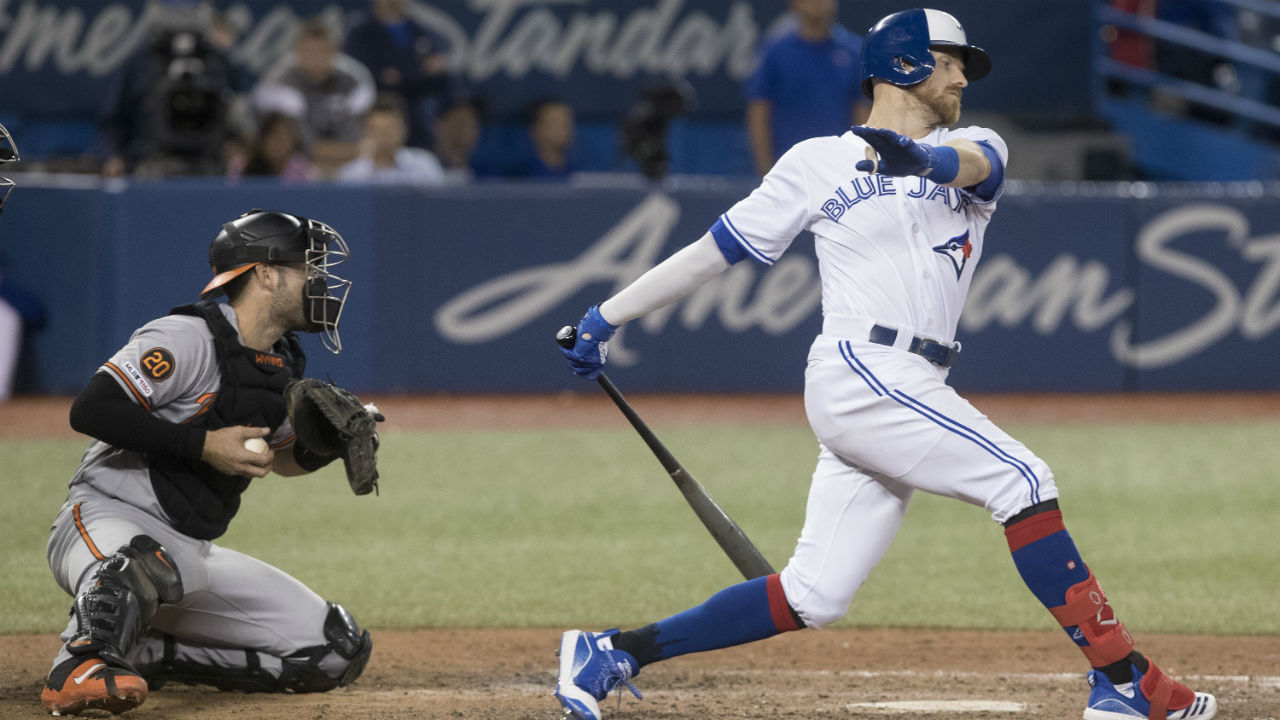

TORONTO – Trey Mancini punishes baseballs on the regular and in the bottom of the first inning, when Thomas Pannone threw him a 1-1 four-seamer just off the plate inside, the Baltimore Orioles first baseman did precisely that.
The ball left the bat at 98.6 m.p.h. and sailed toward the left-field wall but Derek Fisher had a beat on the drive, leaped and got his glove around the ball as he flew into the fence. But as he rolled to the ground, the ball popped out of his glove, and third-base umpire Dan Iassogna signalled no catch, allowing Jonathan Villar to reach third as Mancini trotted into second.
Defensive gem turned double in a snap.
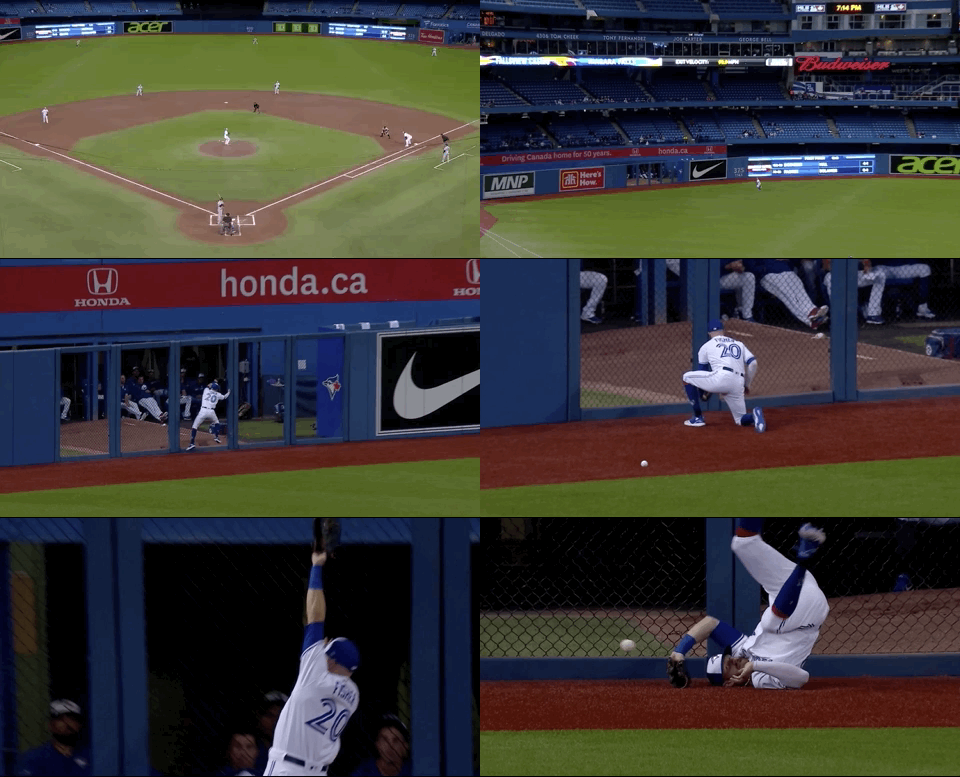
“Just knowing where it was going to land and that there was a chain-link fence there, I tried to kind of jump and find something with my cleat to keep me up there,” Fisher said in describing his approach on the play. “It got in my glove. I did 95 per cent of it. But the five per cent that didn’t happen is the only five per cent that matters.”
Iassogna’s call left the Blue Jays quizzical but since they had already surrendered their replay challenge on an unsuccessful review of a pick-off attempt at first base, they had no recourse.

Manager Charlie Montoyo ran out of the dugout to talk it over, but couldn’t convince Iassogna to initiate a crew review.
“I thought (Fisher) had it long enough,” explained Montoyo. “That’s just watching it with my eyes, I haven’t seen any replay. (Iassogna) said he didn’t think so.”
For clarity, the relevant section of Rule 5.09(a)(1) states there’s no catch “if simultaneously or immediately following his contact with the ball, (the fielder) collides with a player, or with a wall, or if he falls down, and as a result of such collision or falling, drops the ball.”
Sometimes a fielder gets a bit of leeway. Not this time.
Renato Nunez, the next batter, ripped a two-run double and later scored on a Dwight Smith Jr., RBI single, sending the Orioles to an 11-4 victory over the Blue Jays on Tuesday.
Whether or not Fisher caught the Mancini ball wouldn’t have ultimately made much of a difference on a night when the Blue Jays had to make things up after starter Anthony Kay was scratched with back pain.
Their bullpen, even at 12-men deep, was thinned out by Monday’s 15-inning, 5 1/2-hour monstrosity and not in position to stitch together nine frames. It certainly played out that way.
[snippet id=4722869]
“You’ve got to give credit to all those guys who pitched (Monday) and they were on fumes and said, ‘No, we’ll take the ball,” said Montoyo. “That’s awesome, going 15 innings and then, two hours before the game, your starter goes out and we have to figure out how to cover nine innings. A lot of guys took the ball.”
Still, looking forward to 2020 and beyond, the Blue Jays are going to need their outfielders to not only make the routine plays, but to start taking away some hits, as well.
Collectively, the club ranks 22nd in the majors at minus-13 Defensive Runs Saved – a metric that rates players above or below average on defence as measured by runs – but ranks 26th among outfielders at minus-31. The Blue Jays are an impressive third behind the plate at plus-16 (led by Danny Jansen’s team-high plus-12), but their only other positives are on the mound (plus-5, sixth overall) and at shortstop (plus-2, 15th overall).
DRS is by no means a be-all, end-all measure, but it’s a good rough indicator of how a defence has performed. The Blue Jays outfield leaves a lot to be desired, and while the deficiencies in their pitching is a frequent talking point, upgrading their defence there needs to be, too, as more defenders capable of stealing hits would go a long way in bolstering the staff.
Fisher nearly did that for Pannone on Tuesday and credit to him for the effort on a difficult play.
“Well, I can’t say yes,” he replied when asked if he thought he had possession of the ball long enough for an out. “You’ve got to keep control of it when you come down and if the ball comes out of your glove, it’s got to look like you’re taking the ball out of your glove (for a transfer to throw). That’s not what it looked like.”
[snippet id=3305549]
The 26-year-old has had some rough moments since coming over from the Houston Astros in the Aaron Sanchez trade and while he’s a collective minus-2 DRS in 326.2 innings not including Tuesday night, the tools are there for him to make an impact on both sides of the ball.
In the third inning, for example, his solo shot put the Blue Jays on the board and he now has six homers in 36 games with his new team. His average exit velocity of 91.5 m.p.h. ranks 28th in the majors, although that’s skewed by the ninth-highest average on groundballs at 90.6 m.p.h. At 95.7 m.p.h., his average exit velocity on line drives and fly balls dips to 53rd.
In the field, the Mancini play – getting there but not securing the out – was like a microcosm of Fisher’s metrics. His 92nd percentile sprint speed gives him a chance to have elite range but his outs above average is minus-3, a result of an expected catch percentage of 85 and actual catch percentage of 81.
“It’s baseball, that happens, I’m going to be aggressive every time,” said Fisher. “It’s not going to change the way you go after any other ball and if it happens again next time, I’ll do it the same way.”
How to fully tap into that potential is a question the Blue Jays are wrestling with not only for Fisher, but the rest of their outfielders, too, an area of opportunity, an area in need of improvement.
[relatedlinks]