By Mackenzie Liddell, sportsnet.ca
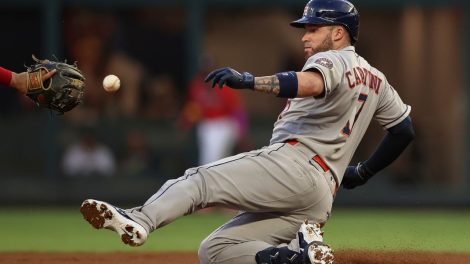
There are few moments in baseball as exciting as a play at the plate.
There are also few plays potentially more dangerous.
On the final play in Toronto’s 2-1 win over the Tampa Bay Rays Friday night at Rogers Centre, Blue Jays catcher Jeff Mathis held off a hard-charging Elliot Johnson as he attempted to score on a single to right that would have tied the game. After corralling Moises Sierra’s throw from right field, Mathis cut off Johnson’s path to the plate causing the two to collide, leaving the Rays infielder bloodied with cuts to his face, and out.
As exciting as the play was for the fans and players on the field, there are some who believe MLB should consider banning the play given the potential risk for injury. As a result of Friday’s collision, Johnson was tested for a concussion. It came back negative.
Rays manager Joe Maddon, a former catcher himself, doesn’t see a need for change.
“Perfect example last night of a great baseball play,” Maddon explained Saturday prior to his team’s 5-4 win at Rogers Centre. “Anytime something awkward happens everybody wants to change the rules or point fingers. I like the play the way it is.”
On Saturday afternoon it was déjà vu all over again, as with two outs in the ninth inning, Rays centre fielder B.J. Upton fielded a sharp single from Colby Rasmus and then delivered a “300 foot-strike,” in the words of Blue Jays manager John Farrell, to catcher Jose Molina, who blocked the plate and stood his ground with Omar Vizquel charging in from third.
With nowhere to go, Vizquel simply ran into Molina’s lower half and Molina subsequently fell on top of him, applying the tag for the game’s final out.
Despite the thrill such home-plate collisions provide, concerns about player safety have been raised after the often-violent clashes result in injury. And there has been plenty of carnage of late.
In St. Louis, Cardinals catcher Yadier Molina is still reeling from a vicious collision with Pittsburgh’s Josh Harrison on Aug. 28 that left the backstop with a strained shoulder, neck and back.
Molina later described the confrontation as a “clean play” and “part of baseball.”
Atlanta’s Chipper Jones and Philadelphia’s Erik Kratz also had a run-in at the plate on Friday, with the Phillies catcher being sent hurtling to the ground in a play that closely resembled an open-ice hit in hockey. Afterwards, there were no hard feelings from Kratz, who escaped the collision unscathed.
“I can respect people’s opinion not wanting players to be put in jeopardy or to risk injury, but a collision at home plate is very much part of this game,” Farrell argued prior to Saturday’s game.
“Some people might take exception if some plays may be judged as not the cleanest slide, or if the catcher is exposed in certain ways,” Farrell continued. “The catcher has full gear on. If you look at last night’s collision (Elliot) Johnson took the brunt of that collision. It was a good clean play, a good clean hard slide.”
But for some, while such plays remain well within the rules of the game, they can invoke animosity amongst those negatively affected.
Last May, San Francisco Giants catcher Buster Posey suffered a season-ending leg fracture while blocking home plate in a collision with Miami’s Scott Cousins. Posey’s injury prompted Giants general manager Brian Sabean to speak out against overly aggressive plays at the plate.
Sabean blasted Cousins in a radio interview, calling the play “malicious,” adding, “If I never hear from Cousins again or he never plays another game in the big leagues, I think we’ll all be happy.”
Former catcher and current Cardinals manager Mike Matheny also criticized Cousins’ actions and called the play unnecessary.
Maddon believes high-speed encounters are an unavoidable by-product of baseball and that rather than engaging in fruitless debates over the legality of home plate collisions, he thinks time would be better spent educating players how to protect themselves in such situations.
“Those that want to change the rule, I’m not a big advocate of that,” Maddon explained. “Teach your catcher how to do a better job of making that play.”
Farrell echoed Maddon’s sentiments.
“It’s an exciting play, and there’s a lot of time spent teaching catchers technique and how to block the plate and reduce the potential of injury,” he said. “In light of what Yadier Molina just went through or what Buster Posey went through a year ago, that’s just part of the game in my mind.”
Even when he comes out on the losing end of such plays, such as Saturday.
“It’s an exciting finish,” said Farrell of the back-to-back, game-ending home plate collisions. “The fans are getting everything they come here for — competitive baseball; good, clean hard baseball that’s been played here.”